
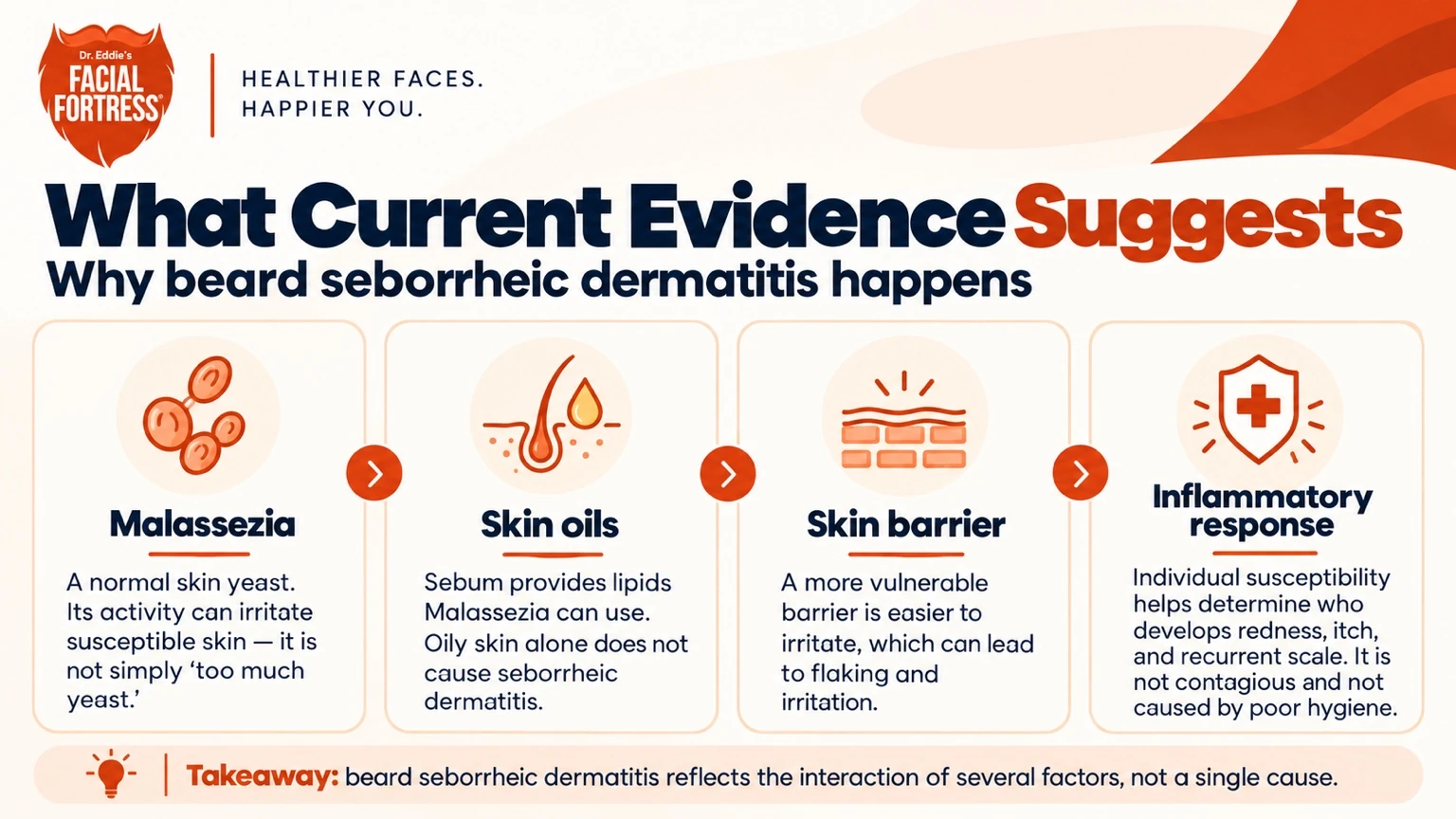
Quick answer: Malassezia is a normal skin yeast involved in seborrheic dermatitis. Beard flares reflect the interaction of yeast activity, skin oils, the skin barrier and individual inflammatory responses. The problem is not explained by yeast quantity alone, and treatment aims to control symptoms rather than permanently sterilize the skin.
Learning that yeast contributes to beard dandruff can make the condition sound like something you caught. Seborrheic dermatitis is more complicated. Understanding the relationship between a normal skin organism and susceptible skin helps explain both recurring flares and the different roles of treatment.
Malassezia as a Normal Skin Resident
Malassezia refers to a group of yeasts commonly found on healthy human skin. Many species depend on lipids, which helps explain their presence in areas rich in sebaceous glands, including the scalp and central face. Finding these organisms does not, by itself, establish a disease or explain a rash.1
Different Malassezia-associated conditions involve different relationships with the skin. Seborrheic dermatitis, pityriasis versicolor and Malassezia folliculitis are not interchangeable diagnoses. Happy Cappy’s overview of Malassezia yeast and its role in skin conditions covers those broader distinctions. Here, the focus is the flaky, inflammatory pattern affecting beard-area skin.
Yeast, Skin Oils and the Barrier
Sebum is the oily material produced by sebaceous glands. It helps shape the environment in which Malassezia lives, but oil production alone does not account for seborrheic dermatitis. Many people with oily skin never develop the condition, and people with seborrheic dermatitis do not always have unusually oily skin.2
As these yeasts use skin lipids, their enzymes can release fatty acids and other byproducts. In susceptible skin, some of those substances may contribute to irritation and changes in the outer skin layer. The barrier’s condition and the immune response influence what happens next. This is an interaction among factors, not a single step that inevitably produces a rash.
Oleic Acid and Individual Susceptibility
Oleic acid is one fatty acid often discussed in dandruff research. Studies summarized in the medical literature found that applying oleic acid to the scalp could provoke flaking in dandruff-susceptible people while having a different effect in people without that susceptibility. This supports the importance of the host skin response, rather than the presence of a substance alone.2
Those scalp findings help inform the explanation of seborrheic dermatitis, but they do not prove that every beard flare has the same trigger. They also do not provide a reliable way to diagnose a facial rash from an oil’s ingredient list or to declare every beard oil harmful. Laboratory activity, scalp studies and real-world facial tolerance answer different questions.
Inflammation and Visible Beard Flakes
The outer skin layer normally sheds cells without making conspicuous flakes. In seborrheic dermatitis, changes in the barrier, inflammation and abnormal shedding can make scale visible. Hair catches some of that scale, so the beard may look affected even though the process is occurring in the skin beneath it.2
Scale can be white and dry-looking or yellowish and greasy. The skin may itch or feel irritated, and inflammation may be easier to recognize by a change in color or texture than by obvious redness. The beard seborrheic dermatitis guide explains the clinical pattern and complete care routine.
Similar symptoms can have other causes. A product reaction, psoriasis, simple dryness or a follicular infection should not automatically be attributed to Malassezia. The broader itchy-beard guide explains those possibilities and the signs that need assessment.
What the Evidence Can and Cannot Explain
Several lines of evidence support a role for Malassezia, including its association with affected sites and improvement with antifungal treatment. Yet the exact contribution of individual species, their metabolites and the skin’s response is still being studied. Measuring yeast abundance alone does not fully capture that relationship.1,2
The condition is generally assessed clinically from the appearance, location and history of the rash. Detecting an organism that commonly inhabits healthy skin would not, by itself, explain why one person’s beard is inflamed. Testing may be useful when a clinician suspects a different condition, such as a dermatophyte infection, rather than to assign every flake to normal skin yeast.3
Flare triggers add another layer. Stress, cold or dry weather and irritating skin-care products may accompany worsening symptoms, but an individual flare may not have a clear trigger. Our discussion of stress and diet examines those influences without reducing the condition to a single lifestyle cause.4
How the Biology Informs Treatment
Care can address more than one part of the process. A medicated wash may help control yeast-associated symptoms, an anti-inflammatory medicine may be needed for a more inflamed flare, and gentle cleansing with moisturizer can support dry or easily irritated skin. One part of the routine does not necessarily replace the others.
Common dandruff actives include ketoconazole, pyrithione zinc, selenium sulfide and salicylic acid. Their roles differ: salicylic acid primarily helps loosen scale rather than acting as the same kind of yeast-targeted treatment. Suitability also depends on the finished formulation and its directions, especially on facial skin.5,6
Facial Fortress is one 0.95% pyrithione-zinc wash option for relief of flaking, scaling, itching and irritation associated with dandruff and seborrheic dermatitis. Its Drug Facts give the specific directions and warnings. The guide to antifungal beard-shampoo terminology and safe use explains product selection without confusing beard dandruff with beard ringworm.7
Trying to eradicate every yeast organism through stronger washing is not a practical treatment goal. Harsh cleansing and repeated scrubbing can make the skin less comfortable while doing little to address individual susceptibility. The aim is controlled symptoms and a routine the skin tolerates.
Recurrence and Follow-Up
Seborrheic dermatitis often returns because successful treatment does not necessarily remove the underlying tendency to flare. Recurrence does not mean the skin has become dirty or that someone has transmitted an infection back to you. Maintenance treatment may be useful once the active flare settles.5
If a consistent, appropriate routine stops helping, reconsider both the treatment and the diagnosis. Persistent symptoms, significant pain, pus, broken hairs or patches of hair loss need assessment. The biology is useful for understanding the condition, but it cannot replace an examination of an unusual beard rash.
Medical References
- Saunte DML, Gaitanis G, Hay RJ. Malassezia-Associated Skin Diseases, the Use of Diagnostics and Treatment. Frontiers in Cellular and Infection Microbiology. 2020;10:112.
- Borda LJ, Wikramanayake TC. Seborrheic Dermatitis and Dandruff: A Comprehensive Review. Journal of Clinical and Investigative Dermatology. 2015;3(2).
- DermNet. Seborrhoeic dermatitis.
- American Academy of Dermatology. Seborrheic dermatitis: Causes.
- American Academy of Dermatology. Seborrheic dermatitis: Diagnosis and treatment.
- American Academy of Dermatology. How to treat dandruff.
- DailyMed. Facial Fortress pyrithione zinc shampoo: Drug Facts.