

Quick answer: With dandruff, oily or fine, straight hair may need daily or every-other-day cleansing; dry, curly or coily hair often needs fewer wash days. Medicated-shampoo frequency is a separate decision based on the product and your treatment plan. Gently cleanse beard skin regularly, adjusting for sweat and comfort.
Washing frequency with dandruff involves two decisions: how often your scalp and beard need cleansing, and how often to use the chosen medicated wash. Hair texture, oiliness, sweat, and skin comfort guide ordinary cleansing; the product directions or your clinician guide treatment.
The goal is fewer flakes and comfortable skin, with a routine you can keep using. Recording which days are treatment days can be more useful than repeatedly changing products or scrubbing harder whenever flakes return.
Cleansing and Dandruff Treatment Have Different Jobs
Dandruff is scalp flaking with little obvious inflammation. What people call beard dandruff is often seborrheic dermatitis beneath facial hair. It reflects interactions among normal Malassezia yeast, skin oils and individual skin susceptibility, rather than simply dirty skin. Our dandruff and seborrheic dermatitis comparison explains the overlap.4
Cleansing removes accumulated oil, loose scale and product residue. A medicated wash adds treatment for dandruff symptoms. However, harsh cleansing and vigorous scratching can add irritation to an already flaky scalp or beard. Washing more often is useful only when the cleanser and schedule suit your skin.
If flakes come with tight, dry skin or burning after a new product, reconsider the cause before increasing treatment. Our guide to beard dandruff versus dry skin explains the differences.
Scalp Washing Frequency with Dandruff
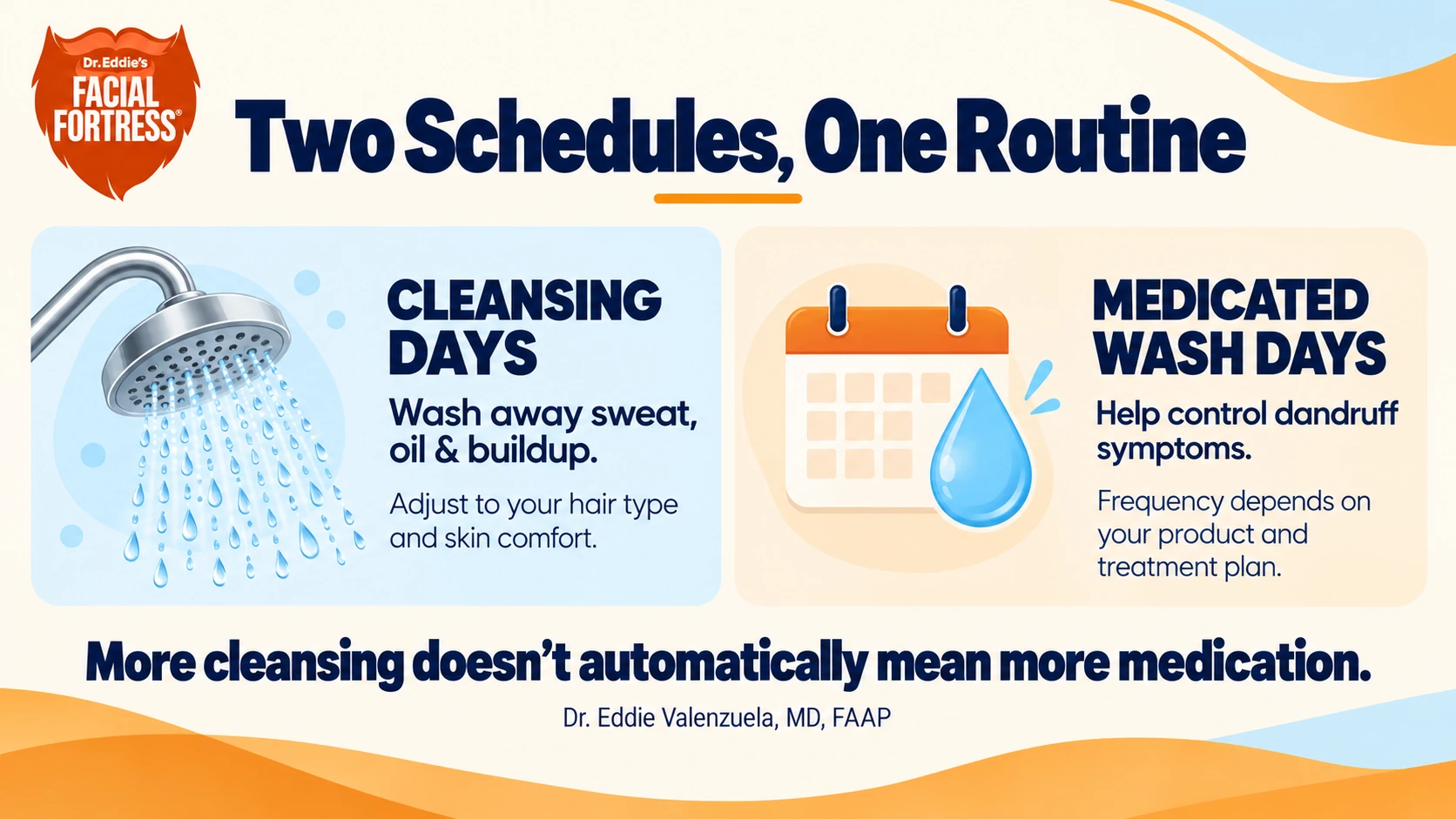
Your total number of wash days may be higher than your number of medicated-shampoo days. The American Academy of Dermatology gives different examples for oily, fine or straight hair and for coarse, curly or coily hair.1 The table below turns those principles into practical routine adjustments; it is not a single prescription for every shampoo.
Washing Frequency by Hair Type, Skin and Climate
| Hair, skin or situation | Ordinary cleansing | Medicated treatment |
|---|---|---|
| Fine or straight hair; oily scalp | Daily or every other day may suit an oily scalp. | Use the schedule for your chosen product; daily cleansing does not automatically mean daily medication. |
| Curly, coily or coarse hair | Wash when the scalp needs cleansing; protect dry lengths with conditioner. | Some dermatologist-directed plans use treatment about weekly. This is not a replacement for a specific product’s directions. |
| Dry or sensitive scalp or beard skin | Choose a gentle cleanser and avoid repeated washing that leaves skin tight. | If treatment burns or worsens irritation, stop and ask about an alternative or adjusted plan. |
| Hot, humid weather or heavy sweating | Rinse or gently cleanse away sweat and buildup as needed. | An extra post-workout rinse does not require an extra medicated treatment. |
| Cold, dry weather | Use lukewarm water and moisturize dry or tight facial skin after cleansing. | Weather can change comfort and ordinary cleansing needs; use medication as directed. |
| Active, persistent or severe symptoms | Keep cleansing gentle; do not scrub away adherent scale. | Use the prescribed or labeled regimen. Persistent inflammation may need a different treatment. |
| Symptoms are controlled | Maintain the cleansing routine that keeps skin comfortable. | Continue a maintenance plan suited to the product; do not assume all washes can be reduced to once weekly. |
For Facial Fortress: use at least twice a week or as directed by a doctor. If that routine does not suit your scalp or hair, a clinician can individualize the plan. A general once-weekly example for another shampoo is not a Facial Fortress instruction.5
Beard Washing Frequency with Dandruff
Gently cleanse the skin beneath your beard as part of regular face care, then use a medicated wash on its own treatment schedule. Daily gentle cleansing may be helpful when your beard collects sweat, oil or styling products. Facial skin that feels tight or irritated needs a gentler approach, not repeated scrubbing.
Work the cleanser through the hair to the affected skin, rinse fully, then moisturize dry skin as needed. Beard length changes how carefully you need to reach and rinse the skin; it does not establish a fixed number of medicated wash days.2 Our everyday beard-cleansing guide covers the ordinary washing decision.
Your scalp and beard do not have to share the same schedule. For choosing a suitable formula, see using anti-dandruff shampoo on a beard. If itch is the main symptom, our itchy-beard guide covers other possible causes.
Matching the Schedule to the Dandruff Wash
Common over-the-counter dandruff actives include ketoconazole, selenium sulfide, pyrithione zinc and salicylic acid. Their roles and directions differ; do not transfer the schedule or contact time from one product to another.1 Our dandruff-wash selection guide explains suitability for facial skin.
Facial Fortress 3-in-1 Medicated Wash contains 0.95% pyrithione zinc for dandruff and seborrheic dermatitis. Its fragrance-free, dye-free formula includes glycerin and panthenol alongside a mild, non-soap cleansing blend made without SLS or SLES. These supporting ingredients help with skin and hair feel; the medicated ingredient supplies the dandruff treatment.5
Its directions are to wet thoroughly, massage onto scalp and skin, and rinse. The label does not specify a leave-on waiting time. Avoid eye contact, and follow the complete ingredients and Drug Facts for product-specific directions and warnings.5
Washing Technique for Hair and Beard
Reaching the skin beneath your beard
Watch how to part beard hair, work cleanser onto the skin, rinse, and apply moisturizer if needed.
Read the video transcript
0:00–0:04 · Reach the skin beneath your beard. Washing, with optional moisturizing.
0:04–0:10 · Wet right through. Use lukewarm water. Wet the beard down to the skin.
0:10–0:19 · Make a small part. Separate the hair with one hand. Reach the exposed skin with your fingertips.
0:19–0:27 · Massage at the roots. Work cleanser gently onto the skin. Use finger pads, not nails. Repeat along the jaw and under the chin.
0:27–0:33 · Rinse thoroughly. Move the hair aside so water reaches the skin and carries the cleanser away.
0:33–0:38 · Pat gently. Use a clean towel. If moisturizing, leave the skin slightly damp.
0:38–0:48 · Moisturize if needed. If skin feels comfortable after washing, you may not need moisturizing cream. If skin feels dry or tight, part the hair. Smooth fragrance-free moisturizer directly onto the skin.
0:48–0:56 · Follow the treatment schedule. For best results, use at least twice weekly or as directed by a doctor.
0:56–1:00 · Part. Reach. Repeat. Technique and product directions at facialfortress.com
Download the transcript as a PDF
Read the complete Facial Fortress directions and Drug Facts.
Shop Facial Fortress
Medicated 3-in-1 Face, Hair & Beard Wash
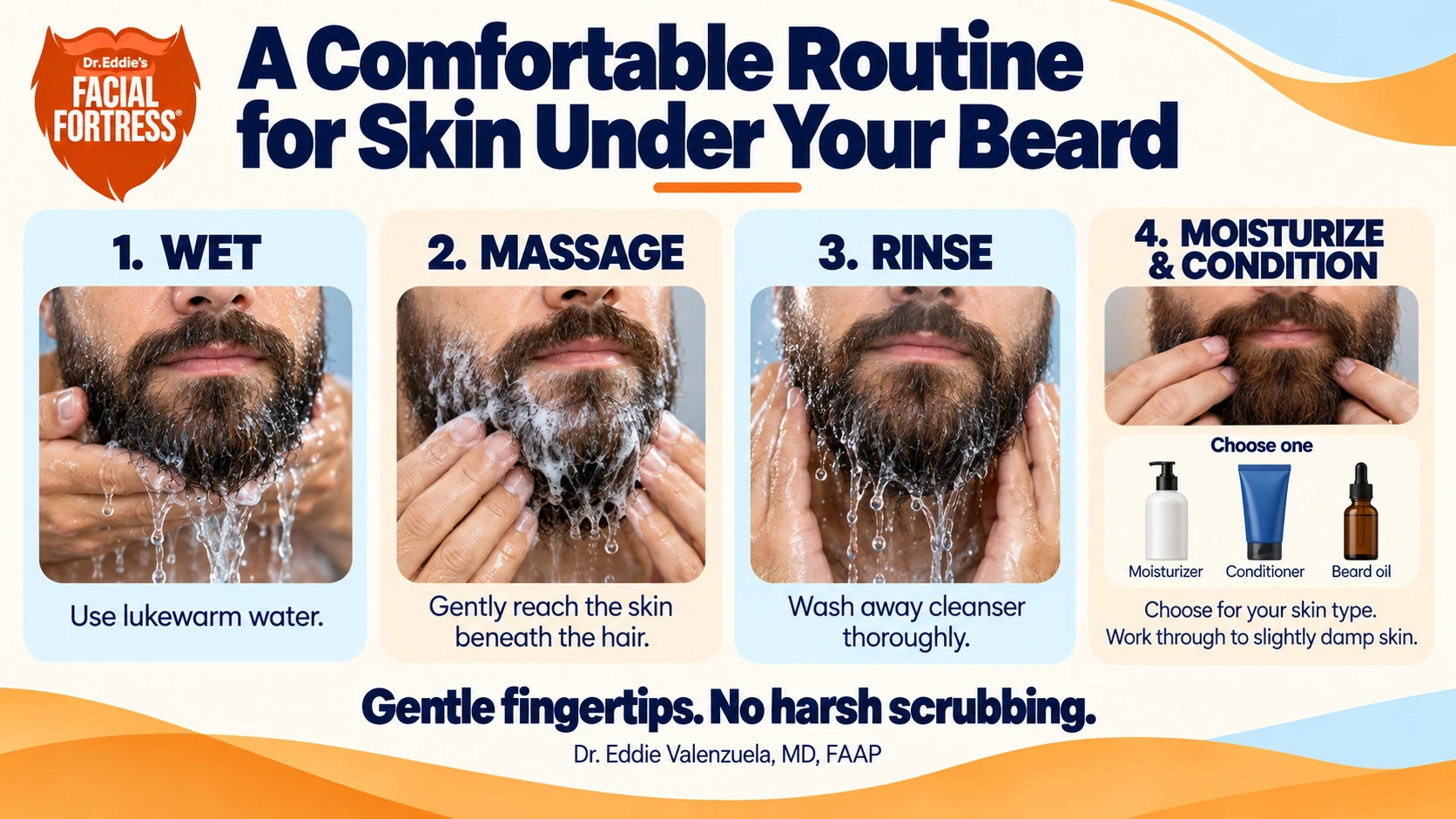
Consistency helps only if the wash reaches the affected skin. Wet thoroughly, use fingertips to work through the hair without scratching, follow the product’s contact-time directions, and rinse completely. A longer beard may require more careful rinsing, rather than a stronger product or extra treatment days.
The beard-shampoo application guide explains the technique and precautions in more detail.
Moisture Support for Dry Skin After Washing
After rinsing, gently pat dry and apply a tolerated, fragrance-free moisturizer to dry or tight skin beneath the beard. Moisturizing supports comfort while medicated care addresses the seborrheic dermatitis.2
For help choosing a texture and getting it through a dense beard, see beard oil versus moisturizer. That choice is separate from how often your medicated wash is due.
Adjusting the Routine During Flares and Maintenance
During a flare, use the treatment schedule recommended for your product or by your dermatologist. More severe inflammation may need prescription treatment rather than simply more washing. After improvement, ongoing treatment can help control recurrence; the schedule may be adjusted to the product and your response.3
There is no universal rule to use every dandruff wash daily during a flare or once weekly afterward. Keep Facial Fortress use consistent with its directions unless your doctor recommends a different plan.
When Washing Alone Is Not Enough
If symptoms worsen or do not improve with regular use as directed, stop using the product and ask a doctor.5 Pain, oozing, marked crusting, pustules or patchy hair loss deserve an examination because another condition may be involved. Burning or swelling after a new grooming product may also signal irritation or a reaction.
If you notice shedding along with scalp inflammation, see our guide to seborrheic dermatitis and hair loss.