Exfoliating Under Your Beard: What Helps, What Hurts, and What Actually Works

Doctor Answer: Should You Exfoliate Under Your Beard?
Usually, no. Most men do not need to exfoliate under their beard.
The skin beneath facial hair sheds dead skin naturally, and gentle daily cleansing is usually enough.
Exfoliating too often can worsen irritation and beard dandruff, especially in sensitive or eczema-prone skin.
Exfoliation may help only in limited cases, such as:
- Thick flakes that don’t rinse away
- Heavy product buildup
- Ingrown hairs without inflammation
For persistent flakes or itching, treating inflammation or yeast sensitivity is more effective than scrubbing.
— Dr. Eddie Valenzuela
If you’re noticing dead skin under your beard, flakes on your facial hair, or persistent itching, the beard itself usually isn’t the problem–the skin underneath is.
One of the most common skin conditions behind these symptoms is beard dandruff (often called “beardruff”), which is typically a form of seborrheic dermatitis affecting the skin beneath facial hair.
While exfoliating is often mentioned in beard-care advice, most people do not need to exfoliate under their beard regularly. In fact, frequent or aggressive exfoliation can worsen irritation, itching, and flaking–especially in men with sensitive skin, eczema, or seborrheic dermatitis.
In this article, we’ll explain when exfoliation may help, when it should be avoided, and what works better for keeping the skin under your beard healthy and flake-free.
In this blog, you’ll learn:
- When exfoliating under your beard may help — and when it can make symptoms worse
- Safer ways to remove dead skin and flakes without irritating sensitive skin
- If and how to exfoliate under your beard, and how often (if at all)
- Which beard and skin products support a healthy, flake-free beard
When Exfoliating Under Your Beard Helps and When It’s Not the Answer
Exfoliating under the beard is often recommended in grooming advice, but it is not necessary for everyone, and in many cases, it can do more harm than good.
The skin under facial hair sheds dead skin cells naturally. For most people, gentle cleansing is enough to remove this buildup without disrupting the skin barrier.
Exfoliation may be helpful only in limited situations, such as:
- Thick, adherent flakes that do not rinse away with gentle cleansing
- Heavy buildup from beard products (waxes, pomades, balms)
- Recurrent ingrown hairs without redness, itching, or inflammation
However, exfoliating too often or too aggressively can worsen common beard skin conditions.
Excess oil and disrupted skin barrier function can create an environment where Malassezia yeast becomes more active. In people who are prone to seborrheic dermatitis, this can lead to inflammation, flaking, scaling, and itching under the beard. While dead skin buildup may be visible, the underlying issue is often inflammation and yeast sensitivity rather than clogged pores.
Because of this, exfoliation can actually aggravate conditions such as:
- Beard dandruff (seborrheic dermatitis)
- Eczema-prone or sensitive skin
- Chronic itching, redness, and irritation
For men experiencing beard dandruff or persistent flakes, treating the underlying cause, not scrubbing the skin, is far more effective. In these cases, antifungal ingredients and gentle cleansing matter more than exfoliation.
Tools That Support Healthy Skin Under the Beard
Not every beard routine needs exfoliation. In fact, for many men, especially those with beard dandruff, eczema-prone skin, or sensitivity, gentle cleansing matters far more than scrubbing.
The right tools depend on what problem you’re trying to solve: visible flakes, product buildup, ingrown hairs, or chronic itching.
Core tools most men actually need
These support skin health without disrupting the barrier:
- Gentle beard or face wash
A fragrance-free, soap-free cleanser (hypoallergenic beard wash) removes oil, sweat, and loose flakes without stripping the skin. - Soft beard brush or wide-tooth comb
Helps distribute cleanser and lift loose flakes without aggressive exfoliation.
Tools that may help in limited situations
These are optional,not daily requirements:
- Exfoliating beard brush (soft bristles only)
May help loosen thick, adherent flakes or product buildup when used gently and infrequently. - Beard scrub or facial exfoliator
Best reserved for men with oily skin or frequent ingrown hairs. Should be used no more than once weekly and avoided entirely if irritation or redness is present. - Beard balm or skin-and-beard moisturizer
Helps restore hydration and support the skin barrier after cleansing. For dandruff-prone skin, balms are often better tolerated than oils.
Important: If you’re dealing with persistent flaking, redness, or itching, exfoliation alone will not fix the problem. Treating the underlying cause, such as yeast-driven inflammation or barrier disruption, is more effective than scrubbing the skin.
How to Exfoliate Under Your Beard (When It’s Actually Needed)

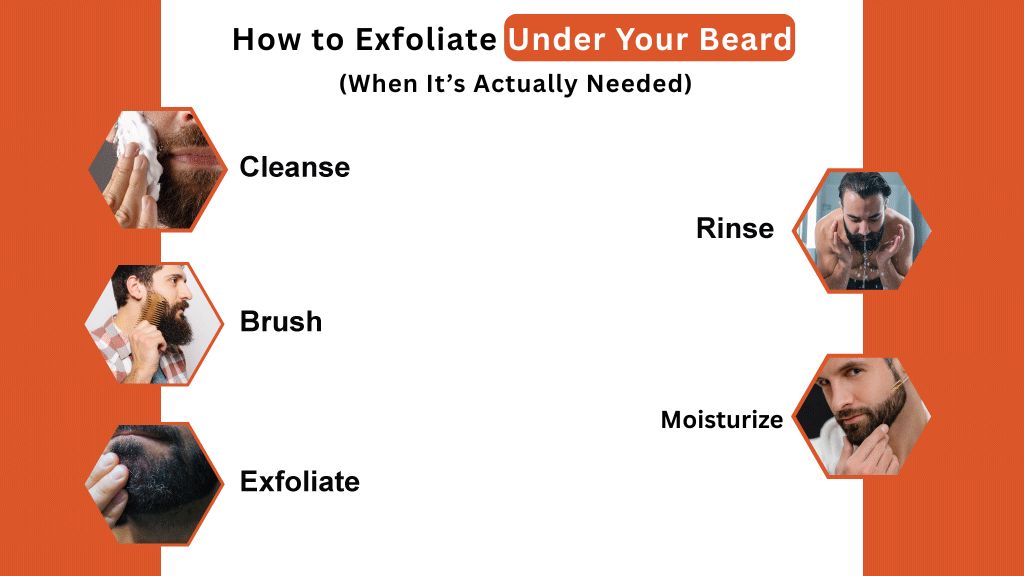
Exfoliating under the beard is not a daily requirement, and it should never be the first step for managing flakes or itching. For most men, gentle cleansing alone is enough to keep the skin under the beard healthy.
If exfoliation is needed, it should be done sparingly and carefully, and only when there is visible buildup that does not rinse away with cleansing.
Step 1: Cleanse First (Always)
Before considering exfoliation, start with cleansing.
- Wet your beard thoroughly with lukewarm or cool water.
- Apply a gentle, fragrance-free beard or face wash to your hands.
- Massage the cleanser into the beard and down to the skin using your fingertips–not nails or brushes.
- Rinse thoroughly to remove oil, sweat, and loose flakes.
If you are experiencing beard dandruff, flaking, or itching, a medicated cleanser is often more effective than exfoliation alone.
For example, a product like Facial Fortress 3-in-1 Medicated Face, Hair, and Beard Wash can be helpful.
It contains 0.95% pyrithione zinc, an FDA-approved active ingredient that helps reduce the growth of Malassezia yeast and control the flaking, scaling, and itching associated with dandruff and seborrheic dermatitis.
In many cases, consistent use of a medicated cleanser is enough to clear flakes, making exfoliation unnecessary.
Step 2: Use a Soft Brush Only If Needed
Brushing can act as mild mechanical exfoliation when done correctly.
- Use a soft-bristle beard brush or wide-tooth comb.
- Brush gently in a downward motion.
- This helps loosen surface flakes and distribute cleanser—without scraping the skin.
Avoid stiff brushes or aggressive brushing, especially if there is redness or irritation.
Step 3: Exfoliate Sparingly (Optional)
This step is optional, not routine.
- Use a gentle facial exfoliator formulated for sensitive skin.
- Apply a small amount to your fingertips.
- Massage lightly into the skin beneath the beard using slow, circular motions.
- Focus on areas with thick, adherent flakes–not the entire beard area.
Do not exfoliate if you have:
- Active redness or burning
- Eczema-prone or highly sensitive skin
- Worsening itching or irritation
Exfoliation should be limited to once weekly at most, and many men should avoid it entirely.
Step 4: Rinse Thoroughly
- Rinse the beard and skin completely to remove all product residue.
- Leftover exfoliant can worsen irritation and dryness.
- Pat dry with a soft towel–do not rub.
Step 5: Restore the Skin Barrier
Moisturizing is essential after cleansing or exfoliating.
- Apply a skin-and-beard moisturizer or balm while the skin is slightly damp.
- Massage gently into the beard and down to the skin.
If you are prone to dandruff or seborrheic dermatitis, avoid heavy beard oils, which can worsen flaking. Barrier-supporting moisturizers and balms are often better tolerated.
How to Choose the Right Exfoliator (If You Actually Need One)?
Not everyone needs to exfoliate under their beard. If gentle cleansing alone controls flakes, itching, and buildup, exfoliation is unnecessary and may increase irritation.
If you do choose to exfoliate, selecting the right type is critical–especially for beard skin, which is more prone to inflammation.
1. Physical vs. Chemical Exfoliators: What’s the Difference?
There are two main types of exfoliators:
Physical Exfoliators
These work by manually removing surface buildup using mild friction.
Examples include:
- Soft beard brushes
- Silicone scrubbers
- Gentle facial scrubs with very fine particles
Best for:
- Thick, adherent flakes that do not rinse away
- Product buildup from waxes or pomades
- Skin that is not red, itchy, or inflamed
Avoid:
- Harsh scrubs, crushed shells, sugar, salt, or stiff brushes
- Any exfoliation during active redness, burning, or itching
Aggressive physical exfoliation can damage the skin barrier, worsen eczema, and flare seborrheic dermatitis.
Chemical Exfoliators
These dissolve dead skin using acids or enzymes rather than friction.
Common ingredients include:
- AHAs (glycolic acid, lactic acid)
- BHAs (salicylic acid)
- Enzymes
While often marketed for acne or oily skin, chemical exfoliants are usually not ideal for beard skin, especially in men with:
- Beard dandruff (seborrheic dermatitis)
- Eczema-prone or sensitive skin
- Ongoing itching or inflammation
These products can:
- Strip protective oils
- Disrupt the skin barrier
- Increase redness and irritation
If used at all, they should be very low-strength and infrequent, and avoided during active flares.
2. Match the Exfoliator to Your Skin Type
Sensitive, itchy, or dandruff-prone skin
- Avoid exfoliation during flares
- Focus on gentle cleansing and antifungal treatment
- Exfoliation may worsen symptoms
Dry skin
- Use hydration-first care
- If exfoliating, limit to once weekly with a very gentle method
Oily skin without redness or itching
- Mild exfoliation once weekly may help remove buildup
3. What Matters More Than Exfoliation
For most men with flakes under the beard, the primary issue is not clogged pores or dead skin buildup, but:
- Inflammation
- Yeast sensitivity (Malassezia)
- Disrupted skin barrier function
In these cases, medicated cleansing and barrier support are far more effective than scrubbing.
Bottom Line
Exfoliation is not a requirement for healthy beard skin.If you exfoliate, do it gently, infrequently, and only when the skin is calm.
For persistent flakes, itching, or redness, treating the underlying cause, not removing more skin, is the smarter approach.
How Often Should You Exfoliate Your Beard?
For most men, regular exfoliation under the beard is not necessary.
The skin beneath facial hair sheds dead skin cells naturally. In many cases, gentle daily cleansing is enough to keep flakes, oil, and buildup under control without disrupting the skin barrier.
General Guidance (If You Choose to Exfoliate)
If exfoliation is needed, it should be limited and infrequent:
- Once per week is sufficient for most skin types
- Up to twice per week only for oily skin without redness, itching, or sensitivity
- Less often or not at all for dry, sensitive, eczema-prone, or dandruff-prone skin
Exfoliating more frequently does not improve results and can increase irritation, redness, and flaking.
When You Should Avoid Exfoliating
Do not exfoliate if you have:
- Active beard dandruff (seborrheic dermatitis)
- Eczema-prone or inflamed skin
- Redness, burning, or itching
- Open skin, cracks, or irritation
In these situations, exfoliation can worsen inflammation and disrupt healing.
What to Do Instead
If flakes or itching persist, focus on:
- Gentle cleansing
- Medicated antifungal washes when appropriate
- Consistent moisturizing to support the skin barrier
For conditions like beard dandruff, treating the underlying cause is far more effective than removing more skin.
Bottom Line
Exfoliation under the beard should be:
- Optional
- Infrequent
- Avoided during flares
Healthy beard skin comes from barrier protection and proper cleansing, not routine scrubbing.
Facial Fortress and Your Beard
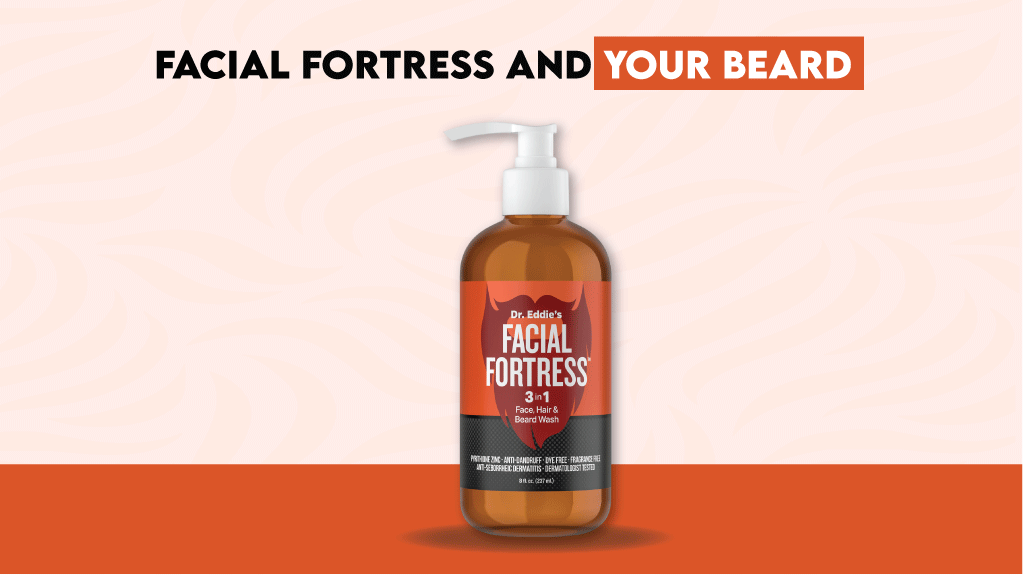
Healthy beard skin starts with proper cleansing, not aggressive exfoliation.
For many men, flakes, itching, and irritation under the beard are caused by inflammation and yeast sensitivity, not a lack of scrubbing. In these cases, using the right cleanser consistently matters far more than exfoliating.
Facial Fortress 3-in-1 Face, Hair, and Beard Wash was developed to support beard and facial skin that is prone to dandruff, irritation, or sensitivity.
Why Cleansing Matters More Than Exfoliation
Unlike exfoliation, which only removes surface buildup, proper cleansing helps:
- Reduce excess oil without stripping the skin
- Support the skin barrier
- Address yeast overgrowth linked to beard dandruff
- Calm itching and irritation at the source
What Makes Facial Fortress Different
Facial Fortress is formulated to be used daily on the face, scalp, and beard and is designed for sensitive skin.
It is:
- Doctor-developed
- Fragrance-free
- Paraben-free
- Sulfate-free
- Dye-free
- Soap-free
- pH-balanced
Most importantly, it contains 0.95% pyrithione zinc, an FDA-approved active ingredient that helps control the growth of Malassezia yeast and reduce the flaking, scaling, and itching associated with dandruff and seborrheic dermatitis.
How to Use It for Beard Care
- Use once daily, or as directed by a healthcare professional
- Massage gently into the beard and down to the skin
- Leave on for a short contact time before rinsing
- Follow with a light, non-comedogenic moisturizer if needed
In many cases, consistent use of a medicated cleanser like Facial Fortress reduces or eliminates the need for exfoliation altogether.
Bottom Line
A healthy beard doesn’t require frequent exfoliation. It requires calm skin, a supported barrier, and proper cleansing.
For men dealing with beard dandruff or irritation, treating the underlying cause, not scrubbing harder, is the most effective approach.
Conclusion
Exfoliating under the beard is often presented as a must-do grooming step, but in reality, most men do not need regular exfoliation to maintain healthy beard skin.
The skin beneath facial hair sheds dead skin cells naturally. For many people, gentle daily cleansing is enough to remove buildup without disrupting the skin barrier. In fact, over-exfoliating can worsen common beard skin issues by increasing irritation, dryness, and inflammation.
When flakes, itching, or redness appear under the beard, the problem is often beard dandruff (seborrheic dermatitis) or sensitive, inflammation-prone skin—not a lack of scrubbing. In these cases, addressing the underlying cause with proper cleansing and antifungal support is far more effective than exfoliating.
Exfoliation may be helpful only in limited situations, such as:
- Thick flakes that do not rinse away with gentle cleansing
- Heavy product buildup from waxes or balms
- Recurrent ingrown hairs without active inflammation
Even then, exfoliation should be gentle, infrequent, and never aggressive.
For ongoing beard health, focus on:
- Consistent cleansing with a gentle, medicated wash when needed
- Supporting the skin barrier rather than stripping it
- Treating dandruff and irritation at the source
Products like Facial Fortress, which contain pyrithione zinc, help manage the flaking, scaling, and itching associated with dandruff and seborrheic dermatitis–often eliminating the need for exfoliation altogether.
A healthy beard isn’t about scrubbing harder. It’s about calm skin, a supported barrier, and the right daily routine.

- How Often Should You Wash Your Beard? Daily vs Weekly Beard Care Explained - January 30, 2026
- Can Beard Dandruff Spread? Why Flakes Appear on Your Eyebrows and Nose - January 29, 2026
- The role of diet and stress in beard dandruff and skin inflammation - January 29, 2026
Recent Post
Frequently Asked Questions
Should I exfoliate under my beard?
Why do I have flakes or dead skin under my beard?
How do I get rid of beard dandruff?
How often should I exfoliate my beard if I do it?
Is exfoliating good for beard growth?
What is the best routine for skin under the beard?
Can exfoliating make beard dandruff worse?
- How Often Should You Wash Your Beard? Daily vs Weekly Beard Care Explained - January 30, 2026
- Can Beard Dandruff Spread? Why Flakes Appear on Your Eyebrows and Nose - January 29, 2026
- The role of diet and stress in beard dandruff and skin inflammation - January 29, 2026