Beard Seborrheic Dermatitis & Malassezia: What Causes It and What Helps
Quick Doctor Answer: Beard seborrheic dermatitis is not simply a fungal infection. Malassezia is a normal skin yeast and appears to contribute when its activity interacts with skin lipids, barrier function, and individual inflammatory susceptibility. Treatment focuses on controlling flaking, scale, itch, and inflammation and preventing recurrences—not permanently eliminating a normal skin organism.
Seborrheic dermatitis can affect the skin beneath a beard and cause flaking, scale, itching, irritation, and greasy or inflamed patches. But not every flaky beard is seborrheic dermatitis: dry skin, contact dermatitis, psoriasis, tinea barbae, and other conditions can look similar.
So what actually contributes to scalp and beard dandruff, and why do some people develop a flaky and itchy beard? Malassezia yeast is part of the normal skin microbiome and is strongly associated with seborrheic dermatitis. The important point is that seborrheic dermatitis is not simply a yeast infection or a problem caused by having ‘too much’ Malassezia. Current evidence points to an interaction among Malassezia, skin-surface lipids, the skin barrier, and an individual’s inflammatory susceptibility.
What Is Malassezia Yeast?
Malassezia is a genus of yeasts that includes 18 currently recognized species; most are lipid-dependent. These organisms are a normal part of the skin microbiome, but they are also associated with several skin conditions, including dandruff and seborrheic dermatitis.
Malassezia does not automatically cause disease simply because it is present, and seborrheic dermatitis is not best understood as a simple yeast-overgrowth problem. Current evidence points to an interaction among Malassezia activity, sebum-derived lipids, the epidermal barrier, and the host immune response. Fungal burden does not consistently track with disease severity, which helps explain why many people carry Malassezia without symptoms while others develop flaking and inflammation.
What Current Evidence Suggests
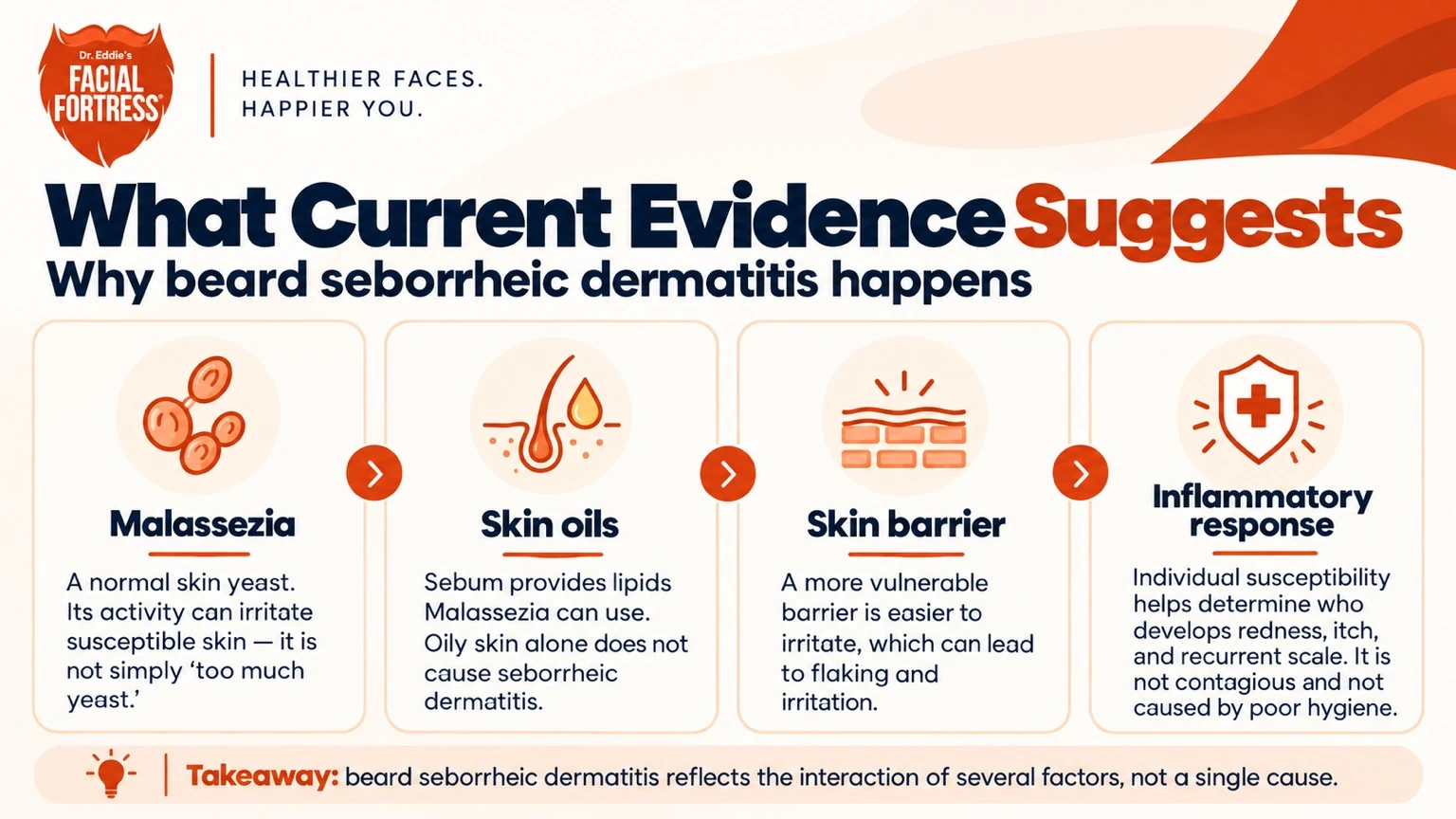
The easiest way to think about seborrheic dermatitis is that several factors interact. No single one explains the condition by itself.
| Factor | What current evidence suggests |
|---|---|
| Malassezia | A normal skin yeast; most Malassezia species depend on external lipids. Their activity can irritate susceptible skin, but their presence does not mean you have a fungal infection or simply “too much yeast.” |
| Skin oils | Sebum provides lipids that Malassezia can use, which helps explain why oil-rich areas are often affected. Oily skin by itself does not cause seborrheic dermatitis. |
| Skin barrier | A more vulnerable barrier may be more easily irritated by lipid byproducts, contributing to flaking and irritation. Seborrheic dermatitis is not simply dry skin. |
| Inflammatory response | Individual inflammatory susceptibility helps determine who develops redness, itch, and recurrent scale. The condition is not contagious and is not caused by poor hygiene. |
Most Malassezia species are lipid-dependent, meaning they rely on fats available on the skin surface rather than making all of the fatty acids they need on their own. They produce enzymes such as lipases that break down skin-surface lipids. That biology is more relevant to seborrheic dermatitis than the yeast’s method of reproduction because those lipid byproducts can interact with the skin barrier and immune system.
Malassezia species are especially abundant in oil-rich areas such as the scalp, face, and upper trunk. Most species depend on external lipids, so sebum helps create the skin environment in which they thrive.
Why Does Malassezia Contribute to Seborrheic Dermatitis in Some People?
Malassezia normally lives on human skin, so its presence alone is not abnormal. Seborrheic dermatitis appears to develop when Malassezia interacts with skin lipids and a susceptible skin barrier and immune response. In other words, the condition is not explained by yeast quantity alone.
Sebaceous glands produce lipid-rich sebum, and Malassezia can use components of those lipids on the skin surface. Seborrheic dermatitis favors oil-rich areas such as the scalp, face, and beard, but excess oil or a hormonal imbalance by itself does not explain who develops the condition. Environment can also influence symptoms: heat and sweating aggravate some people, while cold, dry weather is a common trigger for others. The important variable is the interaction between the skin environment and an individual’s barrier and inflammatory susceptibility.
How Malassezia Contributes to Beard Seborrheic Dermatitis
“Beard dandruff” is a useful everyday term, but dandruff itself is generally considered the mild, scalp-limited end of the seborrheic dermatitis spectrum. When similar scale, redness, and inflammation involve the beard, mustache, eyebrows, or sides of the nose, seborrheic dermatitis of facial skin is the more precise description. Not every flaky beard is seborrheic dermatitis, however, which is why dry skin, contact dermatitis, psoriasis, and tinea barbae still belong in the differential.
So how does Malassezia fit into seborrheic dermatitis? Multiple Malassezia species are associated with dandruff and seborrheic dermatitis. No single species explains the condition by itself; the current model focuses on how the yeast interacts with skin lipids and a susceptible skin barrier.
Most Malassezia species depend on external lipids and use components of sebum on the skin surface. Their enzymes can release free fatty acids from these lipids; in susceptible people, those byproducts may disturb the skin barrier and contribute to inflammation and abnormal scaling. That helps explain why seborrheic dermatitis favors oil-rich areas such as the scalp, eyebrows, sides of the nose, and beard area—but neither the amount of sebum nor the amount of yeast alone fully explains who develops the condition. Common signs can include:
- Inflammation
- Itching
- Redness
- Irritation
- Yellowish and crusty flakes
- Oily and scaly patches
Malassezia enzymes can break down fats in sebum and release free fatty acids, including oleic acid. In susceptible skin, these byproducts can disrupt the outer skin barrier, increase inflammation, and change how skin cells normally shed, producing visible scale. The key point is not that the skin is trying to “remove” oleic acid; rather, some people appear more vulnerable to the barrier-disrupting and inflammatory effects of these lipid byproducts.
Common Myths About Beard Seborrheic Dermatitis
One common question is whether seborrheic dermatitis causes hair loss. It is not a typical cause of permanent pattern baldness, but a significant flare may be associated with temporary shedding, and scratching or inflammation can contribute to breakage. Persistent, patterned, patchy, or progressive hair loss deserves evaluation for another cause. For a fuller explanation, see our doctor’s guide to seborrheic dermatitis and hair loss.
Another myth is that it is contagious. The truth is, this condition is not contagious. It cannot spread to other people by direct or indirect contact.
Shaving does not permanently cure seborrheic dermatitis or eliminate Malassezia from the skin. It can, however, make the affected skin easier to cleanse and treat, and the American Academy of Dermatology notes that shaving the beard or mustache can reduce flare-ups for some people. If you prefer to keep facial hair, the goal is to get treatment down to the skin beneath the beard rather than assuming the hair itself is the cause.
How to Manage Beard Seborrheic Dermatitis
Seborrheic dermatitis is often chronic and recurrent in adolescents and adults. Treatment can calm a flare, reduce scale and itch, and lower the chance of recurrence, but it does not guarantee that symptoms will never return. Infantile seborrheic dermatitis, or cradle cap, behaves differently and often resolves as the child gets older. In adults, maintenance skin care or intermittent medicated treatment may be needed when symptoms repeatedly come back.
OTC and Prescription Options
Treatment depends on the severity of the flare, the area involved, and how the skin responds. Common options include medicated dandruff products, antifungal treatments, and—in selected cases—prescription anti-inflammatory medicines.
Anti-Dandruff Shampoos and Medicated Washes
For mild to moderate seborrheic dermatitis, dermatologists often use medicated dandruff shampoos or cleansers as part of treatment. The exact frequency depends on the active ingredient, the area being treated, hair type, and the product directions. For a practical breakdown by hair type, oiliness, climate, and beard care, see our doctor’s washing-frequency guide. For the beard and face, choose a product appropriate for facial skin and follow the label or your dermatologist’s instructions rather than assuming every dandruff shampoo should be used the same way.
That is why we recommend choosing a medicated wash by Facial Fortress. Facial Fortress is a physician-developed medicated 3-in-1 wash created for the face, beard, hair, and scalp. It pairs 0.95% pyrithione zinc with a more skin-conscious formula that is fragrance-free, dye-free, and dermatologist tested, with added humectants and conditioning ingredients such as glycerin and panthenol. That thoughtful vehicle matters on facial and beard skin, while the medicated active helps relieve the flaking, scaling, and itching associated with dandruff and seborrheic dermatitis.
Antifungal Shampoos and Creams
Ketoconazole is one antifungal option used for seborrheic dermatitis. Depending on the area involved and the formulation, it may be used as a shampoo or as a topical cream, gel, or foam. By reducing Malassezia activity, it can help lessen rash, scaling, and itching. Follow the product directions or your clinician’s instructions because formulations are used differently.
Prescription Anti-Inflammatory Treatments
For a more inflamed flare, a dermatologist may prescribe a short course of a low-potency topical corticosteroid, especially on facial skin where steroid strength and duration matter. In selected patients, steroid-sparing medicines such as pimecrolimus or tacrolimus may also be used. These prescription options should be chosen with a clinician rather than added to a beard routine on your own.
Because the right treatment depends on severity and individual skin type, it’s best to consult a dermatologist to determine the most effective plan for you.
Doctor-Created Wash for Seborrheic Dermatitis Symptoms
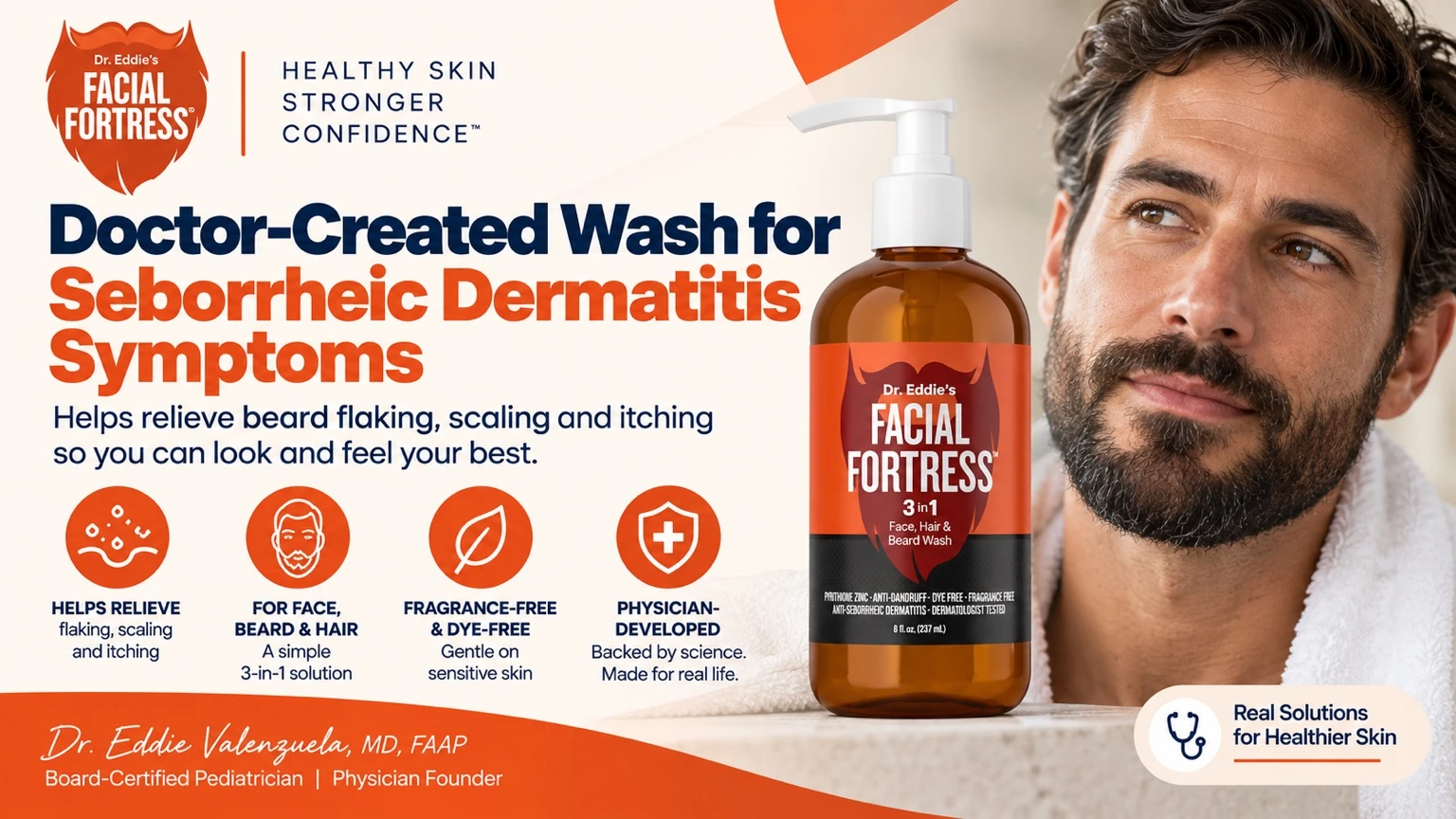
For beard flaking associated with dandruff or seborrheic dermatitis, a medicated wash can simplify care by treating the affected skin while cleansing the beard and face. Facial Fortress is formulated with 0.95% pyrithione zinc and is designed for use on the face, hair, and beard.
- Helps relieve flaking, scaling, and itching associated with dandruff and seborrheic dermatitis
- Contains a medicated dandruff active in a face, hair, and beard wash
- Fragrance-free and dye-free
- Simple rinse-off directions for use on the scalp and affected skin
For dandruff and seborrheic dermatitis—conditions in which Malassezia is one contributing factor—Dr. Eddie’s 3-in-1 Medicated Wash is an OTC medicated option. It can be used on the scalp and affected beard-area skin according to the Drug Facts directions to help relieve associated flaking, scaling, and itching while cleansing the hair and skin. Its active ingredient, pyrithione zinc, is an established OTC dandruff active used to help relieve flaking, scaling, and itching associated with dandruff and seborrheic dermatitis.
Reducing Beard Seborrheic Dermatitis Flare-Ups
Seborrheic dermatitis tends to be chronic and recurrent, so the goal is control rather than a permanent cure. Gentle skin care, appropriate medicated cleansing, and avoiding personal triggers can help reduce flare-ups and keep scaling and itch under better control.
Here are practical ways to reduce irritation and help keep beard seborrheic dermatitis under control:
1. Use Gentle, Consistent Cleansing
Poor hygiene does not cause seborrheic dermatitis, but consistent cleansing helps control oil, flakes, and irritation.
- Wash your skin and scalp regularly to remove excess sebum and loosen flakes.
- Match cleansing frequency to oiliness, hair type, sweating, climate, and irritation rather than using one schedule for everyone. See our doctor’s washing-frequency guide for a more detailed breakdown.
- If the skin feels dry or tight, use a fragrance-free moisturizer that you tolerate to support the skin barrier.
- Regular cleansing also makes flakes easier to remove after bathing.
2. Use a Comb or Beard Brush
Combing or brushing does not treat seborrheic dermatitis directly, but gentle grooming can help lift loose flakes and keep them from collecting in the beard.
- Use a wide-tooth comb or a soft-bristled beard brush, and avoid aggressive scraping of inflamed skin.
- If the skin beneath your beard feels dry, use a fragrance-free moisturizer that you tolerate before grooming. If a beard oil seems to worsen flaking or irritation, stop using it.
- Regular grooming keeps your beard neat and helps remove loose flakes.
3. Protect Against Environmental Triggers
Weather can influence seborrheic dermatitis flares, but the pattern varies from person to person:
- Heat, humidity, and sweating can aggravate symptoms for some people, while others flare more in cold, dry conditions.
- Cold, low-humidity weather is also associated with seborrheic dermatitis flares and can make already-sensitive skin feel drier.
If beard-area skin feels dry or tight, a fragrance-free moisturizer that you tolerate can help support comfort and barrier function. Seek medical care for bleeding, significant pain, spreading redness, drainage, or a rash that is not improving.
4. Manage Stress
Many people notice that seborrheic dermatitis flares during periods of stress. The relationship is complex, but managing stress, sleep, and overall health can be a reasonable part of a broader skin-care plan.
Tips to reduce stress:
- Practice mindfulness, prayer, or meditation.
- Exercise regularly.
- Get consistent, high-quality sleep.
- Stay connected with supportive friends and family.
- If stress feels unmanageable, consult a mental health professional.
Conclusion
Malassezia is part of the normal skin microbiome and appears to contribute to seborrheic dermatitis through its interaction with skin lipids, barrier function, and individual susceptibility. Beard-area symptoms can often be controlled with gentle skin care and appropriately selected medicated treatment. Facial Fortress 3-in-1 Medicated Wash contains 0.95% pyrithione zinc and, when used as directed, helps relieve the flaking, scaling, and itching associated with dandruff and seborrheic dermatitis.
Medical References
Frequently Asked Questions
Can Malassezia yeast spread from the beard to the scalp?
Is Malassezia yeast on skin contagious?
How long does treatment for beard seborrheic dermatitis take?
Can you permanently get rid of Malassezia on the skin?

Dr. Eddie created Facial Fortress, a medicated 3-in-1 face, hair and beard wash for dandruff and seborrheic dermatitis.
More about Dr. Eddie
- Seborrheic Dermatitis on the Body: Chest, Skin Folds & Belly Button - September 17, 2026
- Seborrheic Dermatitis Treatment: Zoryve and Other Options for the Face and Beard - September 17, 2026
- GLP-1 Medications and Beard Changes: What Do We Know? - September 17, 2026