GLP-1 Medications and Beard Changes: What Do We Know?
You start a medication to improve your health, then notice something different in the mirror. Your beard seems thinner, a patch looks more obvious, or your face simply looks different after losing weight. Could the medication be involved?
It is a reasonable question. The honest answer is more specific than either “these drugs cause beard loss” or “they have nothing to do with hair.” We have information about reported hair loss. We have much less information about facial hair in particular.
What are GLP-1 medications, in plain English?
GLP-1 is short for glucagon-like peptide-1, a hormone involved in blood-sugar regulation and appetite. Some medicines mimic its activity. Semaglutide is the active ingredient in Ozempic and Wegovy. Tirzepatide, sold as Mounjaro and Zepbound, acts on both GLP-1 and another hormone pathway called GIP.
The brand names have different approved uses and dosing instructions. A side-effect percentage from a particular Wegovy trial should not automatically be presented as the rate for every person taking Ozempic—or for the entire drug class.
These are part of the wider peptide conversation, but they are different from the copper-peptide serums advertised for skin or hair. Our introduction to peptides, GHK-Cu, and beard-growth claims explains those categories without assuming you already know the chemistry.
Does a GLP-1 make your beard grow faster or fall out?
We did not identify controlled human research establishing a predictable effect on beard growth, density, or loss. That means we cannot recommend these medicines to grow facial hair, and we cannot give a reliable percentage for the risk of beard thinning.
It also means we should not dismiss a change someone notices. A report of hair loss can be relevant to the conversation with a clinician even when a study did not identify the body area affected.
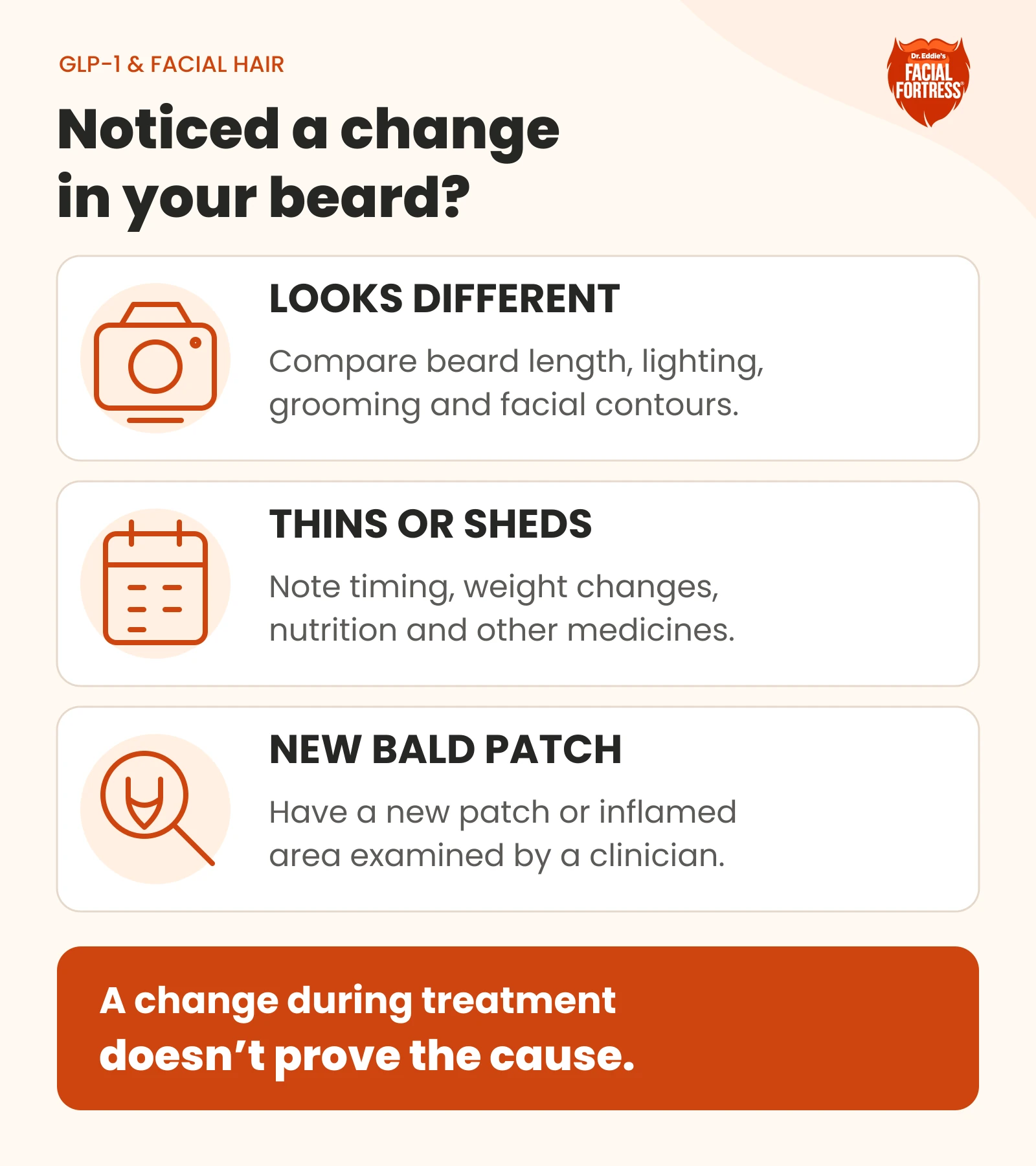
Before-and-after photographs are particularly difficult to interpret when body weight, face shape, beard length, lighting, and grooming all change. An apparently fuller beard is not, by itself, evidence that a drug stimulated new follicles.
What do the medication trials say about hair loss?
Current prescribing information for both Wegovy and Zepbound includes hair loss reported during weight-reduction trials. These are hair-loss reports, not measured beard-loss rates.
| Medication and study setting | Reported hair loss |
|---|---|
| Wegovy 2.4 mg injection Pooled adult weight-reduction trials. | 3.3% with Wegovy versus 1% with placebo overall. Among men, the label reports 0.9% versus 0%. |
| Zepbound Pooled weight-reduction trials across the studied maintenance doses. | 4–5% with Zepbound versus 1% with placebo overall. Among men, the pooled figures were 0.5% versus 0%. |
Sources: Wegovy prescribing information and Zepbound prescribing information, reviewed September 17, 2026. These figures come from different trial populations and are not a head-to-head comparison. They do not tell us whether the loss involved scalp hair, beard hair, or permanent thinning.
Both labels describe the reported hair loss as associated with weight reduction. That supports considering weight change in the assessment; it does not prove that every individual case has the same cause.
A 2026 observational study also found more recorded alopecia diagnoses among adults with type 2 diabetes using GLP-1 receptor agonists than among those using two other classes of diabetes medicine. Because this was an observational comparison, it cannot establish that the medicine directly caused the loss. It also does not provide a beard-specific answer. Read the BMJ publisher’s summary of the study.
Why might hair change while someone takes these medicines?
There are several possibilities, and more than one can be relevant:
- Significant weight loss can act as a physical stressor. Hair shedding may appear after the body goes through a substantial change.
- Eating less can change nutritional intake. A reduced appetite does not automatically mean a deficiency, but it can make it harder to consistently meet protein and other nutrient needs.
- A direct medication effect remains possible. Research has not fully separated the effects of the medicine from weight loss and other factors.
The American Academy of Dermatology discusses these possibilities and the limits of the available evidence in its guide to GLP-1 drugs and skin and hair changes. It is too confident to say that every case is “just weight loss,” or that everyone who sheds hair has a nutritional deficiency.
Other causes still matter. A new medicine can attract attention while an unrelated illness, thyroid problem, inflammatory skin condition, or form of alopecia is responsible. Timing is useful evidence, but it does not establish the diagnosis.
What is telogen effluvium, and can it involve a beard?
Telogen effluvium is increased shedding after more hairs than usual move into the resting phase of the hair cycle. It is most often discussed in relation to the scalp, although other body hair can be affected.
Shedding commonly begins about two to four months after a trigger such as illness, substantial weight loss, or a restrictive diet. That delay can make the connection difficult to recognize. This is a general description of telogen effluvium, not a validated timetable for beard changes on a GLP-1 medication.
It usually produces more diffuse shedding. A sharply defined, smooth bare patch is a reason to consider other diagnoses. Once the trigger is addressed, recovery may take months, and the course varies. We cannot promise that a particular beard will return to its previous appearance by a fixed date. DermNet explains telogen effluvium and its usual course.
What kind of beard change should you have checked?
Start by distinguishing a longstanding growth pattern from a new loss of hair. The next step depends on what actually changed. Our guide to patchy-beard causes and assessment explores those differences.
| What you notice | A useful next step |
|---|---|
| A sparse area that has always looked similar | Compare photographs taken before treatment at a similar beard length. Existing patchiness does not, by itself, show a medication effect. |
| New thinning or increased shedding | Discuss the timing, weight changes, food intake, recent illnesses, and other medicines with your prescriber or dermatologist. |
| A new smooth bald patch, or inflamed skin with broken hairs | Arrange an examination. Patchy or inflamed loss needs an assessment before choosing a growth product. |
Alopecia areata can produce sudden round or oval patches in the beard. Other conditions can also cause patchy loss, so a photograph alone should not be treated as a diagnosis. See the AAD’s description of alopecia areata.
What can you do if your beard seems thinner?
- Make a simple timeline. Note when the medicine started, dose changes, when shedding became noticeable, significant weight changes, and recent illnesses or new products.
- Use comparable photographs. Keep lighting, angle, and beard length similar. This makes a real change easier to distinguish from a grooming or photography difference.
- Review nutrition with your care team. If appetite reduction makes eating difficult, your prescriber or a dietitian can help you meet your needs. Supplements should address an identified need rather than replace that assessment.
- Discuss whether an examination or tests are useful. Testing depends on the history and findings. There is no single “GLP-1 beard panel” that everyone needs.
- Make medication decisions with your prescriber. Bring up the hair concern while also considering the treatment’s benefits and your other health needs. Do not change a prescribed dose on your own.
Be cautious about automatically adding a high-dose “hair” supplement. The NIH notes that evidence for biotin improving hair in people without a deficiency is limited, and biotin can interfere with some laboratory tests. Tell your clinician about supplements before testing. Read the NIH biotin fact sheet.
You do not need to solve the cause before making an appointment. “This is new, here is when it started, and here are comparable photos” is useful information. For general growth expectations, see what actually supports beard growth.
What about your beard-care routine?
Keep care simple while the cause is being evaluated. Introducing several growth serums at once makes irritation—and any change in appearance—harder to interpret.
Choose a basic face-and-beard routine and use products for the symptoms they are designed to address. A moisturizer can help dry-feeling skin; a conditioning product can improve how beard hair feels. Neither observation proves that the underlying shedding has changed. Our beard oil versus moisturizer guide explains the distinction.
If you also have flakes, itching, or scaling, that deserves attention in its own right. Treating those symptoms should not be presented as a proven way to prevent hair loss associated with a weight-loss medication.
Common questions about GLP-1 medications and beards
Does Ozempic increase beard growth?
There is no established clinical basis for using Ozempic to grow a beard. A fuller-looking beard in a photograph does not prove that semaglutide caused new facial-hair growth.
Can Zepbound cause beard loss?
Hair loss appears in Zepbound’s prescribing information, but the reported rates do not establish how often beards are affected. New facial-hair loss is worth discussing with your care team rather than assuming either that the medicine caused it or that it could not be involved.
Does a different-looking face mean I have lost beard hair?
No. Changes in facial contours, beard length, or grooming can change how facial hair looks. Compare similar photographs and look for an actual change in coverage, rather than relying on one overall impression.
Will my beard grow back?
That depends on the cause. Some forms of shedding improve after the trigger is addressed, while other conditions need specific treatment. There is not enough beard-specific GLP-1 research to promise a recovery time.
Should I add GHK-Cu to protect my beard?
We did not identify controlled human evidence that a GHK-Cu product prevents GLP-1-associated beard shedding. Our peptide and beard-growth article explains what copper-peptide studies do—and do not—show.
Sources and further reading
- Novo Nordisk: Wegovy prescribing information.
- Eli Lilly: Zepbound prescribing information.
- BMJ Group: Publisher’s summary of the 2026 observational alopecia study.
- American Academy of Dermatology: GLP-1 drugs and skin and hair changes.
- DermNet: Telogen effluvium.
- American Academy of Dermatology: Alopecia areata signs and symptoms.
- National Institutes of Health: Biotin fact sheet for consumers.