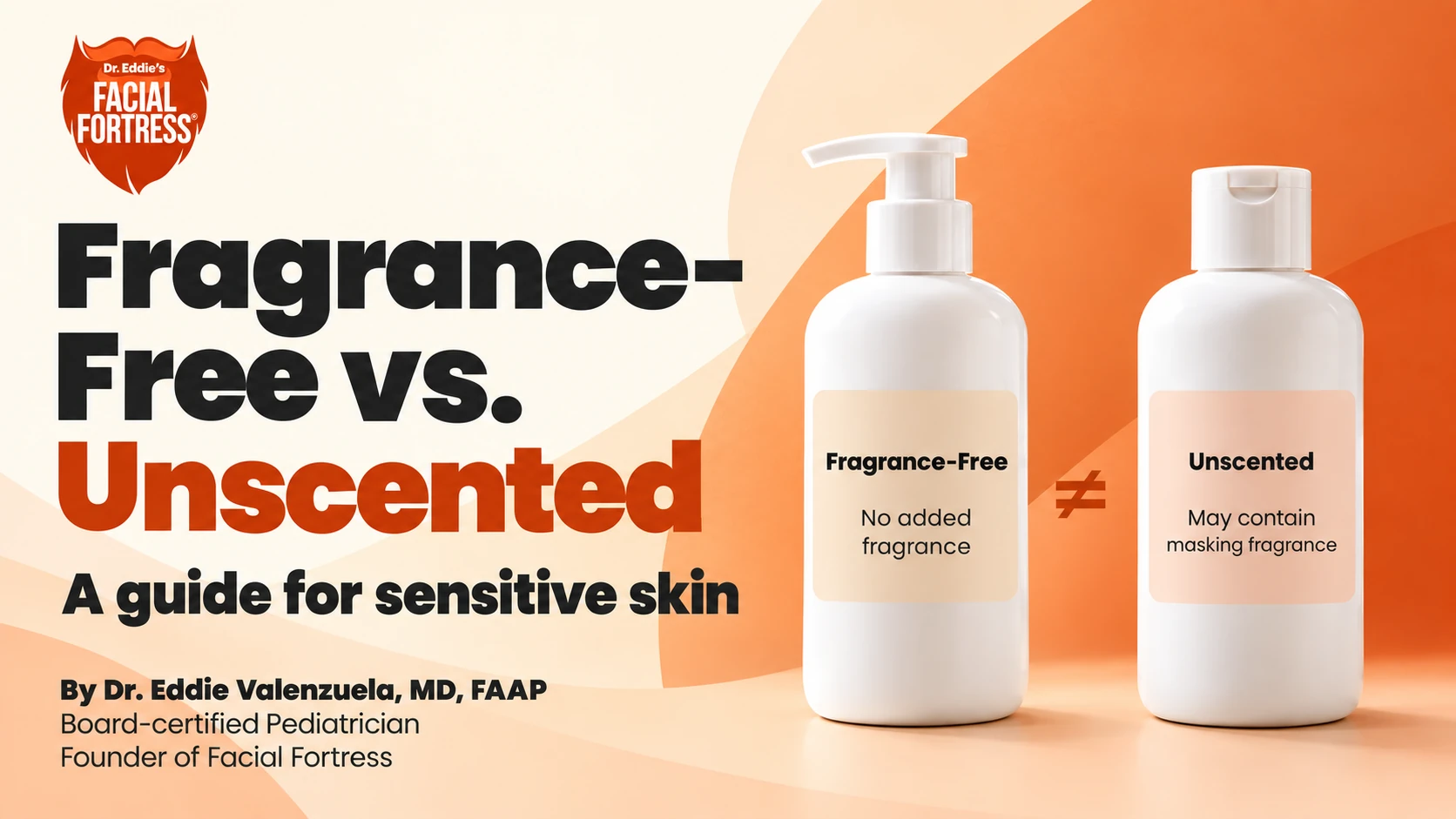
Quick answer: Fragrance-free generally means no added fragrance. Unscented products may contain fragrance to mask other odors. For sensitive skin, start with fragrance-free and check for ingredients you know trigger reactions. Dye-free is a separate claim; neither label guarantees irritation-free skin.
You pick up a bottle labeled “unscented,” then another labeled “fragrance-free.” They seem to promise the same thing. If your skin reacts easily, that small wording difference can matter more than the packaging.
This guide explains those labels so you can make a more informed choice. For help comparing the actual cleansing ingredients, see how to choose a beard wash for sensitive skin.
Fragrance-Free and Unscented Mean Different Things
| Label term | What it tells you | What to check |
|---|---|---|
| Fragrance-free | Generally indicates no added fragrance. | Read the ingredient list; the claim is not a guarantee against allergy. |
| Unscented | The product has little or no noticeable scent. | It may contain fragrance ingredients used to mask other odors. |
| Fragrance or parfum | A fragrance mixture is listed. | The individual components may not all be named. |
| Dye-free | No added dyes are claimed. | It does not mean fragrance-free or free of all possible allergens. |
| Hypoallergenic | A claim suggesting reduced allergy potential. | It does not guarantee that your skin will tolerate the product. |
“Unscented” describes the lack of noticeable scent; it does not reliably tell you that fragrance ingredients are absent. Products can include ingredients that mask other odors.1 A formula can also have a mild odor from its raw ingredients. Read the ingredient list rather than judging by scent alone.
For dry, sensitive skin, the American Academy of Dermatology recommends fragrance-free products. Treat that as a useful starting point, then check your own triggers.1
Natural Fragrance and Essential Oils
Natural fragrance is still fragrance. An essential oil can contain substances that cause irritation or allergy in a susceptible person. “Natural” does not mean it is automatically a better choice for reactive skin.2
Fragrance can come from natural or synthetic sources; you cannot determine its origin from the word “parfum” alone. You also should not assume that every botanical extract is added for scent. Some serve other formulation purposes. If you have a diagnosed fragrance allergy and the label is unclear, ask the manufacturer and your dermatologist.
The Meaning of Dye-Free
Dye-free products leave out added dyes. That can simplify a formula, especially when coloring has no useful role in your wash. It does not establish that all colored products are harmful or that every dye disrupts the skin barrier.
Some people react to particular colorants. The FDA includes dyes among several cosmetic allergen categories; that does not make the allergy risk identical across every ingredient or product.2
A dye-free formula can still have a natural color from its ingredients. Conversely, a clear or white product is not necessarily fragrance-free. Read the label instead of judging by appearance.
Reading a Sensitive-Skin Product Label
- Start with fragrance-free. If you react easily, do not rely on “unscented” alone.
- Read the complete ingredient list. Look for fragrance or parfum and any specific ingredients you have been advised to avoid.
- Separate different claims. Dye-free, sulfate-free and paraben-free each describe something different. None means allergy-proof.
- Use your own history. A diagnosed allergy is more useful than a generic internet list of “bad” ingredients.
- Ask when the label is unclear. A manufacturer may be able to clarify whether a botanical or other ingredient is used for fragrance.
The FDA cautions that there is no federal standard or definition governing cosmetic claims such as “hypoallergenic,” “fragrance-free” or “for sensitive skin” in the United States. Those words do not replace the ingredient list or your individual allergy history.2
Stinging Despite a Fragrance-Free Label
Fragrance is only one possible trigger. A reaction can involve another ingredient, an overly strong cleansing routine, or an existing skin condition. Burning does not mean the product is working.
Stop the product that appears to worsen symptoms and avoid adding several replacements at once. If you have had a substantial reaction, ask a clinician before trying the suspected product again. Persistent or recurring rashes may need assessment and, when allergy is suspected, professional patch testing.2
A rash after beard grooming can resemble other problems. Our guide to beard product reactions versus seborrheic dermatitis helps explain the distinction. Seek urgent help for trouble breathing or swelling of the lips or tongue.
Where Fragrance-Free Care Fits in Your Routine
Use a cleanser and moisturizer your skin tolerates, and appropriate sun protection. You do not need to replace every comfortable product solely because another bottle has more “free-from” claims. Our simple face and beard skincare routine covers the everyday steps.
Fragrance-Free Medicated Care with Facial Fortress
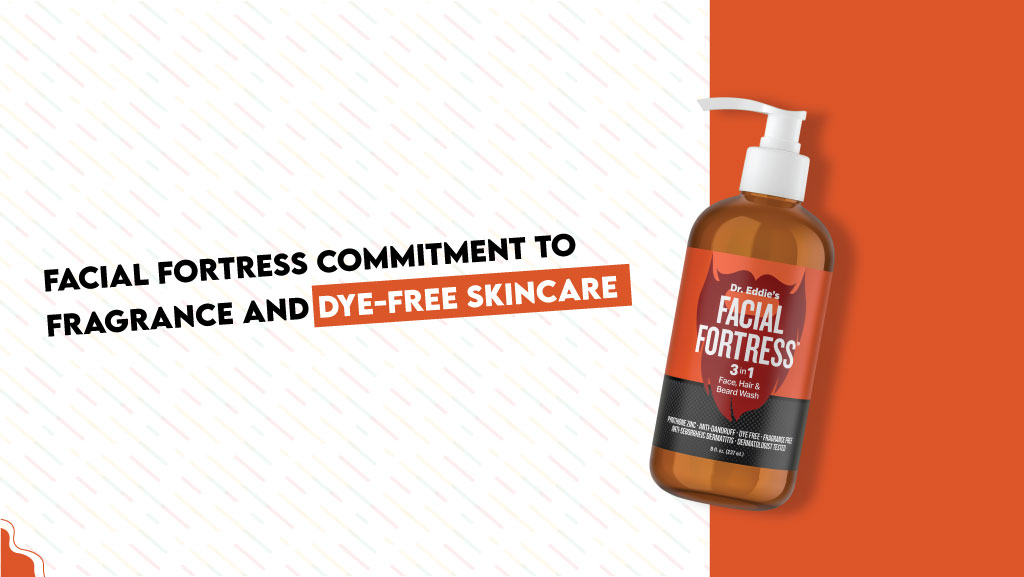
Facial Fortress 3-in-1 Medicated Wash is fragrance-free and dye-free. For dandruff or seborrheic dermatitis, its 0.95% pyrithione zinc provides the medicated function. The absence of perfume or added dyes is a separate formulation choice.3
If your main question is which cleanser to buy, go to our beard-wash surfactant and ingredient guide. For this product’s full formula and directions, see the complete ingredients and Drug Facts.