Beard Dandruff Home Remedies: What Helps, What Can Irritate
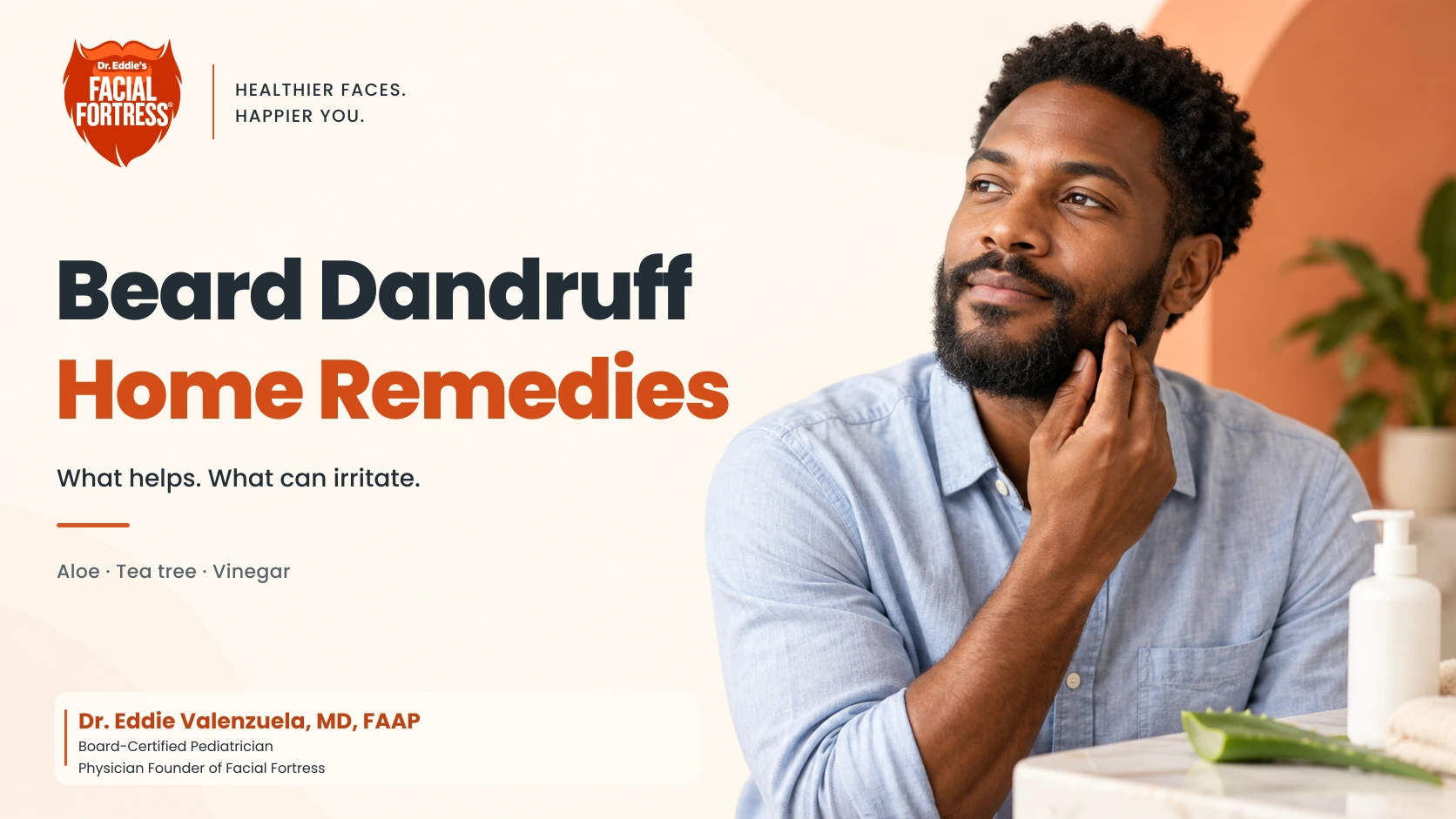
Quick answer: Gentle washing and moisturizer can help dry, flaky beard skin. Aloe and formulated tea tree shampoo have limited clinical evidence, but they are not established replacements for standard beard-dandruff treatment. Avoid vinegar, lemon juice, and abrasive scrubs on irritated skin. Persistent seborrheic dermatitis usually needs treatment directed at the condition.
Wanting a simple, gentle remedy makes sense. If your beard is itchy and your skin already feels sensitive, a familiar plant ingredient may sound more appealing than another treatment bottle.
The useful question is what that ingredient can actually do, in the formula you are using. Soothing skin, softening beard hair, and controlling seborrheic dermatitis are different jobs. A product can be helpful for one without reliably doing the others.
Start with comfortable skin care. Then judge any additional remedy by its evidence and how your skin responds, rather than how “natural” the label sounds.
Is it beard dandruff, dry skin, or a product reaction?
Beard dandruff commonly refers to seborrheic dermatitis beneath facial hair: recurring scale, itch, and inflammation. Malassezia yeast, skin oils, and the skin’s response are involved. It is not simply a dirty beard. The AAD explains what is known about the causes.
Dryness or contact dermatitis can also produce flakes. If the trouble began after a new beard oil or fragranced product, adding another botanical may make the picture harder to interpret. See dandruff versus dry skin under a beard and our guide to reactions to beard products.
Beard dandruff remedies at a glance
This is a guide to priorities, not a shopping list. You do not need to try every option.
| Option | What it may offer | Evidence or limitation | Practical choice |
|---|---|---|---|
| Gentle cleansing and fragrance-free moisturizer | Less dryness and avoidable irritation | Supportive care; a cosmetic moisturizer does not replace needed dandruff medication | Start here |
| Aloe vera | Skin comfort; possible improvement in some symptoms | One small, older seborrheic dermatitis trial studied a specific emulsion | Optional if tolerated |
| Licorice root extract | Soothing and skin-conditioning support | Some research concerns eczema and specific preparations, not a proven beard-dandruff cure | Look for it in a formulated product |
| Apple fruit extract | Skin-conditioning support | Not established as a stand-alone dandruff treatment; different from vinegar | A supporting ingredient |
| Tea tree shampoo | Possible dandruff improvement | A trial used a formulated 5% shampoo on the scalp, not undiluted oil on the beard | Evidence does not establish facial suitability |
| Coconut or other beard oils | Softer hair and, with some products, less dry-feeling skin | Scalp research cannot establish an oil as a beard-dandruff treatment | Optional grooming; judge tolerance |
| Apple cider vinegar, lemon juice, or abrasive kitchen scrubs | No established reliable treatment benefit for beard dandruff | Irritation may add to the existing problem | Skip on irritated facial skin |
The research behind these distinctions is explained below. “Not established” means that we cannot make a dependable treatment recommendation from the available evidence; it does not mean every ingredient has been proved useless.
What to try first at home
Gently wash the skin beneath the beard, rinse thoroughly, and apply a fragrance-free moisturizer if the skin feels dry. Avoid hot water, scratching, and scrubbing flakes off. These steps fit the AAD’s self-care guidance for seborrheic dermatitis.
Make sure a product reaches the skin instead of remaining on the outer beard hairs. You can part longer facial hair with your fingertips. If choosing a leave-on product feels confusing, beard oil versus moisturizer explains their different roles.
Recurring inflamed scale may need a medicated treatment alongside these comfort measures. For the full treatment approach, see how to get rid of beard dandruff.
Can aloe vera help beard dandruff?
Aloe deserves a more balanced answer than “it works” or “it cannot help.” A small randomized, placebo-controlled trial involving 44 adults reported improvement in seborrheic dermatitis with an aloe-containing emulsion. The study was published in 1999 and tested a particular preparation. Read the original aloe trial.
That is a clinical signal, but it does not establish that a fresh leaf, an after-sun gel, or every aloe moisturizer will perform the same way. It also does not establish equivalence to standard treatment for beard-area disease.
If you already tolerate a fragrance-free aloe skin-care product, it may be a reasonable comfort step. Do not treat burning or an itchy rash as something to push through: topical aloe can sometimes cause these reactions. NCCIH summarizes aloe’s safety information.
There is no need to add aloe if your current moisturizer already keeps your skin comfortable.
What about licorice root and apple fruit extract?
Licorice root: useful support, with limits to the treatment claims
Licorice-derived ingredients are used in skin care for soothing and conditioning. A small clinical trial found benefits from specific licorice gels in atopic dermatitis, also called eczema. That supports interest in the ingredient, but eczema is a different condition, and the tested gels were different from a rinse-off beard wash. Read the original licorice-gel study.
Facial Fortress contains the licorice-derived ingredient dipotassium glycyrrhizate to help soothe the appearance of redness. Its role complements the formula’s medicated active ingredient; it should not be presented as an independently proven cure for beard dandruff.
A raw licorice powder or homemade extract is also not interchangeable with a formulated cosmetic ingredient. The extraction method, concentration, and surrounding formula matter.
Apple fruit extract is different from apple cider vinegar
Pyrus Malus (Apple) Fruit Extract is a skin-conditioning ingredient in Facial Fortress. Apple cider vinegar is an acidic fermented food product. Evidence or claims about one cannot be transferred to the other.
Apple fruit extract is not established as a stand-alone treatment for seborrheic dermatitis. Its presence in a wash does not mean the product is a vinegar treatment, a peel, or a way to “detox” the skin. You can see the ingredient roles in our full formula and Drug Facts guide.
Does tea tree oil work for dandruff?
Tea tree shampoo has limited but positive clinical evidence. A 2002 randomized, single-blind trial enrolled 126 people with mild to moderate scalp dandruff. After four weeks of daily use, a 5% tea tree shampoo improved the study’s dandruff severity score by 41%, compared with 11% for placebo. Those figures describe score improvement, not the percentage of people cured. Read the original tea tree shampoo trial.
The trial tested scalp shampoo, not beard treatment, and did not compare tea tree oil with standard medicated dandruff ingredients. It cannot establish that a homemade oil mixture is effective or suitable for facial skin.
Tea tree products can cause redness and irritation, and tea tree oil should never be swallowed. NCCIH explains these safety concerns. Avoid applying undiluted essential oil to the face or mixing it into a medicated wash. For a finished product, follow its intended uses and directions.
Are coconut oil and other beard oils helpful or harmful?
Beard oils are often chosen to soften hair. Whether an oil-containing product feels helpful on your skin depends on the complete formula and your tolerance. Oil alone is not an established substitute for beard-dandruff treatment.
It would also be too simplistic to claim that all oils inevitably “feed yeast” and worsen everyone’s dandruff. A study in 140 Indian women found that coconut-oil use changed the scalp microbiome and was associated with some favorable scalp findings. That was scalp research using a particular regimen, not proof that coconut oil treats seborrheic dermatitis under a beard. Read the coconut-oil study.
You do not need to apply oil to treat flakes. If you enjoy using a beard oil for hair softness, pause it if you notice more itching, redness, or bothersome buildup. Fragrance and essential oils in the blend may be relevant too. Our fragrance-free versus unscented guide helps explain the label differences.
Can apple cider vinegar help beard dandruff?
The idea behind a vinegar rinse is that its acidity might change the skin environment. But lowering skin pH is not the same as demonstrating dandruff relief. Good controlled evidence that apple cider vinegar treats beard seborrheic dermatitis is lacking; there is no established effective dilution or schedule for that use.
A 2019 pilot study provides a caution about tolerability. Twenty-two people, half with eczema and half with healthy skin, used diluted apple cider vinegar on one forearm and water on the other for two weeks. The vinegar did not produce lasting improvement in skin-barrier measurements. Sixteen of the 22 participants reported mild side effects that improved after stopping. Read the original vinegar study.
That was an eczema and healthy-skin study, not a beard-dandruff trial. It does not prove vinegar can never help dandruff, but it gives us a reason to question the assumption that a diluted kitchen remedy is automatically gentle. With uncertain benefit and a real irritation concern, I would skip vinegar on an inflamed beard area.
What about lemon juice and abrasive scrubs?
Skip kitchen acids and rough scrubs on irritated facial skin. Stinging is not evidence that a remedy is working, and scrubbing flakes off can add irritation. Choose products intended for facial skin and stop using anything that clearly makes symptoms worse.
Where Facial Fortress fits
You can value botanical supporting ingredients while choosing a medicated active for dandruff control. Facial Fortress combines 0.95% pyrithione zinc with glycerin, panthenol, licorice-derived dipotassium glycyrrhizate, and apple fruit extract.
Pyrithione zinc provides the medicated action for flaking, scaling, and itching associated with dandruff and seborrheic dermatitis. The other ingredients support moisture, conditioning, or skin comfort. The formula is fragrance-free and uses a blend of non-soap cleansers without SLS or SLES. Mildness still depends on the complete formula and your skin’s response. See Facial Fortress ingredients and label directions.
Use it at least twice weekly or as directed by a doctor. Wet the area, massage onto the skin, and rinse; follow the label rather than adding a homemade leave-on step. Stop use and ask a doctor if the condition worsens or does not improve with regular directed use.
A wash does not replace leave-on moisturizer when your skin needs one. For more on timing, see how often to wash your hair and beard for dandruff control.
When home care is not enough
Seek an assessment if symptoms persist despite appropriate care, or if you develop painful inflammation, pus-filled bumps, spreading redness, broken hairs, or bald patches. A different diagnosis or a prescription may be needed.
If your main question is whether food or a stressful week is involved, read can stress or diet make beard dandruff worse?. Trying several topical remedies and a restrictive diet at the same time makes it harder to tell what actually helped.
Frequently asked questions
What is the best natural remedy for beard dandruff?
No natural ingredient has been established as the best treatment for beard dandruff. Begin with gentle skin care, then use appropriate treatment if seborrheic dermatitis is the cause. You do not need a collection of home remedies.
Can aloe vera replace an anti-dandruff wash?
A small study provides some encouraging evidence for a specific aloe emulsion. It does not establish aloe as an equivalent replacement for standard beard-dandruff treatment. A tolerated aloe product may be an optional comfort measure.
Is apple fruit extract the same as apple cider vinegar?
No. They are different ingredients with different properties. Apple fruit extract in a formulated wash does not turn that wash into an apple cider vinegar treatment.
Can I add tea tree oil to Facial Fortress?
Use the wash as formulated and labeled. Adding essential oil changes the product and may increase irritation; the scalp-shampoo study did not test homemade additions to Facial Fortress.
Does coconut oil always make dandruff worse?
No. That blanket claim goes beyond the evidence. However, coconut oil is not an established treatment for beard seborrheic dermatitis, and you should stop a product that makes your symptoms worse.