Beard Oil vs. Moisturizer: What Should You Put Under Your Beard?
Choosing a beard product can feel like standing in the grocery store staring at ten varieties of apples. You might not discover that Honeycrisp is your favorite until you try one. But if you decide to bake a pie, you might reach for tart Granny Smith apples instead. Your favorite hasn’t changed; what you need it for has.
Beard care can work the same way. A product that feels comfortable in humid summer weather may not be enough when colder weather leaves your skin dry. Start with what your skin needs today, then adjust the product, amount, or application as those needs change. You don’t need every option on the shelf.
Start by checking two things separately: how the hair feels and how the skin feels. A rough beard, dry skin, and stray hairs sticking in every direction can call for different adjustments.
What is the difference between beard oil and moisturizer?
Beard oil is usually an oil-based blend that softens facial hair and conditions skin. Oils can contribute to moisturizing by smoothing the skin and limiting water loss. They are useful options for some men.
A facial lotion or cream usually combines water with moisturizing ingredients. Humectants such as glycerin attract water, while other ingredients soften skin or slow moisture loss. The formula determines how a product spreads and feels; an oil is not automatically lighter than every lotion or cream. DermNet explains these moisturizing functions.
The word “beard” on a label does not tell you everything about the formula. Check its intended use and consider what you want it to accomplish.
| Product | Main job | What to check |
|---|---|---|
| Beard oil | Soften hair and add emollience to skin | Ingredients, fragrance, and whether a small amount leaves your skin comfortable |
| Facial moisturizer | Moisturize the skin | A texture and formula that suit your skin and can reach it through the beard |
| Beard conditioner | Soften and help detangle hair | Whether it rinses out or stays in, and whether it is intended for skin application |
| Beard balm | Condition hair and provide styling hold | How much hold you need and whether its texture is comfortable near your skin |
Balms commonly combine oils with waxes or butters, but formulas vary. A styling balm may help manage flyaway hairs without meeting all of your skin’s moisturizing needs.
“Beard conditioner” is also a broad category. Follow the label: a rinse-out product belongs in the washing step, while a leave-on product is used as directed afterward.
Choose for your skin first
The American Academy of Dermatology offers different starting points for different skin types. Your beard’s length affects how you reach the skin, but it should not override what that skin needs.
| Your skin | A useful starting point |
|---|---|
| Normal-to-dry, without eczema or ongoing irritation | Beard oil may suit you. A comfortable facial moisturizer is another option. |
| Dry or eczema-prone | A fragrance-free cream or ointment; adjust the application technique to get it beneath the hair. |
| Sensitive or easily irritated | A fragrance-free, noncomedogenic facial moisturizer. |
| Acne-prone | Noncomedogenic skin-care products; the AAD also identifies beard conditioner as an option. Check its intended use. |
| Dandruff-prone, with recurring flakes or itch | A fragrance-free moisturizer alongside appropriate care for the scalp or skin condition. |
These are starting points, not a shopping list. Choose for your skin’s needs and adjust based on how it feels. See supporting medical references.
Noncomedogenic means formulated to avoid clogging pores; it does not guarantee that every person’s skin will tolerate the product. Likewise, “natural” is not a guarantee of comfort. Fragrance-free products are a useful starting point for easily irritated skin.
If a cream already keeps your eczema-prone skin comfortable, a longer beard is a reason to refine your technique. It does not automatically mean you should replace that cream with beard oil.
How do you get oil or moisturizer onto the skin under your beard?
The skin needs contact with the product. Smoothing everything over the outside of a dense beard can leave most of it on the hair.
Try this approach with the product you have chosen for your skin:
- Start after washing. Rinse away cleanser, then gently pat with a clean towel, leaving the skin slightly damp.
- Put a small amount on clean fingertips. Follow the product’s amount guidance. You can add more to an area that needs it.
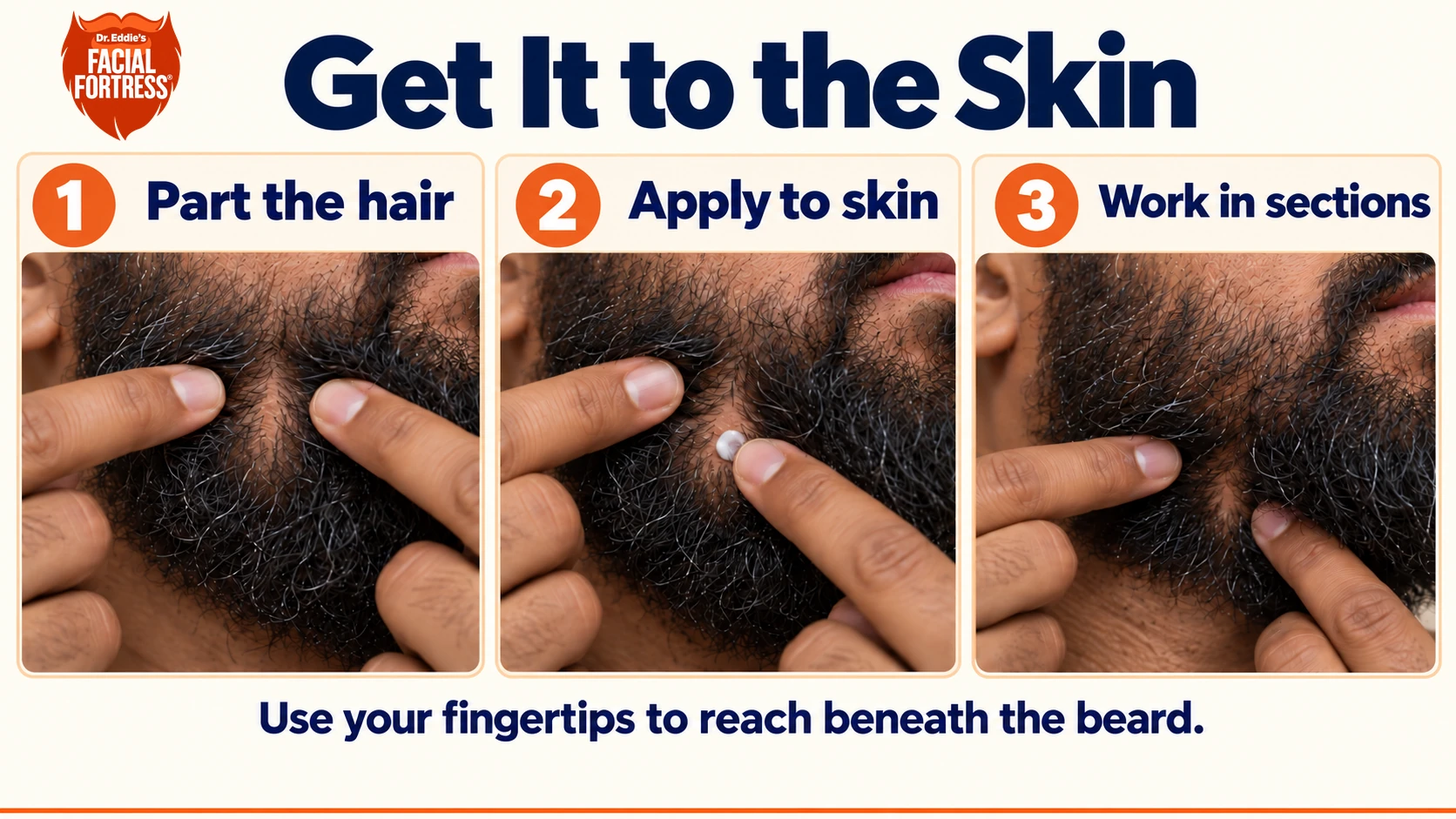
- Open a path through the hair. For a fuller beard, use your other hand to separate a small section so your fingertips can reach the skin.
- Smooth the product gently onto that skin. Work with the direction of hair growth and avoid vigorous rubbing or scratching.
- Move around the beard in sections. Give the cheeks, jawline, chin, and underside attention. Check that you reached the skin before adding more to the outside of the beard.
The NHS recommends applying emollients after washing and smoothing them in the direction of hair growth. Sectioning the beard is a practical way to carry out that skin application. NHS: How to use emollients.
Adjust the technique to your beard
| Beard length or density | How to reach the skin |
|---|---|
| Stubble | Apply directly across the skin, as you would elsewhere on your face. |
| Short beard | Place your fingertips between the hairs, including along the jaw and beneath the chin. |
| Long or dense beard | Part small sections and apply along each exposed area of skin. Work around the face instead of placing one large dollop on the outer hair. |
Beard length alone does not determine the amount your skin needs. More hair may make application harder without increasing the area of skin underneath. Check coverage with your fingertips instead of judging it by how shiny the beard looks.
If the area you struggle with is your upper lip, our guide to dry skin under your mustache takes a closer look at that spot.
Where do brushes and combs fit?
Your fingers do the work of placing product against the skin. Afterward, a comb can help distribute conditioning product through the facial hair. This follows the grooming sequence in the AAD’s healthy-beard guide.
A comb can also separate sections of a fuller beard. A brush may help smooth and shape the hair if its bristles feel comfortable. Neither is mandatory when your fingers do the job.
For tangles, work gently in small sections instead of pulling a tool through a knot. Stop if it scratches or hurts, and clean the tool according to its care instructions. Brushing harder will not make a moisturizer work better.
Do you need both beard oil and facial moisturizer?
Not automatically. Start with the product that meets your skin’s needs. If the hair also feels rough or needs styling, a small amount of an appropriate conditioner, oil, or balm may help with that separate job.
For example, someone with sensitive skin may prefer facial moisturizer underneath and a little tolerated conditioning product along the beard’s lengths. Someone whose normal-to-dry skin feels comfortable with beard oil may not need a separate cream.
If you choose to use both, place the facial moisturizer against the skin first, then assess whether the hair needs anything else. You do not have to coat every area twice. Follow individual product instructions, especially for rinse-out conditioners or prescribed skin treatments.
For the full daily sequence, including cleansing and daytime sun protection, see our simple face-and-beard skincare routine.
What if cream gets caught in your beard?
Try changing how you apply it before giving up on a product that suits your skin. Start with a small section and use your fingertips to carry the cream beneath the hair. A large dollop spread over the entire beard is harder to place precisely.
If the texture still makes application difficult, consider another formula. Lotions can spread readily over hairy areas, while richer creams or ointments can be more useful for significant dryness. DermNet compares the different textures.
For eczema-prone skin, keep the cream-or-ointment preference in mind. A different cream or more careful placement may be a better adjustment than choosing the thinnest product solely because it moves easily through the beard.
If products roll into little pills or leave the beard feeling coated, try using fewer overlapping products and check their directions. Persistent residue is a reason to reassess the amount, placement, or combination you are using.
How much should you use, and how often?
There is no single drop count or pea-sized amount that fits every face, beard, and formula. Begin with the product’s directions, place it carefully, and add a little where needed. The goal is comfortable skin and manageable hair.
A beard does not have to look greasy after application. With beard oil or conditioner, start with a small amount and add more only if needed.
Make moisturizing part of your daily care. Apply moisturizer after washing and gently patting your skin dry. If the skin beneath your beard feels dry again later, reapply moisturizer where needed. Adjust to your skin rather than following a fixed number of applications.
Your cleanser or medicated wash may have a different schedule. Our guide to how often to wash your hair and beard explains that separate decision.
What if you have beard dandruff or seborrheic dermatitis?
Beard oil may improve softness or the feel of dry skin, but a cosmetic oil does not replace treatment for seborrheic dermatitis. This condition involves interactions among skin oils, Malassezia yeast, and individual susceptibility. Borda and Wikramanayake review these factors.
There is also no good reason to assume that every product labeled “beard oil” will affect every person identically. The finished formula and your skin’s response matter. For seborrheic dermatitis, the AAD recommends gentle cleansing, thorough rinsing, and a fragrance-free moisturizer alongside appropriate treatment. AAD: Seborrheic dermatitis self-care.
If flakes persist despite moisturizing, our beard dandruff versus dry skin guide explains the overlapping clues. For treatment steps, see how to get rid of beard dandruff.
For a beard that feels greasy as well as flaky, see oily skin and beard dandruff. If itching is your main concern, our itchy-beard guide covers other possible causes, including shaving irritation and ingrown hairs.
Where Facial Fortress fits
When dandruff symptoms are part of the problem, Facial Fortress® 3-in-1 Medicated Face, Hair & Beard Wash provides a medicated cleansing option. Developed by Dr. Eddie Valenzuela with sensitive facial skin in mind, this hypoallergenic, fragrance-free wash combines dandruff care with moisturizing and conditioning ingredients.
Its 0.95% pyrithione zinc helps relieve flaking, scaling, and itching associated with dandruff and seborrheic dermatitis. Glycerin and provitamin B5 support a soft, conditioned feel, while licorice root extract helps soothe the appearance of redness. Explore the ingredients and Drug Facts.
Rinse the wash away, then apply the leave-on product that suits your skin. Cleansing and moisturizing remain separate steps.
What if a new product makes your skin uncomfortable?
Stop using a product that repeatedly burns, stings, or worsens redness or bumps. Adding more products can make it harder to identify what your skin is reacting to. Moisturizers themselves can occasionally cause irritation or other reactions. The NHS describes possible emollient side effects.
Our guide to beard irritation from seborrheic dermatitis or a product reaction explains why these problems can be confused.
Persistent skin problems, painful bumps, or hair loss deserve a dermatologist’s assessment. The AAD explains when beard problems need medical attention.
Beard oil and moisturizer FAQs
Can I use my regular face moisturizer under my beard?
Yes. If it works well on your facial skin, you do not need a separate moisturizer just because you have grown a beard. The trick is getting it past the hair. Part fuller sections and smooth it onto the skin with your fingertips, including beneath the chin.
If I buy just one product, should it be beard oil or moisturizer?
Start with what your skin needs. A fragrance-free facial moisturizer is a useful starting point for sensitive skin; dry or eczema-prone skin generally benefits from a cream or ointment. Beard oil is an option for normal-to-dry skin without ongoing irritation. If your current moisturizer already works, try applying it under your beard before buying something new.
My beard feels soft, but the skin underneath is still dry. What am I missing?
You may be conditioning the hair without reaching the skin. At your next application, part the beard and place moisturizer directly against the skin instead of smoothing it only over the outside. If dryness continues despite careful placement, reassess the formula. Persistent redness, itching, or flaking deserves a closer look.
Do I need beard oil if I already use moisturizer and beard balm?
Only if it solves a problem those products have not addressed. If your skin feels comfortable and your beard is soft and manageable, there is no need to add another layer. Check what your balm is intended to do, and add a product only for a remaining need, such as conditioning rough hair.
What if beard oil leaves me greasy or gives me bumps?
For a greasy finish alone, try less oil and fewer overlapping products. New bumps, persistent stinging, or worsening redness are a reason to stop using the suspected product rather than keep experimenting with the amount. If the problem persists, get medical advice. Our guide to beard-product reactions and seborrheic dermatitis explains why the symptoms can overlap.
Should I add more beard oil when I see flakes?
First check whether your skin feels dry and whether your moisturizer is reaching it. Flakes alone do not tell you what is causing them. Recurring flakes with itching or redness may need care beyond moisturizing; adding more oil is not a substitute for treating dandruff. See our guide to beard dandruff versus dry skin for the next steps.
Medical references
- American Academy of Dermatology: A dermatologist’s top tips for a healthy beard.
- American Academy of Dermatology: Dermatologists’ top tips for relieving dry skin.
- American Academy of Dermatology: Atopic dermatitis: Self-care.
- American Academy of Dermatology: Seborrheic dermatitis: Self-care.
- American Academy of Dermatology: DIY treatment for five common beard problems.
- NHS: Emollients.
- Guy’s and St Thomas’ NHS Foundation Trust: Emollients and how to use them.
- DermNet: Emollients and moisturisers.
- Borda LJ, Wikramanayake TC. Seborrheic Dermatitis and Dandruff: A Comprehensive Review. Journal of Clinical and Investigative Dermatology. 2015;3(2). doi:10.13188/2373-1044.1000019.