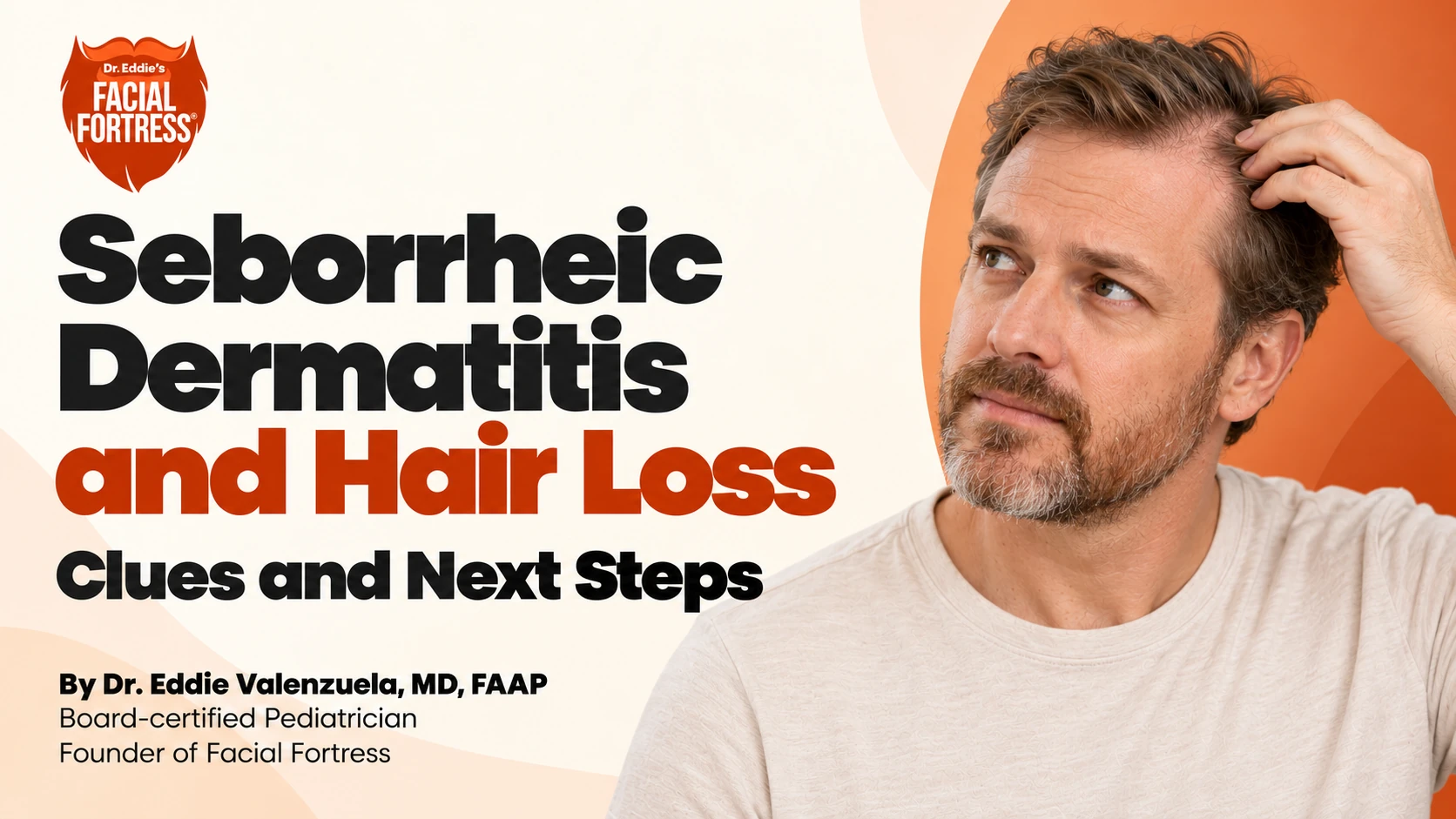
Quick answer: Hair loss is uncommon in seborrheic dermatitis, and uncomplicated dandruff is not a usual cause of permanent baldness. Severe or secondarily infected inflammation can be associated with loose hairs, while scratching can cause breakage. Progressive thinning, distinct bald patches, or shedding that continues after the skin improves should be assessed for another cause.
Seborrheic dermatitis and hair loss can occur at the same time without one fully explaining the other. An itchy, flaky scalp naturally draws attention to hairs in the shower or on a brush, but the pattern and timing of the hair change are just as important as the rash. Separating those observations helps avoid both unnecessary alarm and misplaced reassurance.
Seborrheic Dermatitis and the Inflamed Scalp
Seborrheic dermatitis is an inflammatory skin condition that can cause scaling, itch, and changes in skin color. It commonly affects the scalp and other oil-rich areas, including the eyebrows, sides of the nose, and beard. Its biology involves normal Malassezia yeast, skin oils, barrier function, and the skin’s response. The presence of yeast or visible oil alone does not explain every flare.1
Hair loss is not a defining feature. DermNet describes it as uncommon, with loose hairs sometimes found in secondarily infected, oozing patches. That is a different picture from ordinary loose dandruff on an otherwise comfortable scalp.2
Shedding, Breakage, and Changes in Density
People use “hair loss” to describe several different observations. More full-length hairs coming away suggests shedding; short snapped hairs suggest breakage; a widening part or a receding hairline describes a change in density or distribution. These clues can overlap, and none establishes the cause on its own.
Repeated scratching and pulling at attached scale can injure the skin and break hairs. Significant inflammation or a secondary infection may also accompany temporary localized shedding. Scale and sebum do not simply plug follicles and shut down new hair growth. A scalp that looks less flaky after treatment can still have a separate hair-loss condition.2
If beard hairs are loosening in distinct patches, particularly with crusting, pustules, or swelling, have the area examined. Tinea barbae is a separate fungal infection of beard-area skin and hairs and commonly requires prescription treatment. A dandruff wash is not a substitute.3
Other Causes That Can Coexist with Dandruff
Alopecia is the medical term for hair loss, not one specific diagnosis. The location, speed, and appearance of the change help a clinician decide whether it relates to inflamed skin or requires a separate explanation.
Gradual Pattern Hair Loss
Androgenetic alopecia produces progressive thinning in a characteristic distribution. In men, recession at the temples and thinning at the crown are common patterns. Seborrheic dermatitis may coexist with it, but clearing dandruff does not treat the underlying pattern hair loss. Progressive changes deserve their own assessment.4
Diffuse Shedding and Telogen Effluvium
Telogen effluvium is increased shedding of resting hairs, often beginning a few months after a trigger such as significant illness, major stress, rapid weight loss, or nutritional disruption. The delay means the event may no longer be obvious when the shedding starts. It tends to affect hair across the scalp rather than only one flaky patch.5
A recent medication change or weight-loss history can be relevant, but does not prove causation. Bring that timeline to the appointment instead of stopping prescribed treatment on your own. Our discussion of hair and beard changes during GLP-1 treatment considers that specific context.
Distinct Patches, Infection, and Scarring
Smooth, sharply defined bald patches can occur in alopecia areata. Broken hairs with scale, painful swelling, or pustules raise different possibilities, including scalp ringworm. Shiny areas, loss of visible follicular openings, or progressive painful patches can suggest a scarring process and should be assessed promptly. Photographs can help explain these patterns but cannot diagnose an individual scalp.26
Happy Cappy’s scalp-redness recognition guide includes clinical photographs of several inflammatory and infectious conditions. It provides broader context when the skin changes extend beyond ordinary dandruff.
For changes in facial-hair coverage, our patchy-beard assessment guide distinguishes a longstanding growth pattern from new hair loss.
Care for an Inflamed Scalp During Shedding
Control the skin symptoms while tracking the hair change separately. Appropriate treatment can make the scalp more comfortable and reduce scale, but that response does not prove that all shedding was caused by seborrheic dermatitis.
Medicated Care Matched to the Skin Condition
Common over-the-counter dandruff ingredients include ketoconazole, pyrithione zinc, selenium sulfide, and salicylic acid. Their functions, formulations, and directions differ. Use the selected product according to its label; prescription antifungals or anti-inflammatory medicines may be needed for persistent disease. Your hair type and scalp tolerance also affect the routine.78
The hair and beard washing-frequency guide covers schedule adjustments. Washing frequency, contact time, and the length of treatment depend on the specific product, the area being treated, and your clinician’s advice.
Gentle Handling of Hair and Scale
Massage cleanser with your fingertips, rinse thoroughly, and avoid scratching with nails or scraping attached scale. Pat dry and detangle gently. An irritated scalp may react to a product it previously tolerated, so simplify the routine if a styling product or cleanser consistently causes burning or worsening itch. Painful, oozing, or infected-looking areas need assessment rather than a more forceful brushing routine.
The Role of Facial Fortress
Facial Fortress 3-in-1 Medicated Wash contains 0.95% pyrithione zinc for scaling, flaking, redness, itching, and irritation associated with dandruff and seborrheic dermatitis. Its role here is care for those skin symptoms. It is not a hair-regrowth treatment. Follow the Drug Facts directions: use at least twice weekly for best results, or as directed by a doctor, wet thoroughly, massage onto scalp and skin, and rinse.9
Recovery and Follow-Up
When temporary shedding accompanies a reversible problem and the follicles remain intact, regrowth may occur as the underlying problem settles. There is no dependable universal “seborrheic dermatitis hair-loss recovery time.” Hair cycling takes time, and improvement in itching or scale may be noticeable before a change in apparent density.
For telogen effluvium, shedding often reduces after the trigger has resolved, but the course varies and restoration of visible fullness can take longer. Ongoing shedding should not be assigned an open-ended recovery period without reassessing the diagnosis.5
Photographs taken occasionally with similar lighting, hairstyle, and camera position can make changes easier to describe at follow-up. Record the onset of shedding, associated scalp symptoms, illness or weight changes, and the treatments used. Keep the focus on the overall pattern rather than judging recovery from one wash or one unusually full brush.
Hair Changes That Need Medical Evaluation
Arrange an examination for sudden or progressive loss, distinct bald patches, a receding hairline or thinning crown, or shedding that continues after scalp symptoms improve. Seek prompt care for pain, pus, drainage, significant swelling, broken hairs in scaly patches, or possible scarring. These findings may require treatment beyond dandruff care.
A clinician may examine the scalp and hair shafts closely and, depending on the pattern, consider fungal testing, selected blood tests, or a biopsy. The aim is to identify what is happening to both the skin and the hair. A calmer scalp is worthwhile in its own right; persistent hair loss still deserves an explanation.
Medical References
- DermNet. Seborrhoeic dermatitis.
- DermNet. Diagnosis of scalp rashes.
- DermNet. Tinea barbae.
- DermNet. Male pattern hair loss.
- DermNet. Telogen effluvium.
- American Academy of Dermatology. Alopecia areata: Signs and symptoms.
- American Academy of Dermatology. Seborrheic dermatitis: Diagnosis and treatment.
- American Academy of Dermatology. How to treat dandruff.
- DailyMed. Facial Fortress pyrithione zinc shampoo: Drug Facts.