Quick answer: A patchy beard may be your natural growth pattern or a new loss of hair. For stable patchiness, a suitable length, deliberate shaping, and gentle care can improve appearance. New smooth bald patches, rapid shedding, broken hairs, or inflamed skin need an assessment. Grooming and dandruff washes do not create new follicles.
A patchy beard has areas that are thinner or bare compared with the surrounding facial hair. The most useful first distinction is whether those areas have always looked similar or whether hair has recently disappeared.
That distinction changes the next step. A comfortable beard with longstanding uneven coverage may simply need a style that works with its pattern. A new gap deserves attention before you try to hide it or add a growth product. For the evidence on increasing growth overall, see our beard-growth guide.
Patchy Beard Growth and New Hair Loss
Compare photographs taken at a similar beard length, angle, and light. A few longer hairs can cover a gap, while a close trim can make the same area look much more obvious. These appearance changes do not necessarily mean the follicles have changed.
Look at the skin as well as the hair. Smooth new bald patches, redness, scale, pustules, or hairs breaking near the skin are useful clues to bring to a clinician. They cannot reliably be sorted out by choosing whichever online photograph looks closest.2, 3
| Pattern | Useful next step |
|---|---|
| Stable thin areas with comfortable skin | Judge your natural coverage at a consistent length and choose a style around it. |
| A new smooth round or oval bald patch | Arrange an examination for alopecia areata or another cause of hair loss. |
| Inflamed patches, crusts, pustules, or broken hairs | Have the skin assessed for infection or another inflammatory condition. |
| More widespread new shedding | Review its timing, recent illness, weight changes, medicines, and food intake with a clinician. |
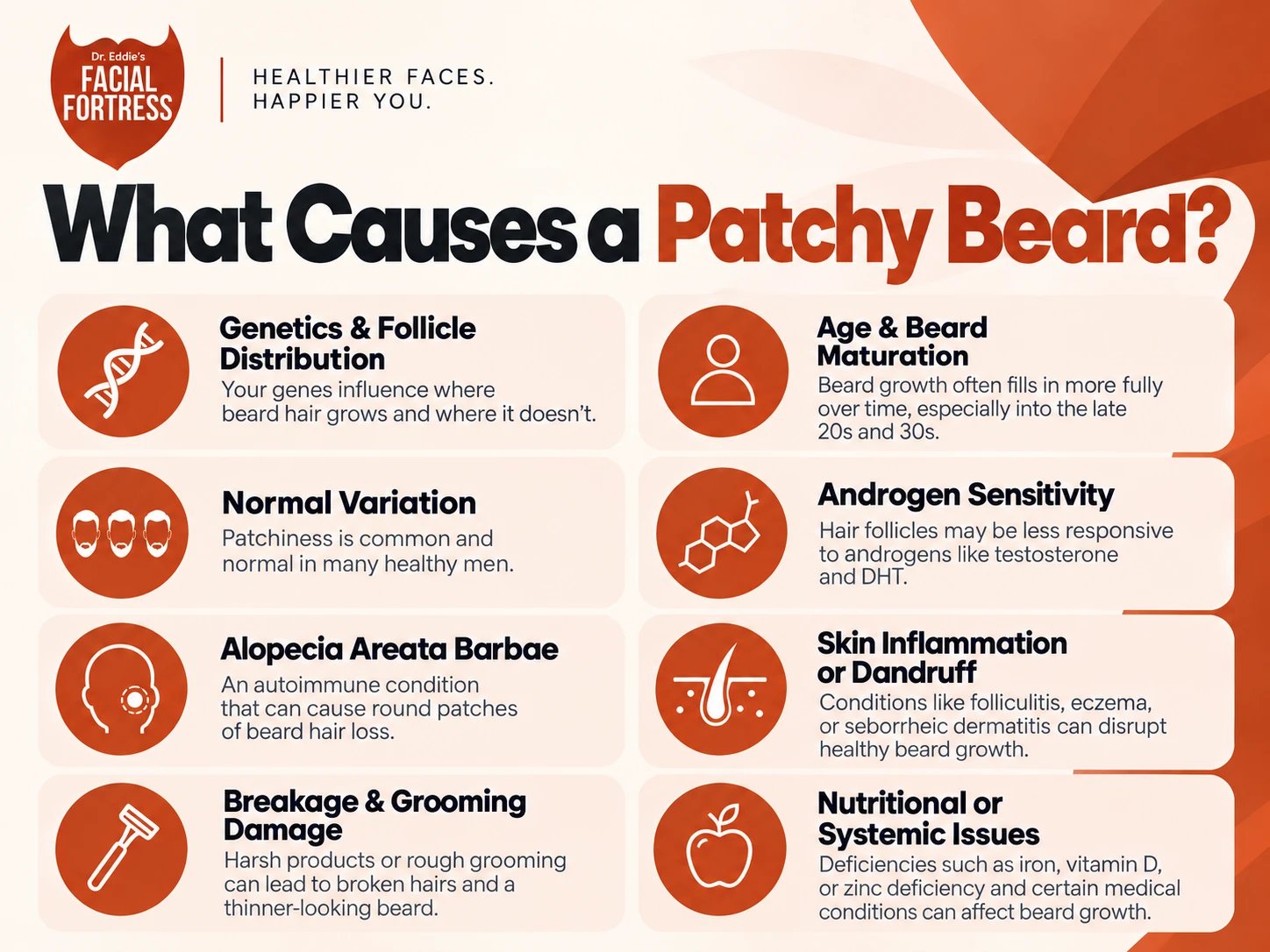
Causes of a Patchy Beard
Genetics, Age, and Hormone Response
Genetics helps determine your facial-hair pattern and how follicles respond to androgens such as testosterone. Beards can continue to change through young adulthood, but there is no birthday by which every sparse area should fill in. A relative’s dense beard also does not promise that yours will follow exactly the same pattern.1
A patchy beard alone does not diagnose low testosterone. If reduced facial hair comes with other changes, such as reduced libido or loss of muscle, a clinician can assess the whole picture. Diagnosing testosterone deficiency requires appropriate symptoms and blood testing, rather than judging beard density alone.4
Alopecia Areata and Beard Infection
Alopecia areata is an immune-mediated hair-loss condition that can affect the beard. It often starts as a sudden round or oval smooth patch, although its pattern can vary. Treatment depends on an examination and the extent of disease; a beard-growth cosmetic is not a substitute for that assessment.2
Tinea barbae is a fungal infection of the beard area. It can cause inflamed lumps, pustules, crusting, and affected hairs that loosen or break. A clinician may examine hair or skin samples to confirm the diagnosis. Oral antifungal medicine is often needed, so an ordinary beard wash should not be relied on to clear it.3
Inflammation, Breakage, and Grooming Damage
Skin inflammation and repeated scratching can change how a beard looks, while rough drying, forceful brushing, or high heat can damage existing hair. Broken hairs are different from follicles that never produced much visible hair. Gentle care is useful for both comfort and appearance, but persistent inflammation deserves its own diagnosis.5 Our itchy-beard guide explains the skin clues that help distinguish common causes of itching.
If recurring flakes accompany the change, our seborrheic dermatitis and hair-loss guide explains the possible connection and why it should not be assumed to explain every bald patch.
Shedding After Illness, Weight Change, or Nutritional Problems
Significant illness, weight loss, restrictive eating, and some medicines can contribute to shedding. Telogen effluvium is usually discussed as diffuse scalp shedding, although body hair can be affected. This is a different question from a stable, lifelong gap in beard coverage.6
Testing and supplements should follow a reason to suspect a deficiency. Extra biotin has little supporting evidence for hair growth in people without a deficiency and can interfere with some laboratory tests.7 If changes began during weight-loss treatment, see the GLP-1 medications and beard-changes article.
Realistic Options for Patchy Growth
The goal may be better appearance, less breakage, relief of a skin condition, or treatment of true hair loss. Decide which problem you are trying to solve before comparing products. An oil that makes hair softer can be useful without changing its growth rate.
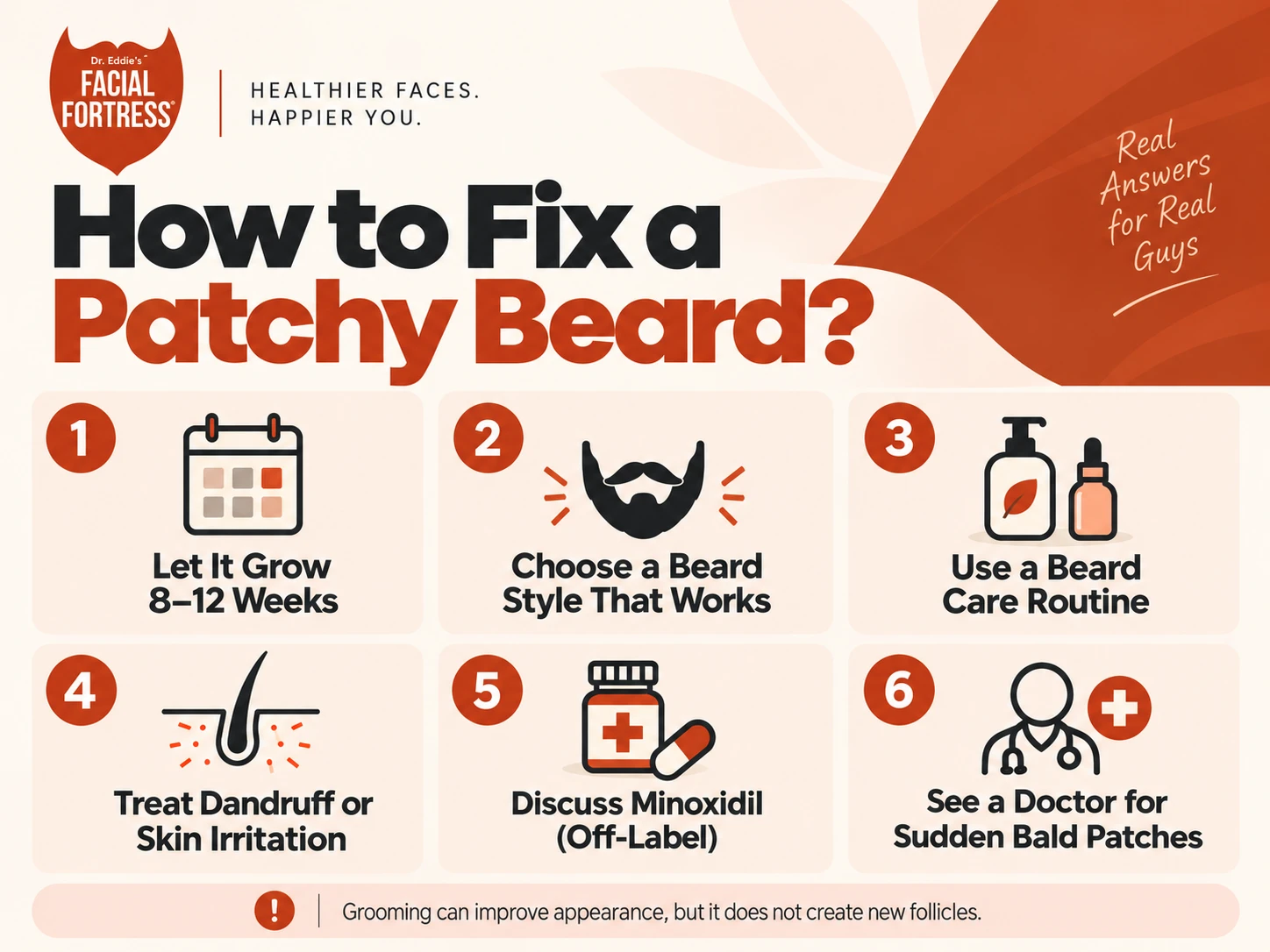
Topical minoxidil has some clinical evidence for facial-hair enhancement, but beard use is off-label and results and tolerance vary. It can irritate skin and has other potential adverse effects. Discuss it with a clinician rather than treating a newly bare patch on your own. Our minoxidil evidence discussion covers the studies and limitations.8
Procedures also need a clear diagnosis and realistic expectations. PRP injections are not an established answer for every patchy beard; transplantation moves follicles into selected areas and has surgical risks. Neither should be a shortcut around assessing new hair loss. Evidence for peptide and GHK-Cu beard-growth claims is a separate, limited discussion.
Care Based on the Cause of Patchiness
A Grow-Out Period for Stable Patchiness
If the pattern is longstanding and the skin feels well, letting your beard grow for roughly eight to twelve weeks can be a useful styling experiment. Longer neighboring hairs may cover some gaps and reveal which parts grow most densely. This is not a medical timetable or a promise that new follicles will appear.
Take a few comparable photographs during that period. If extra length only makes the difference between dense and sparse areas more obvious, a shorter style may suit you better. You do not need to keep growing a beard you dislike to prove that you gave it enough time.
Gentle Care for the Skin and Existing Hair
Wash your face and beard gently with a cleanser suited to your skin, rinse well, and use a moisturizer if the skin feels dry. Work products through to the skin beneath the hair instead of coating only the beard’s surface. The American Academy of Dermatology recommends daily gentle face-and-beard cleansing; a medicated wash has its own separate instructions.5
Pat dry, detangle gently, and reduce heat or forceful brushing if hairs are breaking. Brushing can arrange existing hairs in a useful direction, but it does not train follicles to grow into empty areas. Our face-and-beard skincare routine and oil-versus-moisturizer guide explain product choices.
Care for an Identified Skin Condition
Stop a new product that repeatedly burns or worsens a rash. Recurring scale, eczema, infection, and alopecia need different approaches, so persistent symptoms are a reason to seek a diagnosis. Treating the skin can improve comfort and reduce avoidable scratching; it does not guarantee that every sparse area will fill in.
Styling a Patchy Beard
A deliberate outline can make uneven coverage look like a chosen style. Start with the areas where your beard is naturally strongest, then choose a length that keeps the contrast between thick and thin areas comfortable for you. A barber can help you compare options before taking off more length than intended.
Length, Direction, and Temporary Coverage
Short, even stubble can reduce the contrast between dense and sparse areas. Alternatively, slightly longer neighboring hairs may cover a small gap. Comb those hairs gently into place, and use a small amount of tolerated balm if you want light hold. Avoid a tight comb-over that pulls on the hair or irritates the skin.
Beard fibers or cosmetic pencils can temporarily reduce contrast with the skin. They do not treat hair loss or create follicles. Choose a product intended for the area, follow its directions, wash it off as directed, and stop if it irritates your skin.
Styles That Work With Different Growth Patterns
- Even stubble: a practical option when coverage is uneven across several areas.
- Goatee: emphasizes stronger growth around the chin and mouth when the cheeks are sparse.
- Van Dyke: separates the mustache and chin beard, so a missing connection can be part of the style.
- Chinstrap: follows stronger jawline growth while keeping sparse cheeks clear.
- Mutton chops: emphasize sideburn and cheek growth when chin coverage is less dense.
- Chin curtain or Brett-style beard: can suit stronger jaw and chin coverage without relying on a full mustache.
Use the pattern as a starting point, not a rule about what your face should look like. A style you can maintain comfortably is a better result than constantly trying to force your beard into someone else’s shape.
Dandruff Care When Patchiness Is Also Present
Facial Fortress Medicated 3-in-1 Face, Hair & Beard Wash contains 0.95% pyrithione zinc for flaking, scaling, and itching associated with dandruff and seborrheic dermatitis. That is its role when dandruff accompanies patchiness; it is not a beard-growth treatment.9
Follow the label for use, and see the beard-dandruff guide for recognition and the broader care plan. A new bald patch, pustules, or scarring needs an examination even if there are also flakes.
Realistic Expectations and Next Steps
For stable patchiness, choose a comfortable routine and a style that suits your coverage. For a new change, bring comparable photographs and a timeline to your clinician. Mention recent illness, weight changes, medicines, supplements, and new grooming products rather than assuming one of them is responsible.
Arrange an assessment for new smooth bald patches, ongoing shedding, painful or crusted areas, pustules, or skin that appears scarred. These findings deserve a diagnosis before a growth experiment. The aim is to take care of a change that matters while letting a healthy, naturally uneven beard be its own normal pattern.
Medical References
- Cleveland Clinic. Beard development, genetics, and age.
- American Academy of Dermatology. Alopecia areata: Signs and symptoms.
- DermNet. Tinea barbae.
- Endocrine Society. Hypogonadism in Men.
- American Academy of Dermatology. A dermatologist’s top tips for a healthy beard.
- DermNet. Telogen effluvium.
- National Institutes of Health. Biotin fact sheet for consumers.
- Ingprasert S et al. Minoxidil 3% lotion for beard enhancement: Randomized trial.
- DailyMed. Facial Fortress pyrithione zinc shampoo: Drug Facts.