
Quick answer: Genetics, age and the way follicles respond to hormones shape beard growth. Adequate nutrition and comfortable skin care support normal growth, but shaving, beard oil and extra supplements do not reliably make it faster. Topical minoxidil has some direct facial-hair evidence; beard use is off-label in the United States and needs an informed discussion with a clinician.
Growing a beard involves several different goals. You may want more length, thicker-looking hairs, or better coverage on your cheeks. A product that softens the hair can improve its appearance without changing its growth rate. Keeping those outcomes separate makes beard-growth claims much easier to judge.
This guide explains normal facial-hair development and the evidence behind common ways of trying to change it. If your main concern is uneven coverage or a new bare patch, the patchy-beard guide covers that assessment and styling choices in more detail.
Factors That Shape Beard Growth
Genetics and Age
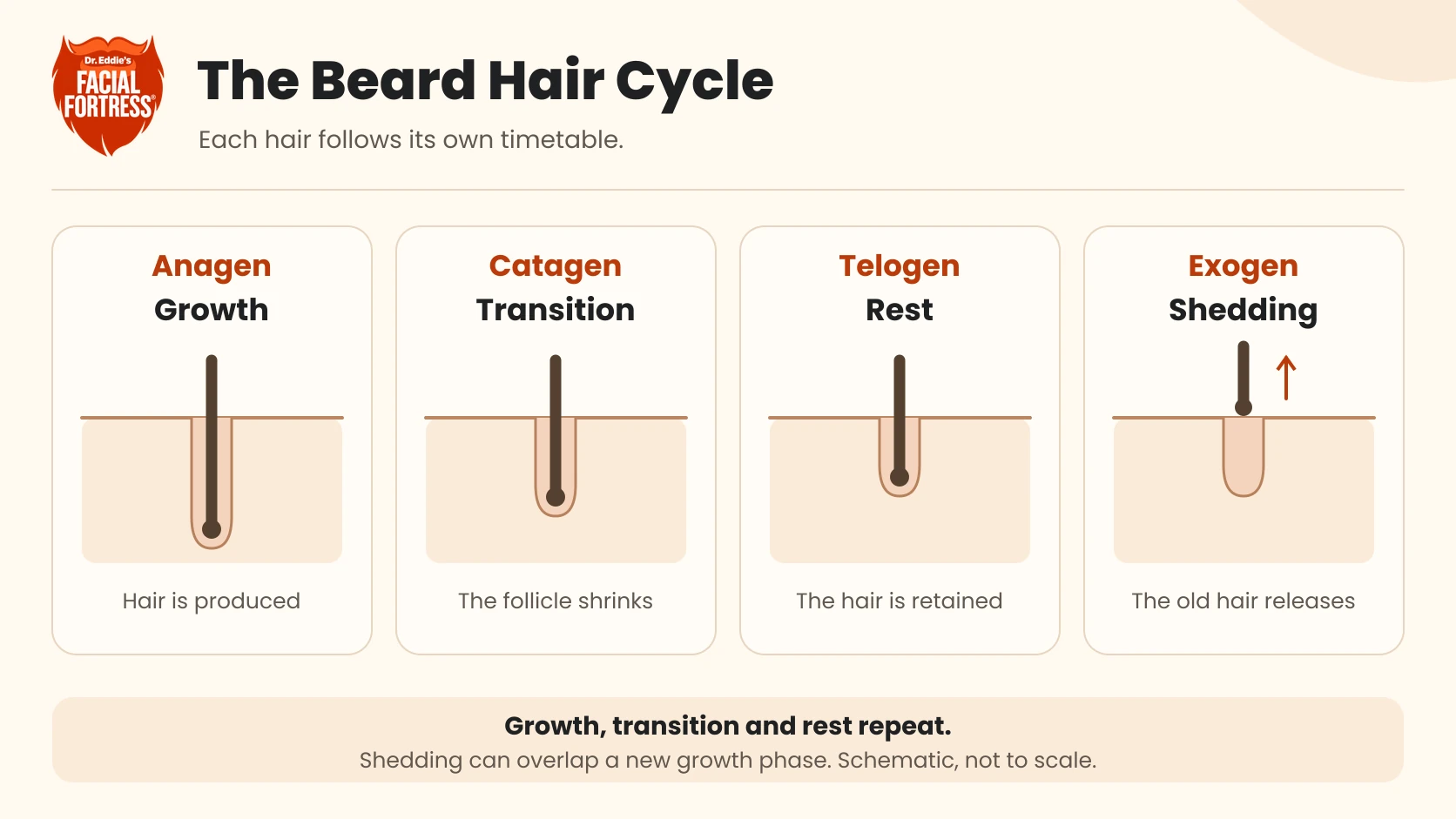
Your inherited growth pattern influences where facial hair develops, how dense it appears and how coarse the hairs become. Facial hair often continues developing through the late teens and twenties, so an early beard is not necessarily its final pattern. Two people of the same age can have very different coverage without either having a medical problem.1
Length also changes appearance. As neighboring hairs grow, they can cover areas that looked sparse during the stubble stage. Giving a comfortable beard time to grow is a reasonable grooming experiment, but it is not a promise that every gap will eventually fill in.
Androgens and Follicle Response
Testosterone and dihydrotestosterone, usually shortened to DHT, help facial hairs develop into coarser terminal hairs. The response of the follicles matters as well as the amount of hormone circulating in the body. Research on beard follicles helps explain why facial and scalp hair can respond differently to androgens.23
A sparse beard alone does not diagnose low testosterone. Taking testosterone or a “testosterone booster” simply to change an otherwise normal beard is not an appropriate shortcut. When limited facial hair accompanies symptoms such as reduced libido, loss of body hair or incomplete puberty, a clinician can decide whether hormone testing is warranted.
The Beard-Hair Growth Cycle
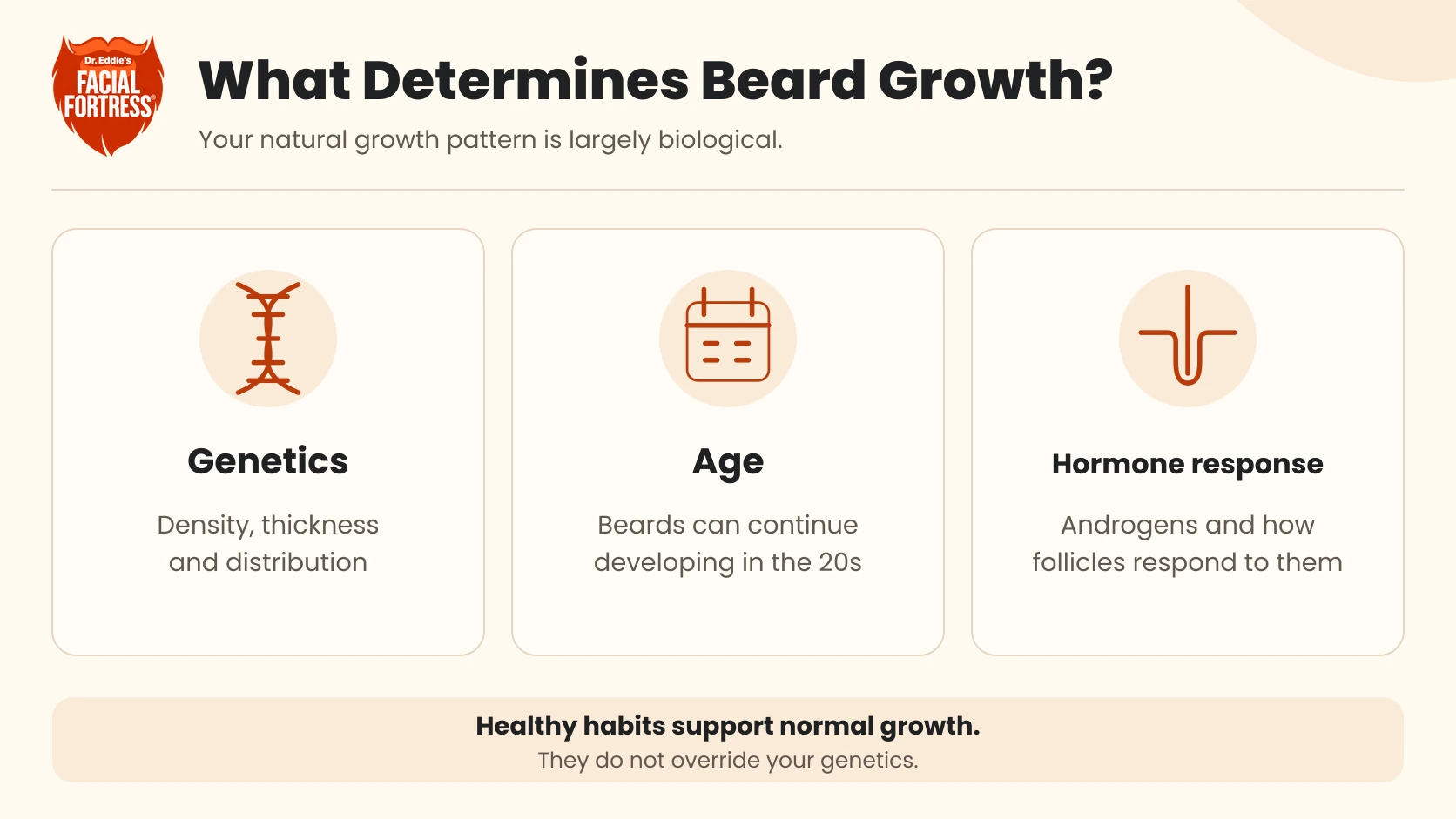
Each beard follicle moves through periods of active growth, transition and rest. A hair eventually sheds and another grows from the same functioning follicle. These cycles are not synchronized, which is why ordinary shedding does not leave the whole beard bare at once.4
A published review describes an average beard growth rate of about 10 millimeters, roughly four-tenths of an inch, per month. This is a broad estimate, not a deadline or a target every hair should meet. Growth rate, hair thickness, curl and the length of the active-growth phase all affect the beard you see in the mirror.4
Supporting Normal Beard Growth
Nutrition and Supplements
Adequate food and protein support normal hair production. A significant nutritional deficiency can interfere with hair health, but eating extra amounts of a particular food does not establish a way to accelerate an otherwise normal beard. A varied diet is a more useful starting point than a list of supposed beard-growth superfoods.
Iron, zinc, biotin and other nutrients are often marketed as hair boosters. Supplementation is most useful when a deficiency or another medical reason has been identified. Taking more than you need may create problems, and excessive amounts of some nutrients can contribute to hair loss. If dietary restriction, illness or unexplained shedding raises concern, ask a clinician about evaluation before assembling a supplement routine.56
Sleep, Exercise and Stress
Sleep deserves attention for your overall health. One small study of ten young men found reduced beard-hair growth after 48 hours without sleep. That extreme experiment does not show that sleeping extra hours beyond your needs will speed normal beard growth, but it is a useful reminder that hair production happens within the rest of the body.7
Exercise and manageable stress habits also support health and well-being. Their benefits do not depend on producing a fuller beard. There is much less direct evidence that a particular workout, breathing exercise or relaxation routine increases normal facial-hair growth, so set goals around how you feel and function rather than a promised number of new whiskers.
Skin Care and Dandruff
Gentle cleansing, moisturizer where needed and careful grooming can make growing a beard more comfortable. Work products through the hair to the skin, rinse thoroughly and avoid repeated pulling or vigorous brushing. These measures help with dryness and breakage; ordinary washing does not create new follicles. The face-and-beard skincare routine explains the daily steps.8
Recurring flakes and inflammation deserve treatment for their cause. The beard-dandruff guide covers seborrheic dermatitis and maintenance care. Facial Fortress is one medicated wash option: its 0.95% pyrithione zinc helps relieve flaking, scaling and itching associated with dandruff and seborrheic dermatitis. Glycerin and panthenol support moisture and conditioning in the fragrance-free, dye-free formula. Its role is dandruff care, and its Drug Facts provide the directions; it is not a beard-growth medicine.9
Minoxidil for Beard Growth
Direct Facial-Hair Evidence
Topical minoxidil is one of the few widely discussed approaches with direct facial-hair trial evidence. A small randomized, placebo-controlled study published in 2016 evaluated 3% minoxidil for beard enhancement and reported improvement compared with placebo.10
A 2026 randomized trial also studied 3% topical minoxidil in 69 transgender men receiving stable gender-affirming hormone therapy and reported a facial-hair benefit. That treatment context matters: a result in people receiving hormone therapy should not be assumed to predict exactly the same outcome for every person seeking a fuller beard.11
These studies support a discussion of potential benefit, but they do not establish that every strength, combination or at-home routine is equally effective. They also do not make a topical product a substitute for diagnosing new hair loss.
Facial Minoxidil Use Is Off-Label
U.S. over-the-counter minoxidil products are labeled for scalp hair regrowth. The Drug Facts direct application to the scalp and warn against use on other body areas. Applying it to a beard therefore falls outside that labeled use.12
A clinician can discuss whether it is suitable, what outcome is realistic and which adverse effects or medical conditions matter for you. Skin irritation and unwanted hair growth are among the concerns. Seek medical advice for symptoms such as chest pain, rapid heartbeat, faintness or swelling. Do not use a stronger concentration, add microneedling or change the route simply because a social-media routine promises a faster result.12
Grooming and Beard-Growth Claims
Shaving and Beard Oil
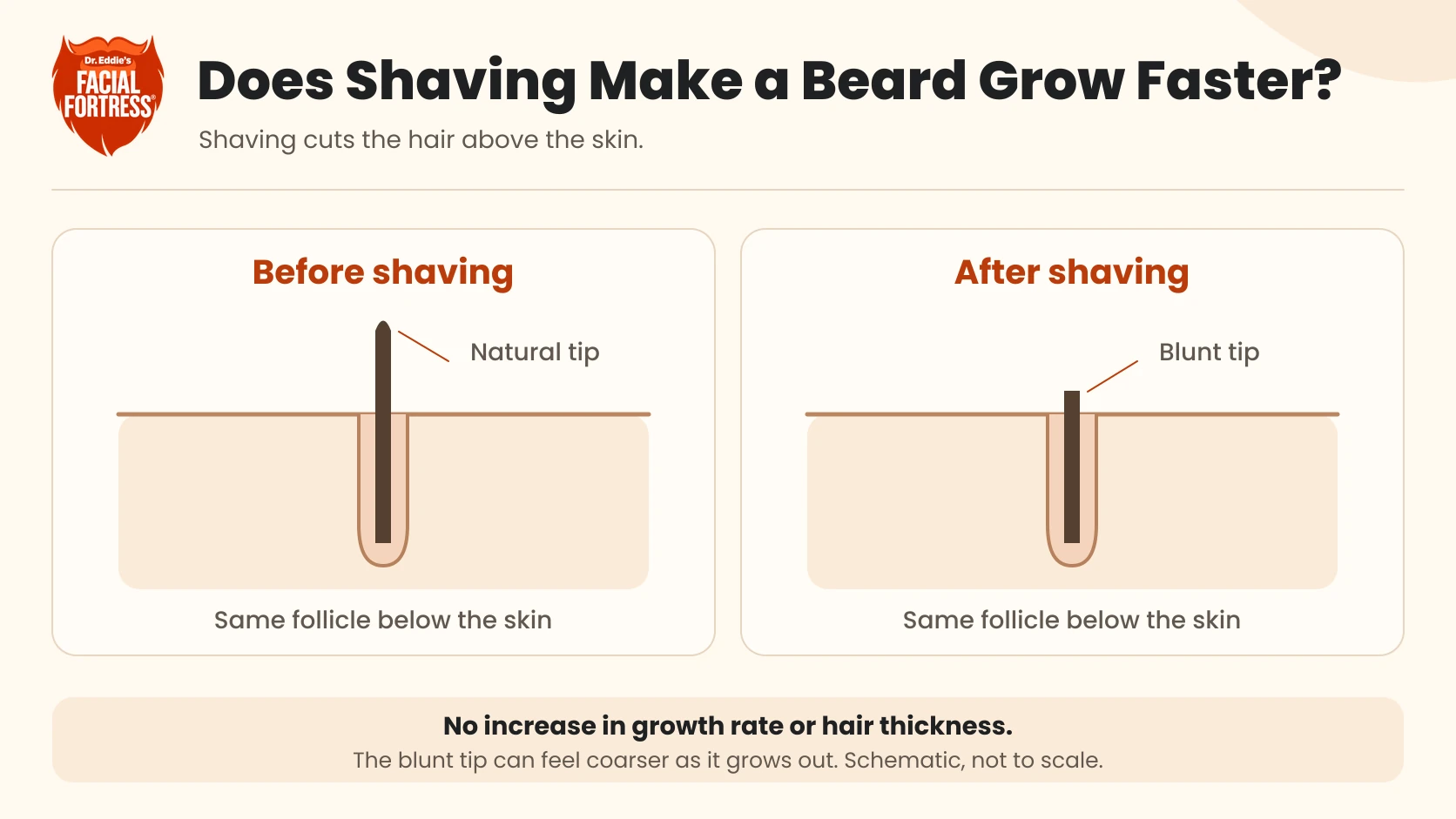
Shaving cuts the hair above the skin. It does not change the follicle’s growth rate or the diameter of the hair it produces. The blunt tip of new stubble can feel coarser and look more noticeable, which helps explain why the myth persists.13
Beard oil can soften hair and improve its appearance when the formula suits your skin. Those are grooming benefits, not evidence that oil creates follicles or accelerates growth. The beard oil and moisturizer comparison explains which product serves which need.
Microneedling and Peptides
Research on treating scalp hair loss does not automatically establish a benefit for a normal beard. At-home microneedling can injure skin and carries risks such as infection, pigment changes and scarring. It should not be presented as an established beard-growth routine simply because a roller is easy to buy.14
Peptide claims need the same attention to the exact product, route and outcome. Laboratory findings about a copper peptide do not by themselves show that a serum fills in facial hair. Our review of GHK-Cu and beard-growth evidence examines those studies and their limits.
Hydration and Forceful Grooming
Drink enough for your health and circumstances, but extra water has not been established as a beard-growth accelerator. Likewise, aggressive brushing, scraping or massage does not turn a naturally sparse area into a dense one. A routine that leaves skin sore or hairs breaking is moving away from the goal of a comfortable, healthy-looking beard.
Beard Changes That Need Medical Assessment
A beard that has always been sparse is different from hair that has newly disappeared. Have sudden smooth bald patches, rapid shedding, broken hairs, pain, pustules or scarring assessed. Alopecia areata can affect the beard, and inflammatory or infectious conditions can require their own treatment.15
If flaking and inflammation accompany shedding, the seborrheic dermatitis and hair-loss guide explains the connection and its limits. Changes during weight-loss treatment are covered in the GLP-1 medications and beard-changes article.
For a stable, comfortable beard, time and a style that suits your growth pattern are often the most useful next steps. If you are considering treatment, define the change you want and discuss the evidence for that specific outcome. A realistic plan is easier to judge than a promise to “grow a beard faster.”
Medical References
- Cleveland Clinic. Beard development, genetics and age.
- Inui S, Itami S. Androgen actions on the human hair follicle.
- Thornton MJ et al. Testosterone metabolism in beard and scalp follicles.
- Review of beard-hair biology.
- American Academy of Dermatology. Hair-loss causes.
- American Academy of Dermatology. Hair-loss care and supplements.
- Gottesmann C, Hamon JF. Sleep deprivation decreases beard-hair growth.
- American Academy of Dermatology. A dermatologist’s top tips for a healthy beard.
- DailyMed. Facial Fortress pyrithione zinc shampoo: Drug Facts.
- Ingprasert S et al. Minoxidil 3% lotion for beard enhancement: Randomized trial.
- Topical 3% minoxidil for facial-hair enhancement in transgender men: Randomized trial, 2026.
- DailyMed. Minoxidil topical solution: Drug Facts.
- Mayo Clinic. Shaving and hair growth.
- FDA. Microneedling devices: Uses, risks and safety.
- American Academy of Dermatology. Alopecia areata: Signs and symptoms.