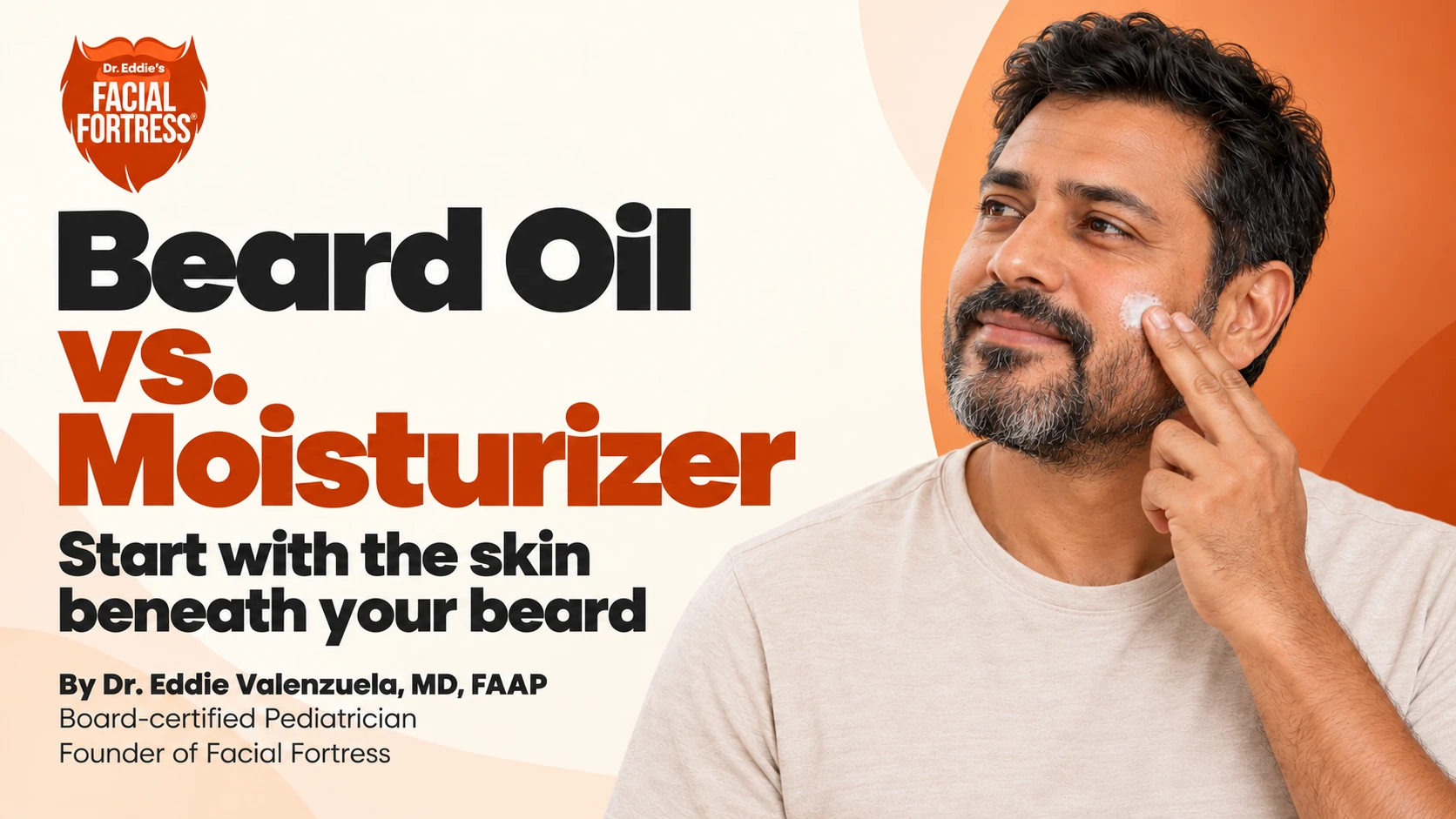
Quick answer: Beard oil conditions facial hair and skin; a facial lotion or cream usually combines water with moisturizing ingredients. Beard oil may suit normal-to-dry skin; a fragrance-free facial moisturizer can suit sensitive skin, while dry or eczema-prone skin often benefits from a cream or ointment. Work the product through the hair to the skin. Add conditioner or balm when the hair needs softening, detangling, or hold.
Beard products serve three different needs: moisturizing the skin, conditioning the hair and holding a style. A rough beard and dry skin underneath may occur together, but coating the hair does not necessarily take care of both.
Start with what your skin needs today, then adjust the texture, amount or placement as those needs change. A product that feels comfortable in humid summer weather may need a different application when colder weather leaves your skin dry. You do not need every option on the shelf.
Check the hair and the skin separately. That makes it easier to choose one useful product, then add another only when it has a different job.
Beard Oil and Moisturizer Have Different Roles
Beard oil is usually an oil-based blend that softens facial hair and conditions skin. Oils can contribute to moisturizing by smoothing the skin and limiting water loss. They are useful options for some men.
A facial lotion or cream usually combines water with moisturizing ingredients. Humectants such as glycerin attract water, while other ingredients soften skin or slow moisture loss. The formula determines how a product spreads and feels; an oil is not automatically lighter than every lotion or cream.8
The word “beard” on a label does not tell you everything about the formula. Check its intended use and consider what you want it to accomplish.
- Beard oil: Softens hair and adds emollience to skin. Check the ingredients, fragrance, and whether a small amount leaves your skin comfortable.
- Facial moisturizer: Moisturizes the skin. Choose a texture and formula that suit your skin and can reach it through the beard.
- Beard conditioner: Softens hair and helps detangle it. Check whether it rinses out or stays in, and whether it is intended for skin application.
- Beard balm: Conditions hair and provides styling hold. Consider how much hold you need and whether its texture is comfortable near your skin.
Balms commonly combine oils with waxes or butters, but formulas vary. A styling balm may help manage flyaway hairs without meeting all of your skin’s moisturizing needs.
“Beard conditioner” is also a broad category. Follow the label: a rinse-out product belongs in the washing step, while a leave-on product is used as directed afterward.
Choosing for Your Skin
The American Academy of Dermatology offers different starting points for different skin types. Your beard’s length affects how you reach the skin, but it should not override what that skin needs.
| Your skin | A useful starting point |
|---|---|
| Normal-to-dry, without eczema or ongoing irritation | Beard oil may suit you. A comfortable facial moisturizer is another option. |
| Dry or eczema-prone | A fragrance-free cream or ointment; adjust the application technique to get it beneath the hair. |
| Sensitive or easily irritated | A fragrance-free, noncomedogenic facial moisturizer. |
| Acne-prone | Noncomedogenic skin-care products; the AAD also identifies beard conditioner as an option. Check its intended use. |
| Dandruff-prone, with recurring flakes or itch | A fragrance-free moisturizer alongside appropriate care for the scalp or skin condition. |
These are starting points, not a shopping list. Choose for your skin’s needs and adjust based on how it feels. 1, 2, 3
Noncomedogenic means formulated to avoid clogging pores; it does not guarantee that every person’s skin will tolerate the product. Likewise, “natural” is not a guarantee of comfort. Fragrance-free products are a useful starting point for easily irritated skin.
If a cream already keeps your eczema-prone skin comfortable, a longer beard is a reason to refine your technique. It does not automatically mean you should replace that cream with beard oil.
One option for dry, sensitive skin is Dr. Eddie’s Dermal Defense Moisturizing Cream for Face & Body. It combines glycerin and petrolatum in a fragrance-free, fast-absorbing cream. Use it on dry facial skin and beneath the beard, then on dry hands, arms or legs as needed. Choosing a face-and-body cream lets the same moisturizer serve the skin beyond your beard.
Applying Products to the Skin Under a Beard
Reaching the skin beneath your beard
Watch how to part beard hair, work cleanser onto the skin, rinse, and apply moisturizer if needed.
Read the video transcript
0:00–0:04 · Reach the skin beneath your beard. Washing, with optional moisturizing.
0:04–0:10 · Wet right through. Use lukewarm water. Wet the beard down to the skin.
0:10–0:19 · Make a small part. Separate the hair with one hand. Reach the exposed skin with your fingertips.
0:19–0:27 · Massage at the roots. Work cleanser gently onto the skin. Use finger pads, not nails. Repeat along the jaw and under the chin.
0:27–0:33 · Rinse thoroughly. Move the hair aside so water reaches the skin and carries the cleanser away.
0:33–0:38 · Pat gently. Use a clean towel. If moisturizing, leave the skin slightly damp.
0:38–0:48 · Moisturize if needed. If skin feels comfortable after washing, you may not need moisturizing cream. If skin feels dry or tight, part the hair. Smooth fragrance-free moisturizer directly onto the skin.
0:48–0:56 · Follow the treatment schedule. For best results, use at least twice weekly or as directed by a doctor.
0:56–1:00 · Part. Reach. Repeat. Technique and product directions at facialfortress.com
Download the transcript as a PDF
Read the complete Facial Fortress directions and Drug Facts.
Shop Facial Fortress
Medicated 3-in-1 Face, Hair & Beard Wash
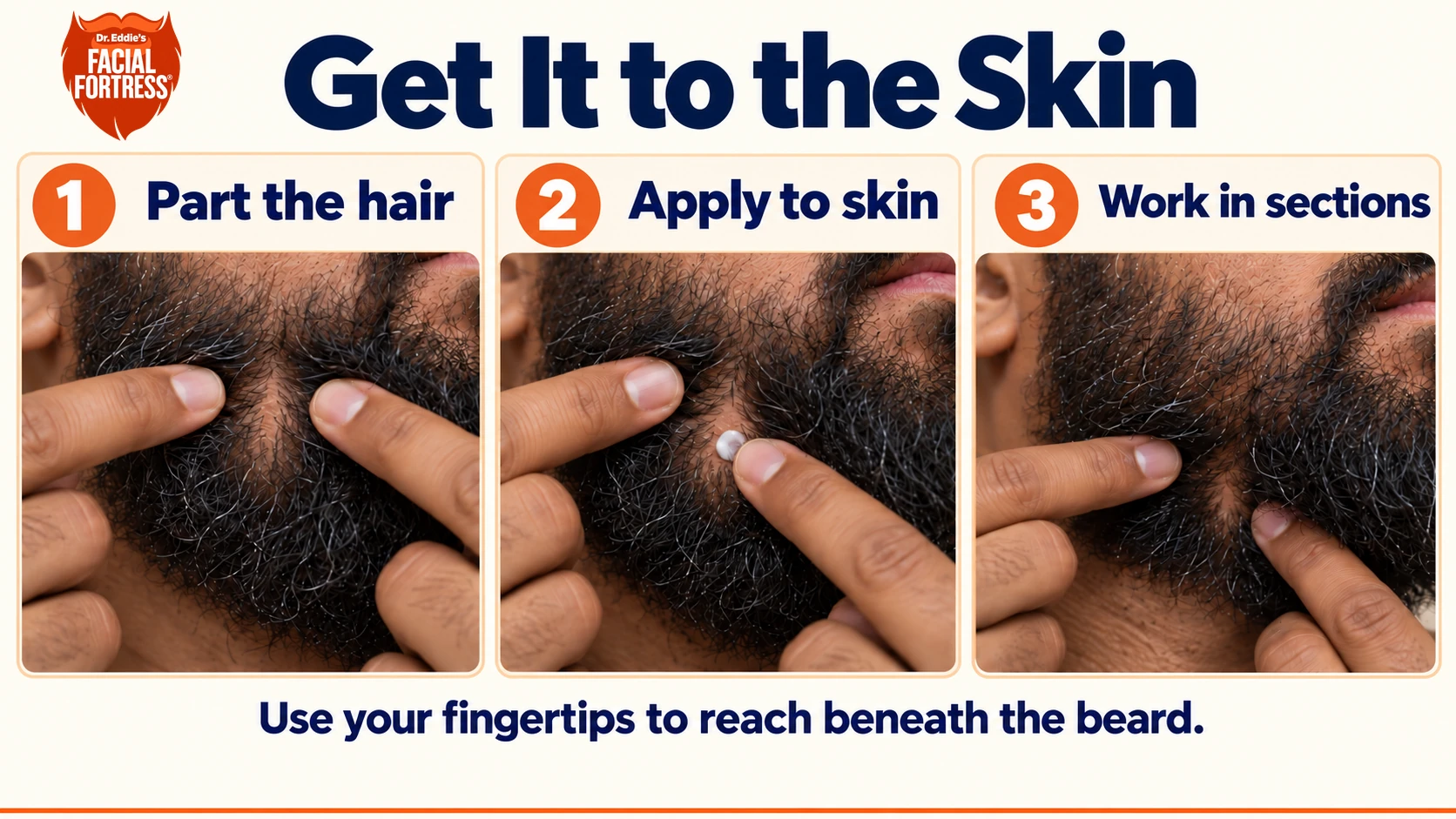
The skin needs contact with the product. Smoothing everything over the outside of a dense beard can leave most of it on the hair.
Try this approach with the product you have chosen for your skin:
- Start after washing. Rinse away cleanser, then gently pat with a clean towel, leaving the skin slightly damp.
- Put a small amount on clean fingertips. Follow the product’s amount guidance. You can add more to an area that needs it.
- Open a path through the hair. For a fuller beard, use your other hand to separate a small section so your fingertips can reach the skin.
- Smooth the product gently onto that skin. Work with the direction of hair growth and avoid vigorous rubbing or scratching.
- Move around the beard in sections. Give the cheeks, jawline, chin, and underside attention. Check that you reached the skin before adding more to the outside of the beard.
The NHS recommends applying emollients after washing and smoothing them in the direction of hair growth. Sectioning the beard is a practical way to carry out that skin application.6
Adjusting the Technique to Your Beard
| Beard length or density | How to reach the skin |
|---|---|
| Stubble | Apply directly across the skin, as you would elsewhere on your face. |
| Short beard | Place your fingertips between the hairs, including along the jaw and beneath the chin. |
| Long or dense beard | Part small sections and apply along each exposed area of skin. Work around the face instead of placing one large dollop on the outer hair. |
Beard length alone does not determine the amount your skin needs. More hair may make application harder without increasing the area of skin underneath. Check coverage with your fingertips instead of judging it by how shiny the beard looks.
If the area you struggle with is your upper lip, our guide to dry skin under your mustache takes a closer look at that spot.
Brushes and Combs for Product Distribution
Your fingers do the work of placing product against the skin. Afterward, a comb can help distribute conditioning product through the facial hair. This follows the grooming sequence in the AAD’s healthy-beard guide.1
A comb can also separate sections of a fuller beard. A brush may help smooth and shape the hair if its bristles feel comfortable. Neither is mandatory when your fingers do the job.
For tangles, work gently in small sections instead of pulling a tool through a knot. Stop if it scratches or hurts, and clean the tool according to its care instructions. Brushing harder will not make a moisturizer work better.
Using Beard Oil and Moisturizer Together
Start with the product that meets your skin’s needs. If the hair also feels rough or needs styling, a small amount of an appropriate conditioner, oil, or balm may help with that separate job.
For example, someone with sensitive skin may prefer facial moisturizer underneath and a little tolerated conditioning product along the beard’s lengths. Someone whose normal-to-dry skin feels comfortable with beard oil may not need a separate cream.
If you choose to use both, place the facial moisturizer against the skin first, then assess whether the hair needs anything else. You do not have to coat every area twice. Follow individual product instructions, especially for rinse-out conditioners or prescribed skin treatments.
For the full daily sequence, including cleansing and daytime sun protection, see our simple face-and-beard skincare routine.
Working Cream Through a Fuller Beard
Try changing how you apply it before giving up on a product that suits your skin. Start with a small section and use your fingertips to carry the cream beneath the hair. A large dollop spread over the entire beard is harder to place precisely.
If the texture still makes application difficult, consider another formula. Lotions can spread readily over hairy areas, while richer creams or ointments can be more useful for significant dryness.8
For eczema-prone skin, keep the cream-or-ointment preference in mind. A different cream or more careful placement may be a better adjustment than choosing the thinnest product solely because it moves easily through the beard.
If products roll into little pills or leave the beard feeling coated, try using fewer overlapping products and check their directions. Persistent residue is a reason to reassess the amount, placement, or combination you are using.
Amount and Frequency
There is no single drop count or pea-sized amount that fits every face, beard, and formula. Begin with the product’s directions, place it carefully, and add a little where needed. The goal is comfortable skin and manageable hair.
A beard does not have to look greasy after application. With beard oil or conditioner, start with a small amount and add more only if needed.1
Match moisturizing to your skin’s needs. If skin feels dry or tight, apply moisturizer after washing and gently patting dry. If the skin beneath your beard feels dry again later, reapply moisturizer where needed. Adjust to your skin rather than following a fixed number of applications. Keep any moisturizing routine prescribed for eczema or another skin condition.6, 7
Your cleanser or medicated wash may have a different schedule. Our guide to how often to wash your hair and beard explains that separate decision.
Moisturizing When Beard Dandruff Is Present
Beard oil may improve softness or the feel of dry skin, but a cosmetic oil does not replace treatment for seborrheic dermatitis beneath the beard. Moisturizing and treating the condition are connected steps with different jobs.
There is also no good reason to assume that every product labeled “beard oil” will affect every person identically. The finished formula and your skin’s response matter. For seborrheic dermatitis, the AAD recommends gentle cleansing, thorough rinsing, and a fragrance-free moisturizer alongside appropriate treatment.4
If flakes persist despite moisturizing, our beard dandruff versus dry skin guide explains the overlapping clues. For treatment steps, see how to get rid of beard dandruff.
For a beard that feels greasy as well as flaky, see oily skin and beard dandruff. If itching is your main concern, our itchy-beard guide covers other possible causes, including shaving irritation and ingrown hairs.
The Medicated Cleansing Step
Facial Fortress 3-in-1 Medicated Wash is a rinse-off wash with 0.95% pyrithione zinc for dandruff and seborrheic dermatitis. It belongs in the cleansing step and does not replace a leave-on moisturizer when your skin needs one.9
Use it according to the Drug Facts, rinse, then use a leave-on product if your skin or beard hair needs it.
Responding to Product Irritation
Stop using a product that repeatedly burns, stings, or worsens redness or bumps. Adding more products can make it harder to identify what your skin is reacting to. Moisturizers themselves can occasionally cause irritation or other reactions.6
Our guide to beard irritation from seborrheic dermatitis or a product reaction explains why these problems can be confused.
Persistent skin problems, painful bumps, or hair loss deserve a dermatologist’s assessment.5
Related Guides
Medical References
- American Academy of Dermatology. A dermatologist’s top tips for a healthy beard.
- American Academy of Dermatology. Dermatologists’ top tips for relieving dry skin.
- American Academy of Dermatology. Atopic dermatitis: Self-care.
- American Academy of Dermatology. Seborrheic dermatitis: Self-care.
- American Academy of Dermatology. DIY treatment for five common beard problems.
- NHS. Emollients.
- Guy’s and St Thomas’ NHS Foundation Trust. Emollients and how to use them.
- DermNet. Emollients and moisturisers.
- DailyMed. Facial Fortress: Drug Facts.