
How to Grow a Beard Faster: What Actually Works (and What Doesn’t)
Have you ever caught yourself staring at your stubble in the mirror and wondering, how can I make my beard grow faster?
You’re definitely not the only one. The internet is full of beard-growth hacks: shave more often, take biotin, rub oil into your face, use a dermaroller, drink more water, boost your testosterone, brush harder—the list goes on.
But how much of that actually works?
Doctor Answer: Can You Really Make Your Beard Grow Faster?
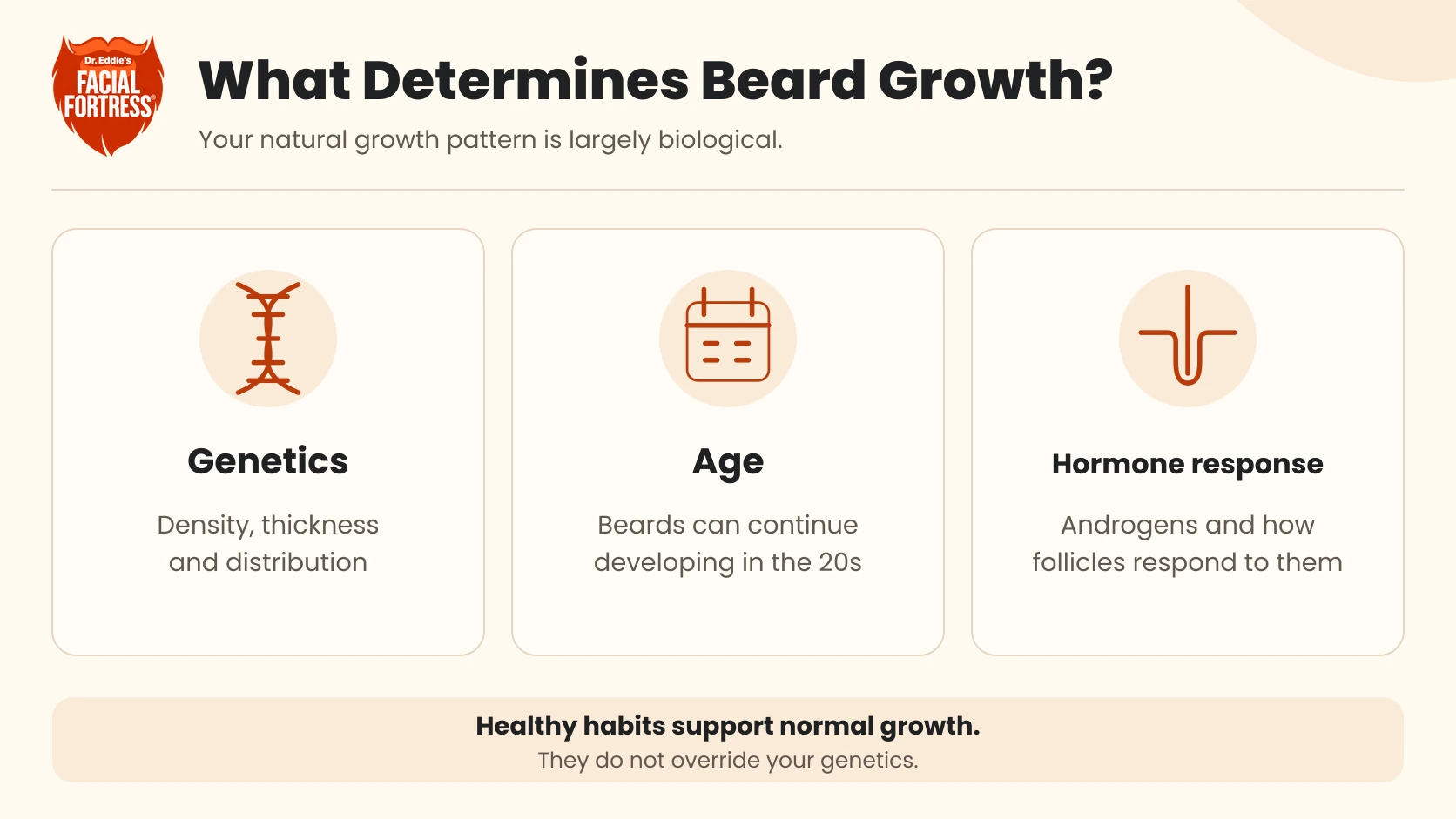
Not dramatically. Your beard’s growth rate, density, thickness, and distribution are determined largely by genetics, age, hormones, and how sensitive your individual hair follicles are to androgens such as testosterone and dihydrotestosterone (DHT).
Healthy nutrition, adequate sleep, exercise, good skin care, and treating nutritional deficiencies or medical problems can help your beard reach its natural growth potential. But they do not create brand-new beard follicles or allow you to override your genetics.
There is also clinical evidence that topical minoxidil can increase facial-hair density, although applying minoxidil to the face is off-label in the United States and should be discussed with a healthcare professional.
So the more useful question isn’t really, “How can I force my beard to grow faster?” It’s: How can I give my beard the best chance to grow as well as it naturally can?
What Determines How Fast and Thick Your Beard Grows?
Genetics Plays a Major Role
Genetics is probably the biggest reason one guy can grow a dense beard at 19 while another still has sparse areas in his late 20s. Your genes influence how many beard follicles you have, where those follicles are distributed, hair thickness, how strongly your follicles respond to androgens, and when your beard reaches its mature pattern.
Cleveland Clinic notes that beard thickness and distribution depend heavily on genetics and that facial hair can continue becoming thicker and coarser from roughly ages 18 to 30. Read the Cleveland Clinic explanation of beard development.
So if you are 18, 20, or even 24 and don’t yet have the beard you want, your beard may simply not be finished developing.
Testosterone and DHT Matter — But “More Testosterone = More Beard” Is Too Simple
Testosterone and its more potent metabolite, DHT, play important roles in converting fine facial hairs into thicker terminal beard hairs during and after puberty. Beard follicles are particularly sensitive to androgens, and research has identified differences in androgen receptors and 5-alpha-reductase activity in beard follicles compared with scalp follicles. Review androgen actions on human hair follicles on PubMed.
But this does not mean that a man with an average or patchy beard necessarily has low testosterone. The sensitivity of each person’s follicles to those hormones also matters. Two men can have normal testosterone levels and dramatically different beards.
Researchers studying beard and scalp follicles have demonstrated that beard follicles metabolize testosterone differently and that DHT has an important role in androgen-sensitive facial-hair development. See the beard-follicle testosterone metabolism study on PubMed.
If you otherwise went through normal puberty and have no symptoms of testosterone deficiency, taking testosterone simply to improve your beard is not an appropriate beard-growth strategy.
Age Matters More Than Many Guys Realize
Facial hair starts developing during puberty, but that doesn’t mean your beard reaches its final form at 16 or 18. For many men, the beard continues becoming denser, coarser, and more evenly distributed well into the 20s. Sometimes time really is the treatment.
How Fast Does Beard Hair Actually Grow?
There isn’t one universal beard-growth rate. A reasonable ballpark is around 10 millimeters, or about 0.4 inches, per month, although growth varies significantly among individual hairs and individuals.
A dermatology review of beard-hair biology reports beard growth around 10 mm per month and describes the beard follicle as having a much shorter active-growth phase than scalp hair—about 4 to 14 weeks. Read the peer-reviewed beard-hair review.
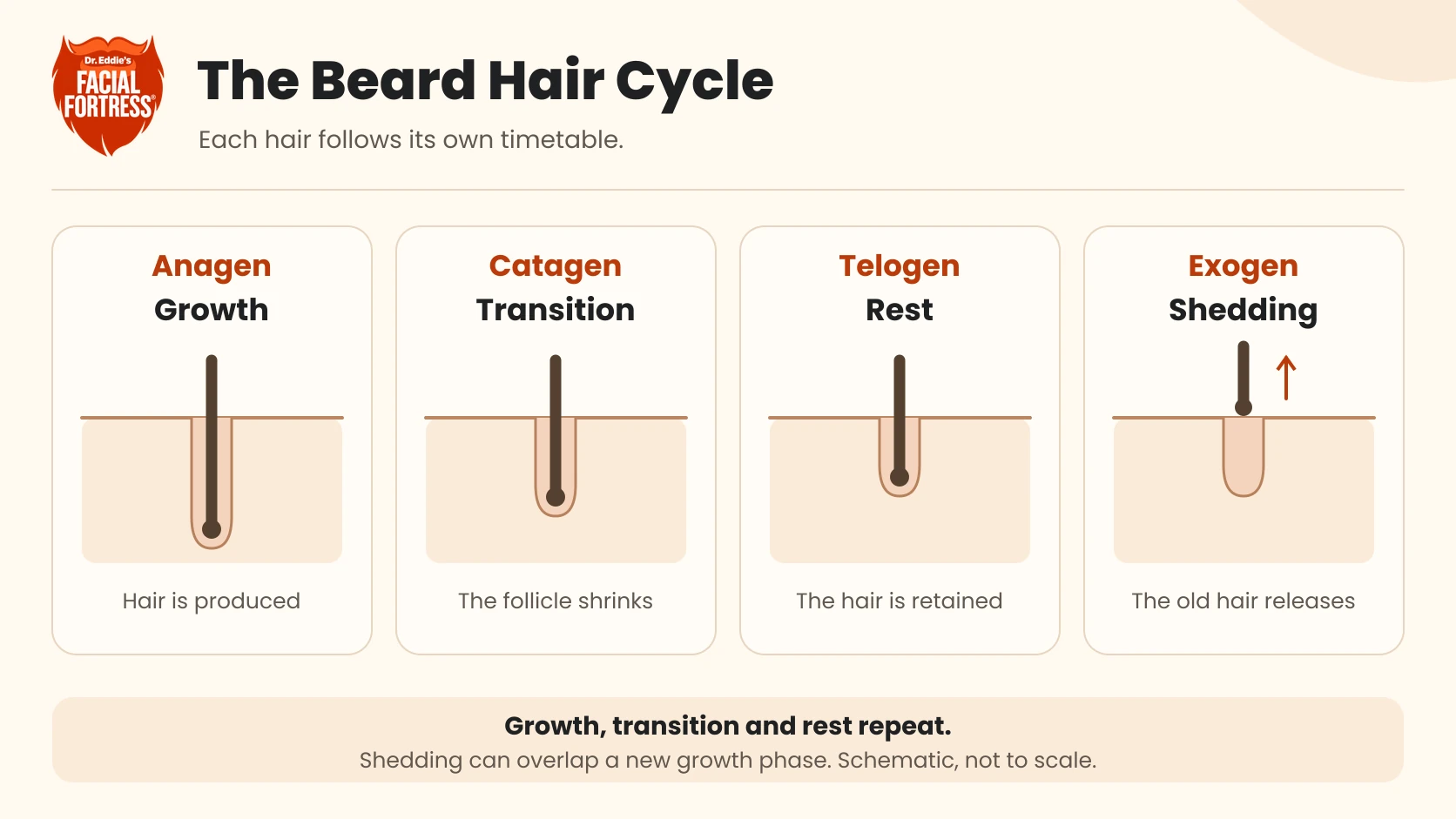
That is an important correction to a common misconception: an individual beard hair does not simply grow forever. Each follicle repeatedly moves through a hair-growth cycle.
10 Ways to Support Healthy Beard Growth
1. Give Your Beard Enough Time
When guys start growing a beard, they often judge the result too early. Different follicles cycle independently, and slower-growing areas can begin looking fuller as nearby hairs gain length. Instead of making a verdict after two weeks, give your beard enough time to reveal its natural pattern.
If certain areas remain persistently sparse, read our dedicated guide to patchy beard causes and what you can actually do about them.
2. Eat Enough Protein and Maintain a Balanced Diet
Hair is composed primarily of keratin, a protein, and significant nutritional deficiencies can interfere with normal hair growth. A balanced diet containing adequate protein, iron, zinc, vitamins, essential fatty acids, fruits, vegetables, and other nutrients supports normal skin and hair biology.
That is very different from saying that eating extra salmon, eggs, avocados, or spinach will suddenly make your beard grow twice as fast. Think support normal growth, not “supercharge” it.
3. Correct Nutritional Deficiencies — Don’t Blindly Take Hair Supplements
Biotin, zinc, iron, vitamin D, and other nutrients are frequently sold as hair-growth boosters. But more is not automatically better. The American Academy of Dermatology notes that too little biotin, iron, protein, or zinc can contribute to hair loss and recommends evaluating deficiencies rather than blindly supplementing. See the AAD’s review of nutritional causes of hair loss.
The AAD also warns that taking too much of some nutrients can contribute to hair loss. Read the AAD’s hair-loss supplement guidance. If you suspect a nutritional deficiency, discuss it with your physician rather than guessing with a handful of supplements.
4. Get Adequate Sleep
Sleep is important for overall health, and there is actually some interesting beard-specific research here. In a small study, 10 young men underwent 48 hours of sleep deprivation, and investigators measured a 19% decrease in beard-hair growth during that extreme period. Read the sleep-deprivation beard-growth study on PubMed.
That does not mean sleeping an extra two hours every night will give you a Viking beard. It does show that severe sleep deprivation can influence biological processes involved in hair growth.
5. Exercise for Your Health — Not as a Beard-Growth Drug
Exercise has enormous health benefits, and intense exercise can produce temporary changes in hormone levels. But that is not the same thing as proving that lifting weights will cause a normal beard to grow significantly faster.
Exercise because it benefits cardiovascular health, metabolism, sleep, mood, muscle, and overall wellness. If your beard happens to enjoy living on a healthier human being, all the better. Just don’t expect squats to turn three whiskers into a lumberjack beard.
6. Manage Chronic Stress
Stress affects many systems throughout the body and can contribute to certain types of hair shedding. There is much less evidence that meditation, breathing exercises, or yoga directly increase normal beard-growth speed. Stress management should therefore be thought of as part of maintaining overall health—not as a treatment that creates additional beard follicles.
7. Take Care of the Skin Under Your Beard
Healthy-looking facial hair starts with taking care of the skin underneath it. Gentle cleansing and appropriate moisturizing can reduce problems such as dryness, acne, itching, ingrown hairs, and beard dandruff.
Washing your beard does not stimulate dormant follicles into producing new hairs. What it can do is make the process of growing and maintaining a beard considerably more comfortable.
8. Treat Beard Dandruff If You Have It
If growing your beard brings itching, redness, greasy scale, or flakes, you may be dealing with beard dandruff or seborrheic dermatitis rather than a beard-growth problem. You can read our detailed guide to why your beard itches and flakes.
Treating beard dandruff can make growing and maintaining a beard much more comfortable. But here’s the important distinction: treating beard dandruff does not create new hair follicles or make a genetically normal beard suddenly grow faster.
Facial Fortress 3-in-1 Face, Hair & Beard Wash combines 0.95% pyrithione zinc with a more skin-conscious, fragrance-free and dye-free formula designed for the beard and the skin underneath it. Added humectants and conditioning ingredients such as glycerin and panthenol help make it a more thoughtful choice for facial and beard skin while the medicated active helps control the flaking, scaling, and itching associated with dandruff and seborrheic dermatitis. You can also review the Facial Fortress ingredients and Drug Facts.
9. Don’t Abuse Your Beard in the Name of “Stimulating” It
You may have heard that aggressively brushing, combing, exfoliating, or massaging your beard increases circulation and therefore makes it grow faster. There is no good clinical evidence that vigorous brushing makes normal beard follicles produce hair faster.
Gentle grooming can remove loose scale, organize hairs, and improve the appearance of your beard. Aggressive grooming can cause irritation and hair breakage. Your beard is not a Chia Pet. Scratching the soil harder does not make it grow faster.
10. Pay Attention to Sudden or Unusual Beard Hair Loss
A naturally sparse beard and new beard hair loss are not necessarily the same thing. If you suddenly develop smooth circular bald areas, marked asymmetry, pain, inflammation, broken hairs, pustules, scarring, or rapid hair loss, it is worth being evaluated by a physician or dermatologist. If shedding is happening along with recurrent flaking or inflammation, see our guide to seborrheic dermatitis and hair loss.
If changes began during GLP-1 treatment, our guide to GLP-1 medications and beard changes explains the evidence and questions to raise at your visit. Conditions such as alopecia areata, fungal infections, inflammatory skin disease, nutritional deficiencies, thyroid problems, and other medical conditions can sometimes affect hair. Similarly, very limited facial hair along with symptoms such as reduced libido, erectile dysfunction, loss of body hair, or other signs of possible low testosterone deserves medical evaluation rather than a bottle of “testosterone booster.”
Can Minoxidil Help Grow a Beard?
This is where the beard-growth discussion gets particularly interesting. There is clinical evidence that topical minoxidil can improve facial-hair growth. For another widely advertised option, see what the evidence says about peptides and beard growth.
A randomized, double-masked, placebo-controlled study published in 2016 evaluated 3% topical minoxidil for beard enhancement and found improvement compared with placebo. Read the 2016 randomized beard-minoxidil study on PubMed.
More recently, a 2026 randomized, double-blind, placebo-controlled trial involving 69 transgender men receiving stable gender-affirming hormone therapy found that 3% topical minoxidil used for 12 weeks significantly increased beard and mustache hair density and diameter compared with placebo. Read the 2026 randomized facial-hair minoxidil trial on PubMed.
That newer study is encouraging, although its specific study population means the results should not automatically be assumed to apply identically to every man seeking a fuller beard.
The Important Catch: Facial Minoxidil Use Is Off-Label in the U.S.
Topical minoxidil products sold in the United States are labeled for scalp hair regrowth, not beard enhancement. A current U.S. Drug Facts label directs users to the scalp and warns against applying the product to other parts of the body. Review the current minoxidil Drug Facts on DailyMed.
So: minoxidil may be useful for facial-hair enhancement, but beard use is off-label and deserves an informed conversation with a healthcare professional rather than casual experimentation.
What About a Dermaroller or Microneedling?
Microneedling has attracted considerable attention in hair-loss treatment, particularly when combined with therapies used for scalp hair loss. The problem is that evidence for scalp hair does not automatically equal evidence for beard growth.
There is currently much less clinical evidence demonstrating that at-home microneedling reliably makes an otherwise healthy beard grow faster or denser. Improper technique can also cause irritation, inflammation, pigmentation changes, infection, or scarring. I would not describe a dermaroller as a scientifically established beard-growth treatment.
Does Shaving Make Your Beard Grow Faster or Thicker?
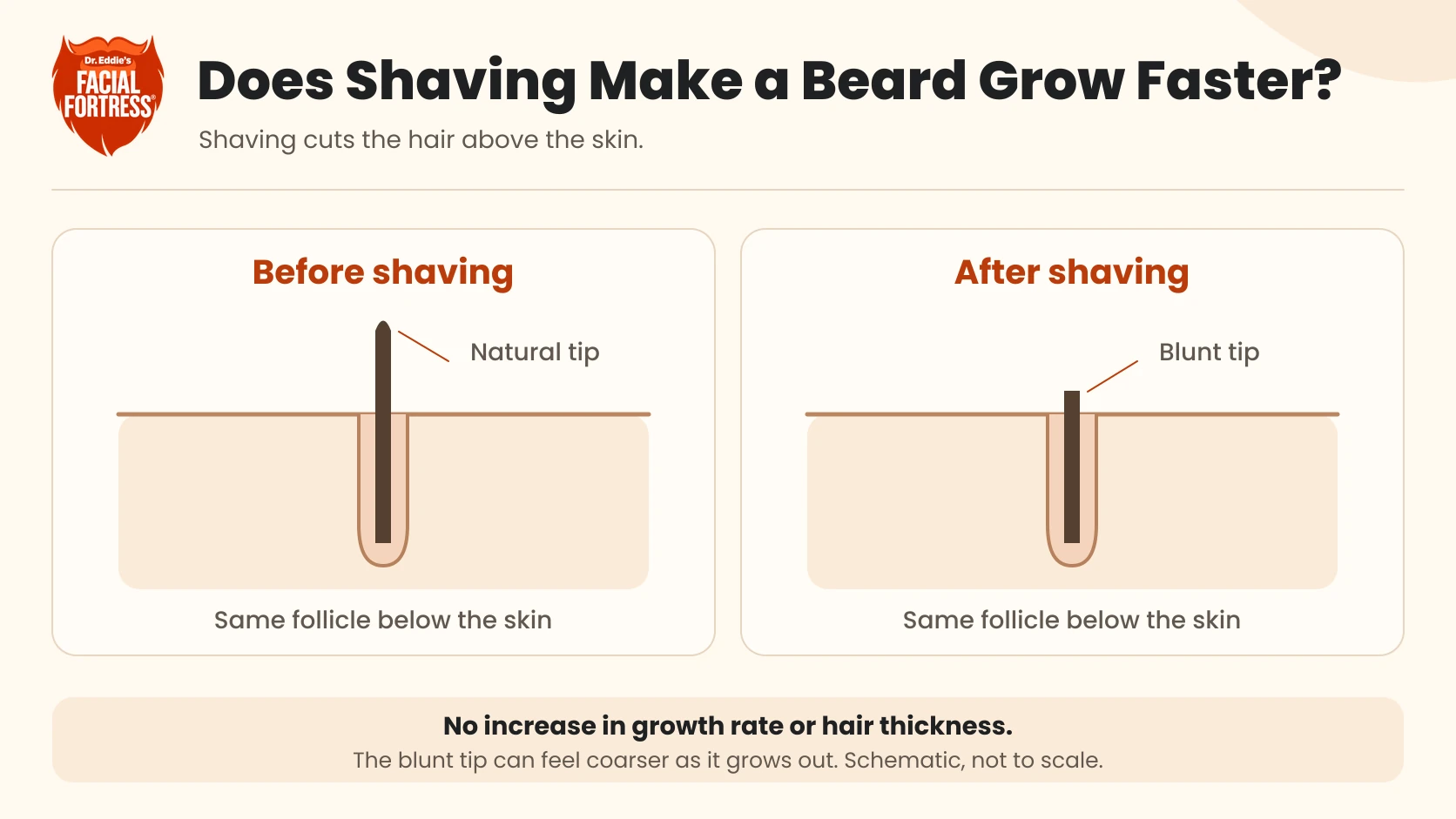
No. Shaving cuts the hair at the surface of the skin. It does not change the follicle underneath your skin, alter its growth rate, or increase the diameter of the hair it produces.
A freshly shaved hair has a blunt end, which can make new stubble feel coarser and temporarily look darker or thicker. But the biology of the follicle hasn’t changed. Mayo Clinic specifically states that shaving does not alter a hair’s thickness, color, or rate of growth. Read Mayo Clinic’s explanation of the shaving myth.
Does Beard Oil Make Your Beard Grow?
Beard oil can be useful for grooming. Depending on the product and your skin type, it may soften beard hair and reduce the dry feeling of the skin underneath. But beard oil has not been shown to create new beard follicles or meaningfully accelerate normal facial-hair growth.
Does Drinking More Water Make Your Beard Grow Faster?
Your body obviously needs adequate hydration to function normally. But the popular claim that drinking extra water sends more nutrients to your beard follicles and therefore increases beard-growth speed has not been established. Drink enough water for your health and thirst. You don’t need to carry a gallon jug around because your beard demanded it.
Does Your Beard Ever Stop Growing?
Your beard as a whole can continue producing hair throughout adulthood, assuming the follicles remain healthy. But each individual beard hair has its own biological growth cycle. A hair actively grows, eventually leaves the active-growth phase, rests, sheds, and is later replaced by another hair from that follicle.
When Should You See a Doctor About Beard Growth?
Most variations in beard density are normal and genetic. Consider talking with a healthcare professional or dermatologist if you develop sudden bald patches, rapid beard hair loss, painful or inflamed skin, scarring, pustules, significant scaling that doesn’t improve with treatment, or other symptoms suggesting a hormonal or systemic medical problem.
The Bottom Line
If you came here looking for the secret to growing a beard twice as fast, I’m going to disappoint you. There isn’t one.
Genetics, age, and your follicles’ response to hormones determine most of your beard’s natural growth pattern. A nutritious diet, adequate sleep, regular exercise, sensible stress management, gentle skin care, and correction of genuine nutritional or medical problems can help your beard reach its natural potential.
Shaving does not make it grow faster. Beard oil does not create new follicles. Taking extra biotin when you aren’t deficient isn’t a beard-growth shortcut. And aggressively scrubbing your face will not wake up sleeping follicles.
Topical minoxidil is one of the few interventions with clinical evidence suggesting it can increase facial-hair growth, but facial use remains off-label in the United States and should be discussed with a healthcare professional.
And if the problem isn’t how fast your beard grows but the itching, redness, scaling, or flakes underneath it, treat the skin problem for what it is. Facial Fortress was developed for exactly that part of beard care: helping control the flaking, scaling, and itching associated with dandruff and seborrheic dermatitis while cleansing the beard, face, and scalp.


Frequently Asked Questions
How can I make my beard grow faster naturally?
At what age does a beard fully develop?
How fast does a beard grow?
Does shaving make a beard grow back thicker?
Does biotin help grow a beard?
Can low testosterone cause poor beard growth?
Can minoxidil help grow a beard?
Does a dermaroller make your beard grow?
What should I do if my beard suddenly becomes patchy?

Dr. Eddie created Facial Fortress, a medicated 3-in-1 face, hair and beard wash for dandruff and seborrheic dermatitis.
More about Dr. Eddie
- Seborrheic Dermatitis on the Body: Chest, Skin Folds & Belly Button - September 17, 2026
- Seborrheic Dermatitis Treatment: Zoryve and Other Options for the Face and Beard - September 17, 2026
- GLP-1 Medications and Beard Changes: What Do We Know? - September 17, 2026