Peptides and Beard Growth: What’s Behind the Hype?
It can feel as though everyone suddenly knows what a peptide is. One person is talking about a weight-loss medication, another about a recovery injection, and a skincare ad is promising younger-looking skin. Now the same word is appearing in beard-growth products.
If you have never heard of GHK-Cu, you have not missed a basic rule of beard care. The name belongs to one ingredient in a much bigger conversation. Before deciding whether a peptide deserves a place in your routine, it helps to understand what the word means—and what a study would need to show.
What are peptides, in plain English?
A peptide is a short chain of amino acids, the building blocks that also make up proteins. That is a description of its structure. It does not tell you its purpose, how well it works, or whether it is safe for a particular use. The National Cancer Institute gives this basic definition.
Think of amino acids as letters: changing their sequence changes the message. A chain involved in blood-sugar regulation is not interchangeable with one being studied in skin. Some peptides act as signals in the body, while others are ingredients in medicines, cosmetics, or supplements.
“Peptide” therefore cannot answer the question, “Will this grow my beard?” We need the name of the molecule, the finished formulation, how it is used, and evidence for the result being promised.
Why does the peptide conversation seem to be everywhere?
Several different conversations have converged. Prescription peptide medicines have made the word familiar. Skincare products use it in claims about texture and appearance. Wellness marketing uses it for a much wider range of proposed benefits, including recovery and hair growth.
The enthusiasm makes the categories easy to blur. A well-studied medicine can give the whole word “peptide” a scientific glow, even when another product has very different evidence. This is why the first useful question is simply: Which kind of peptide product are we discussing?
| What you may encounter | What to understand |
|---|---|
| Prescription peptide medicines Examples include semaglutide and tirzepatide. | Specific medicines have defined indications, doses, trials, and risks. Their success does not validate an unrelated beard serum. |
| Topical cosmetic peptides Serums and creams, including some copper-peptide products. | Claims about smoother-looking skin or conditioned hair need to be distinguished from actual increases in beard density. |
| Collagen-peptide supplements Powders, capsules, or drinks. | These are a different intervention from a topical copper peptide. A skin or nutrition study does not establish beard regrowth. |
| Injectable products marketed for recovery or anti-aging | Identify the exact substance and its approval and safety status. A prescription or “research” label alone does not establish effectiveness for beard growth. |
If you are wondering about a weight-loss medication you already take, our companion article examines GLP-1 medications and possible beard changes. This article focuses on peptides marketed to improve growth.
What is GHK-Cu?
GHK-Cu is a copper-binding peptide complex. GHK refers to three amino acids—glycine, histidine, and lysine—and Cu is the chemical symbol for copper. On cosmetic ingredient lists, it is commonly called Copper Tripeptide-1.
Researchers have investigated GHK and copper-peptide complexes in skin biology and tissue remodeling. That helps explain the interest in them. It does not establish that applying a particular serum will create a denser beard.
There is also a similarly named molecule, AHK-Cu. Its first amino acid is alanine rather than glycine. That small-looking change matters when reading the research: an AHK-Cu experiment should not be presented as a clinical trial proving GHK-Cu beard growth.
What does the hair-growth research actually show?
The evidence is worth examining without either dismissing it or stretching it. Two published studies help illustrate the gap between an interesting finding and a useful beard-growth recommendation.
| Study | Finding and limit |
|---|---|
| AHK-Cu laboratory study, 2007 | Researchers studied cultured human hair follicles and dermal papilla cells, which help regulate hair growth. They reported growth-promoting effects in that model. This was not a trial of men applying GHK-Cu to their beards. |
| 5-ALA plus GHK scalp study, 2016 | A small randomized study enrolled 45 men with pattern hair loss for six months. The combination showed a signal for improved hair counts; hair length and thickness did not significantly differ between groups. It tested a copper-free GHK complex on the scalp, not GHK-Cu alone on the beard. |
Sources: Pyo and colleagues’ laboratory study and Lee and colleagues’ clinical study.
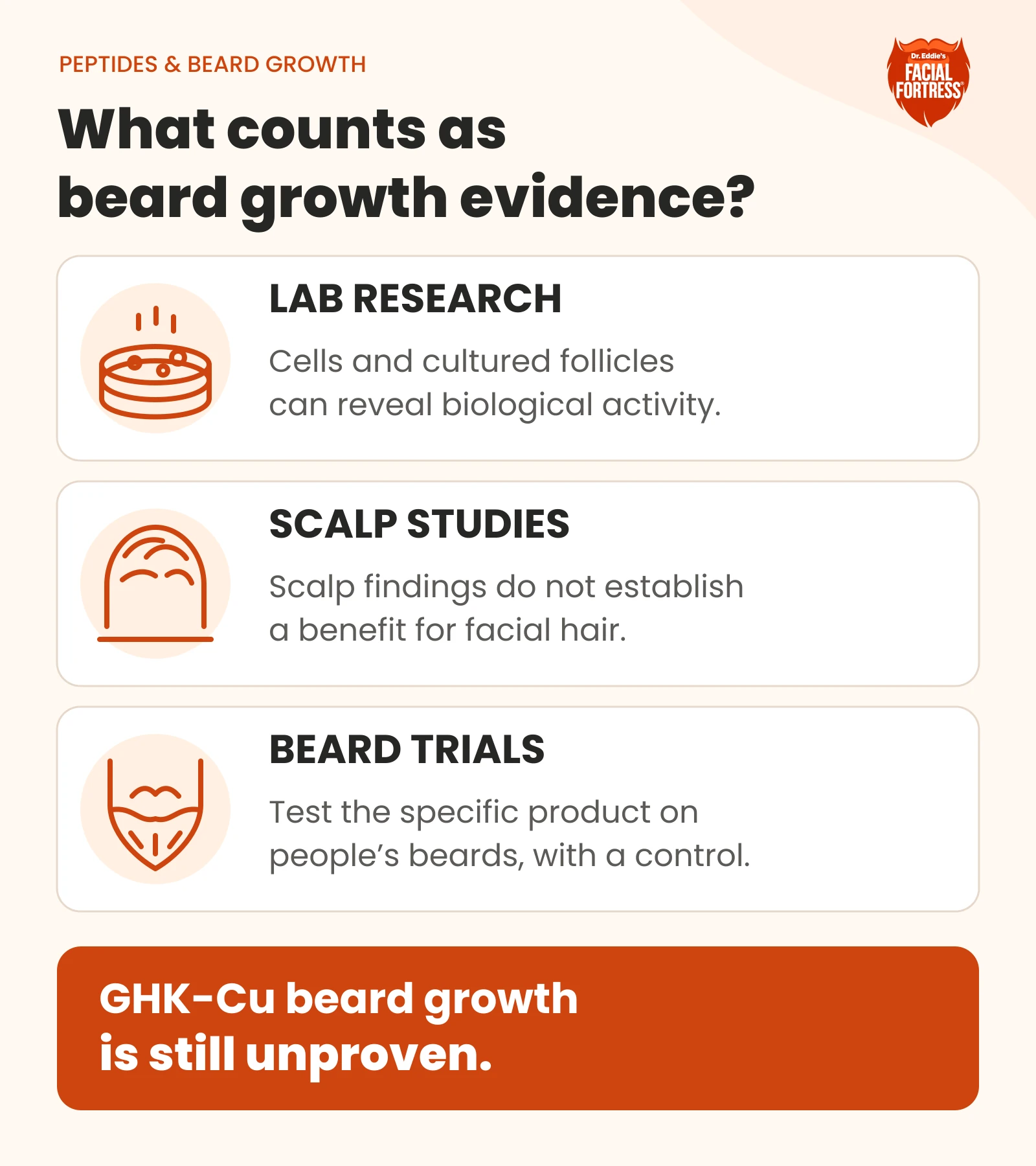
A positive finding in a combination product cannot tell us which component produced the effect. Likewise, a result in cultured cells does not tell us whether a cosmetic product reaches the relevant tissue or produces a visible benefit during normal use.
For this review, we did not identify a controlled human study establishing that GHK-Cu alone improves beard density, coverage, or growth. That leaves the beard claim unproven. It does not mean future research cannot find a benefit.
Why can’t we assume scalp results apply to a beard?
A study answers a particular question in a particular setting. Scalp pattern hair loss and sparse facial hair are not the same clinical problem. Research that counts hairs on a balding scalp does not directly measure whether a patch on someone’s cheek fills in.
Even the outcome matters. A beard can look fuller because the hairs are longer, less tangled, or styled differently. That is different from increasing the number of growing hairs or their diameter.
Useful beard research would measure facial-hair outcomes, compare with an appropriate control, and keep photography, beard length, and other treatments consistent. The formulation being sold should also match the formulation being studied.
For the broader discussion of what affects facial-hair development, see what actually helps beard growth.
How should you read a peptide beard-growth claim?
You do not need a biochemistry degree. Ask a few practical questions before letting a dramatic photograph make the decision:
- Was the exact ingredient tested? GHK-Cu, copper-free GHK, AHK-Cu, and a multi-ingredient serum are not interchangeable names.
- Was it tested on people’s beards? Cells, animals, scalp hair, and facial hair provide different kinds of evidence.
- What actually improved? Look for measured hair count, thickness, or coverage. Skin hydration and hair softness are worthwhile outcomes, but answer different questions.
- What else changed? Minoxidil, microneedling, beard length, lighting, or several new products can make a before-and-after comparison hard to interpret.
- Does the seller link to the actual study? “Clinically tested” is incomplete without knowing what was tested, against what, and for which outcome.
A photograph can be a reason to ask a question. It is not enough to establish the cause of a change. We would apply the same standard to any beard-growth claim, including one made by our own brand.
Are peptide serums and injections equally well understood?
No. Route of administration changes the safety question. A cosmetic designed to sit on intact skin is not interchangeable with a substance injected into the body. Neither route guarantees effectiveness for facial-hair growth.
The FDA specifically flags compounded injectable GHK-Cu for potential immune-reaction concerns related to aggregation and peptide impurities, with limited human safety information. This warning concerns injectable use; it is not a finding that every cosmetic containing a copper peptide has the same risk. Read the FDA’s safety assessment.
For beard growth, there is no established GHK-Cu injection regimen we can recommend from the evidence reviewed here. Buying a product labeled for research does not establish that it is appropriate for use in a person.
For a topical product, consider the complete formula and its intended use. If a new serum causes persistent burning, redness, or itching, stop using it and have ongoing symptoms assessed. Our guides to fragrance-free versus unscented products and beard irritation versus a product reaction can help you think through that distinction.
What is a reasonable approach if you want a fuller beard?
First distinguish a beard that has always grown unevenly from hair that has newly disappeared. The second situation deserves an explanation before you start experimenting with growth products. Our patchy-beard guide explains how to approach both situations.
A new smooth bald patch can be a sign of alopecia areata, which can affect the beard. Tenderness, pustules, marked scaling, or broken hairs also warrant assessment. A growth serum is not a diagnosis. The AAD shows the patterns of alopecia areata.
There is some direct beard research on topical minoxidil, including a small randomized trial. Beard use is off-label, however, and deserves a discussion of suitability and adverse effects with a clinician. It is not evidence that combining minoxidil with a peptide works better. See the beard-enhancement trial.
For everyday comfort, use a simple face-and-beard skincare routine. Choose moisturizer or conditioning products for the job you need them to do. A softer, better-groomed beard can be a worthwhile result without being called new growth.
Facial Fortress is a medicated wash for flaking, scaling, and itching associated with dandruff and seborrheic dermatitis. It is not a peptide treatment or a beard-growth drug. If flakes are the concern, our beard dandruff versus dry skin guide is a better starting point.
Common questions about peptides and beards
Does GHK-Cu fill in a patchy beard?
We do not have convincing controlled human evidence establishing that it does. Promising findings in other tissues or on scalp hair do not settle that question. If patchiness is new, find out why the hair changed before treating it as a cosmetic issue.
Does GHK-Cu work better than minoxidil?
A claim of superiority for beards would require a credible comparison in people using the relevant formulations on facial hair. We did not identify that evidence. The existence of a small minoxidil beard trial does not validate a peptide comparison.
Is a higher peptide percentage better?
A bigger number on the bottle is not proof of better results. Concentration is only one feature of a formulation, and without appropriate beard trials there is no evidence-based “best percentage” to recommend.
Will collagen peptides make my beard grow?
A collagen supplement is different from a copper-peptide serum. Evidence about one cannot be used to prove the other. We did not identify robust beard-growth evidence that justifies recommending collagen peptides specifically to fill in facial hair.
Are GLP-1 medications beard-growth peptides?
They are peptide-based medicines used for specific medical indications. They are not established beard-growth treatments. Our GLP-1 and beard-changes article looks at reported hair loss and what remains uncertain about facial hair.
Sources and further reading
- National Cancer Institute: Definition of peptide.
- Pyo HK et al. The effect of tripeptide-copper complex on human hair growth in vitro. Archives of Pharmacal Research. 2007.
- Lee WJ et al. Efficacy of a complex of 5-aminolevulinic acid and glycyl-histidyl-lysine peptide on hair growth. Annals of Dermatology. 2016.
- FDA: Compounding substances that may present significant safety risks, including injectable GHK-Cu.
- Ingprasert S et al. Efficacy and safety of minoxidil 3% lotion for beard enhancement. Journal of Dermatology. 2016.
- American Academy of Dermatology: Alopecia areata signs and symptoms.