
Seborrheic Dermatitis on the Body: Chest, Skin Folds & Belly Button

You may recognize the flaky patches around your nose or in your hairline. A similar patch on your chest or irritation tucked into a skin fold can be harder to place. Those areas may be part of the same condition, and they deserve the same attention.
This guide focuses on seborrheic dermatitis beyond the face and scalp: where it appears, what can look similar, and how care differs between dry patches and moist folds. The adult seborrheic dermatitis overview explains the condition as a whole. For the eyebrows, nose, and other facial areas, see our facial-dandruff guide.
Seborrheic Dermatitis Body Sites
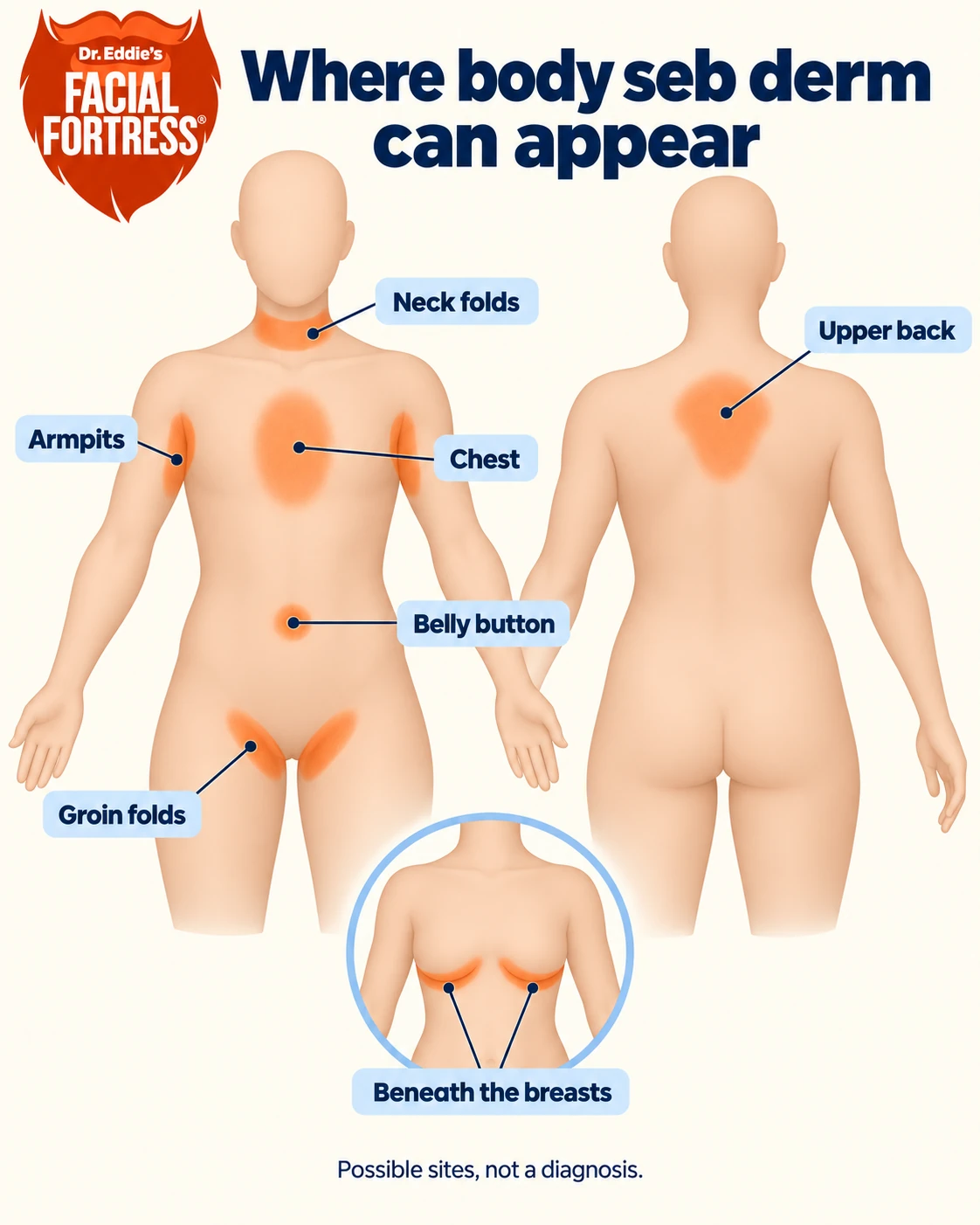
The chest and upper back are recognized locations. Seborrheic dermatitis can also affect the neck and skin folds, including the underarms, groin, and skin beneath the breasts. The American Academy of Dermatology also lists the belly button and buttocks among sites that may be affected in more extensive disease.2
| Area | What to notice |
|---|---|
| Chest and upper back | Recurring patches with scale. On the chest, patches may form around the breastbone and sometimes have curved or petal-like edges. |
| Neck and beneath neck folds | Location alone cannot identify the rash. Sweat, friction, and reactions to products can also contribute to irritation here. |
| Armpits | Inflamed fold skin may look smoother or more moist than a flaky scalp. Deodorant irritation and other fold conditions can look similar. |
| Beneath the breasts | A fold rash needs assessment of moisture, friction, and possible infection as well as inflammatory skin disease. |
| Groin folds | Seb derm is one possibility. Jock itch, Candida, and inverse psoriasis are other possibilities that require different care. |
| In or around the belly button | Flaking or inflammation can occur. Tenderness, persistent moisture, or discharge calls for assessment rather than more scrubbing. |
These are clues to discuss with a clinician, not a way to diagnose yourself from a single feature.6
Frequency of Body Involvement
One useful finding comes from a 2007 Spanish multicenter study of 2,159 people with seborrheic dermatitis: 26.8% had involvement of the thorax, or chest region. That is approximately one in four patients in that study.1
The denominator matters. These participants already had seborrheic dermatitis. The figure does not mean that one in four people in the general population has chest seb derm, and it does not tell us how many had body involvement without any scalp or facial disease. Participants could have more than one affected area.
Reliable population-level incidence figures for individual locations such as the underarms, groin folds, and belly button are harder to establish. These are recognized sites, but an exact percentage for each would imply more certainty than the evidence we found supports.
Appearance on Body Skin and in Folds
It may cause fine scale, larger flakes, itching, or patches that look inflamed. Color varies: redness can be obvious on lighter skin, while affected areas may look darker, lighter, or somewhat purple on darker skin.
A skin fold holds moisture. That can soften scale and leave the area looking moist or irritated instead of covered in obvious flakes. Skin that stays wet can become tender and break down.2
Oil-Rich Skin and Body Folds
Seborrheic dermatitis reflects an interaction between skin oils, Malassezia yeast that normally lives on skin, and the skin’s response. The precise cause is not fully understood. Having this yeast is normal; its presence alone does not explain why one person develops a rash and another does not.
The condition favors areas rich in skin oil, such as the chest. It is not caused by being dirty. Repeatedly washing harder is unlikely to solve a problem driven by inflammation and skin susceptibility.3
Seb derm is not contagious. Having patches in several locations does not mean you transferred a contagious infection from your scalp to your body. Our guide to dandruff versus seborrheic dermatitis explains their relationship.
Other Causes of Skin-Fold Rashes
Intertrigo describes inflammation where skin surfaces meet. It does not identify one specific cause. Seborrheic dermatitis is among the possible causes; infection, friction, and other inflammatory conditions may also be involved.
| Possible cause | Why the distinction matters |
|---|---|
| Candida-related intertrigo | A yeast infection in a moist fold may need an antifungal chosen for that infection. |
| Tinea cruris, or jock itch | A dermatophyte infection requires its own treatment plan. A seb derm wash is not a substitute. |
| Inverse psoriasis | Psoriasis in folds often looks smooth. Its treatment differs from seb derm care. |
| Irritant or allergic contact dermatitis | Friction, cleansers, deodorant, fragrance, or another exposure may be contributing. |
| Erythrasma | This bacterial condition can resemble other fold rashes and needs a different approach. |
A clinician may use the examination, a skin scraping, or another test to narrow the diagnosis. Identifying the cause matters because a treatment that helps one fold rash may do little for another.7
Facial Fortress as a Medicated Body Wash
Facial Fortress 3-in-1 Medicated Face, Hair & Beard Wash can be used as a medicated body wash on affected external skin. Its 0.95% pyrithione zinc helps relieve the flaking, scaling, and itching associated with seborrheic dermatitis. The same wash can fit a routine for the scalp, face, beard, and affected body skin.8
The fragrance-free formula combines its medicated ingredient with cleansing ingredients for washing away dirt, sweat, and excess oil. Glycerin and panthenol support moisture and skin conditioning; dipotassium glycyrrhizate is a licorice-derived ingredient included for soothing care. These supporting ingredients complement the pyrithione zinc rather than replacing its medicated role. Our ingredient guide explains the formula.8
Massage onto wet skin and rinse thoroughly. For best results, use at least twice weekly or as directed by a doctor. Avoid the eyes. Ask a doctor before use if seborrheic dermatitis covers a large area of the body. Stop and ask a doctor if the condition worsens or fails to improve with regular directed use.8
For a groin-area rash, establish the diagnosis and appropriate treatment first. Groin folds are external skin; this discussion is not an instruction to wash inside genital openings or apply medicated cleanser to mucosal surfaces.
A Practical Body-Care Routine
- Start with the diagnosis. A recurring chest patch and a painful, wet fold may need different care. Ask about a new or uncertain rash.
- Cleanse gently. Use comfortably warm water and the wash recommended for your situation. Keep medicated washing to the product’s directions or your clinician’s plan.
- Rinse completely and pat dry. Give folds attention without rubbing or scraping them. Change out of damp clothing.
- Adjust moisture care to the area. A fragrance-free moisturizer may help dry skin. Persistently wet or broken-down folds need an individualized plan.
- Keep the routine manageable. Choose comfortable clothing and avoid known product irritants. Tell your clinician if the routine itself causes burning or persistent irritation.
Gentle care supports treatment without adding unnecessary irritation.4 For more on product labels, see fragrance-free versus unscented.
Creams and Prescription Treatment
A wash may be one part of treatment. Persistent patches may need a leave-on antifungal or an anti-inflammatory medicine chosen for that site. The AAD describes medicated shampoos for seborrheic dermatitis on other body areas as well as additional topical and prescription options.5
Skin folds call for particular care with topical steroids. Strong steroids or prolonged use can damage fold skin. Ask which medicine to use, exactly where, for how long, and what to do when symptoms recur.
Our separate seborrheic dermatitis prescription-treatment review explains Zoryve and other options, with a focus on facial and beard application. For a body rash, a clinician should tailor the choice to the affected area.
Body Rash Changes That Need Assessment
Arrange an evaluation for an uncertain diagnosis, widespread disease, recurrent wet folds, or symptoms that do not improve with directed treatment. Seek prompt care for increasing pain, pus, fever, or rapidly spreading inflammation. Those changes can indicate a problem beyond uncomplicated seb derm.
Bring the products you use, or photos of their labels, to the visit. Mention where the rash started, whether it comes and goes, and which treatments helped or made it worse. That history can be more useful than adding another product on your own.
Medical References
- Peyrí J, Lleonart M, Spanish SEBDERM Study Group. Clinical and therapeutic profile and quality of life. Actas Dermosifiliográficas. 2007;98:476–482.
- American Academy of Dermatology: Signs and symptoms.
- American Academy of Dermatology: Causes.
- American Academy of Dermatology: Self-care.
- American Academy of Dermatology: Diagnosis and treatment.
- DermNet: Seborrhoeic dermatitis.
- DermNet: Intertrigo and its causes.
- DailyMed: Facial Fortress Drug Facts.
This adult-focused guide provides education and does not replace an individual diagnosis. Dr. Eddie Valenzuela is the physician founder of Facial Fortress.