
Quick answer: Prescription options for facial or beard seborrheic dermatitis include topical antifungals, roflumilast (Zoryve) foam and selected anti-inflammatory medicines. They may reduce yeast, calm inflammation, or do both. The choice depends on the diagnosis, affected area and response to prior treatment. Apply the prescribed medicine to the skin beneath the hair and follow its own directions.
Seborrheic dermatitis on the face and beard sometimes needs prescription treatment to control inflammation or persistent scale. If you have tried washing more, washing less, and changing beard products but the same patches keep returning, a different treatment plan may help. Needing more help does not mean you have failed at taking care of your skin.
This guide explains the main treatment options, where Zoryve fits, and the practical problem that is easy to overlook: getting a medicine past the beard and onto the skin that needs it.
Seborrheic Dermatitis of the Face and Beard
Seborrheic dermatitis, often shortened to “seb derm,” is a recurring inflammatory skin condition. It commonly affects the scalp, eyebrows, sides of the nose, ears, and beard area. Scaling may accompany itching and changes in skin color; redness can be less obvious on darker skin.5
Its causes are not fully understood. Skin oils, the yeast Malassezia that normally lives on skin, and the way an individual’s skin responds all matter. It is not a sign that your beard is dirty, and it is not contagious. An antifungal can help by reducing yeast involved in the condition; that does not make seb derm the same thing as a contagious fungal infection.3
For more about the relationship to dandruff, see dandruff versus seborrheic dermatitis. For symptoms outside the beard, see our face dandruff guide.
Prescription Treatment Options
A dermatologist may use treatment to reduce yeast, calm inflammation, or address both. These medicines have different jobs. The choice also depends on where the rash is and whether you need help with an active flare or recurring symptoms.2
- Zoryve (roflumilast) 0.3% foam: Steroid-free treatment that inhibits PDE4. Once-daily leave-on foam; prescribed for seb derm in people age 9 and older.
- Topical ketoconazole: Antifungal treatment. Creams, gels, foams, and shampoos have different directions and labeled uses.
- Ciclopirox: Another topical antifungal option. Its prescription shampoo is labeled for scalp seb derm; ask about the appropriate formulation and any off-label facial use.
- Low-potency topical corticosteroid: Calms inflammation during a flare. A clinician should specify the medicine, location, and short course appropriate for facial skin.
- Pimecrolimus cream or tacrolimus ointment: Steroid-sparing anti-inflammatory options. Used off-label for seb derm; require an individualized discussion of benefits and precautions.
“Off-label” means a clinician uses a medicine outside its specific FDA-approved labeling. Ask which part of your prescription is off-label and why it is appropriate for your situation. The same drug name does not make every strength or formulation interchangeable.
Zoryve Foam for Seborrheic Dermatitis
Zoryve is the brand name for roflumilast. The 0.3% foam is approved for seborrheic dermatitis in people age 9 and older. Roflumilast inhibits phosphodiesterase-4, or PDE4, an enzyme involved in inflammatory signaling. It is neither a corticosteroid nor an antifungal. Zoryve creams have separate indications and directions; they are not interchangeable with the foam.1
For someone considering treatment, the practical appeal is a steroid-free medicine in a once-daily, leave-on foam. A prescription still needs to match your diagnosis and medical history. The manufacturer’s patient information explains the formulation and approved age group.
Results from the Clinical Studies
In the STRATUM trial, 79.5% of participants using roflumilast foam met the treatment-success endpoint at eight weeks, compared with 58.0% using the foam vehicle without roflumilast. Success required clear or almost-clear skin plus at least a two-grade improvement in the investigator’s assessment.1
Those results help answer whether the active drug adds benefit over its vehicle. They do not establish that Zoryve works better than ketoconazole, ciclopirox, or a steroid: those were not the comparison treatments in this trial.
Use on Skin Beneath a Beard
A clinician can prescribe it for seborrheic dermatitis affecting the skin beneath facial hair. The pivotal studies included affected face, scalp, and/or body areas. The label reports overall outcomes, however, rather than a separate success rate for bearded participants. We should not turn an overall trial result into a promise about your beard.
Side Effects and Precautions
Reported side effects in seb derm trials included cold-like symptoms, nausea, and headache. Zoryve is contraindicated in moderate-to-severe liver impairment. Tell your prescriber about your medicines and medical history. Its foam is flammable: avoid flame, fire, and smoking during and immediately after application. Keep it out of the eyes and mouth.1
Other Prescription Medicines
Antifungals: Ketoconazole and Ciclopirox
These are established options for reducing the yeast component of seb derm. A leave-on preparation may be useful for an affected facial patch, while a shampoo has a rinse-off role. The directions for one cannot be carried over to the other. Your prescription should identify the formulation, where to put it, how often to use it, and when to reassess. Burning or irritation is a reason to contact the prescriber.2
Topical Steroids for Short Flare Treatment
A mild corticosteroid, such as an appropriately selected hydrocortisone preparation, may help settle inflamed facial skin. Facial use calls for particular care: prolonged or inappropriate steroid use can cause skin thinning and visible blood vessels. Ask for a clear stopping plan, especially if the rash keeps returning.5
Pimecrolimus and Tacrolimus as Steroid-Sparing Options
These topical calcineurin inhibitors are sometimes used off-label for facial seb derm, particularly when repeated steroid treatment would be undesirable. They may sting or burn when applied. Their approved indications are for atopic dermatitis, and their labeling carries a boxed warning about uncertain long-term safety and rare reports of malignancy; a causal relationship has not been established. Discuss the intended schedule and precautions with your prescriber.62
Oral Medicines for Selected Cases
Extensive or difficult-to-control seborrheic dermatitis sometimes needs an oral antifungal under a dermatologist’s supervision. These medicines are not a routine first step for a small beard-area rash.2
Applying Treatment Beneath a Beard
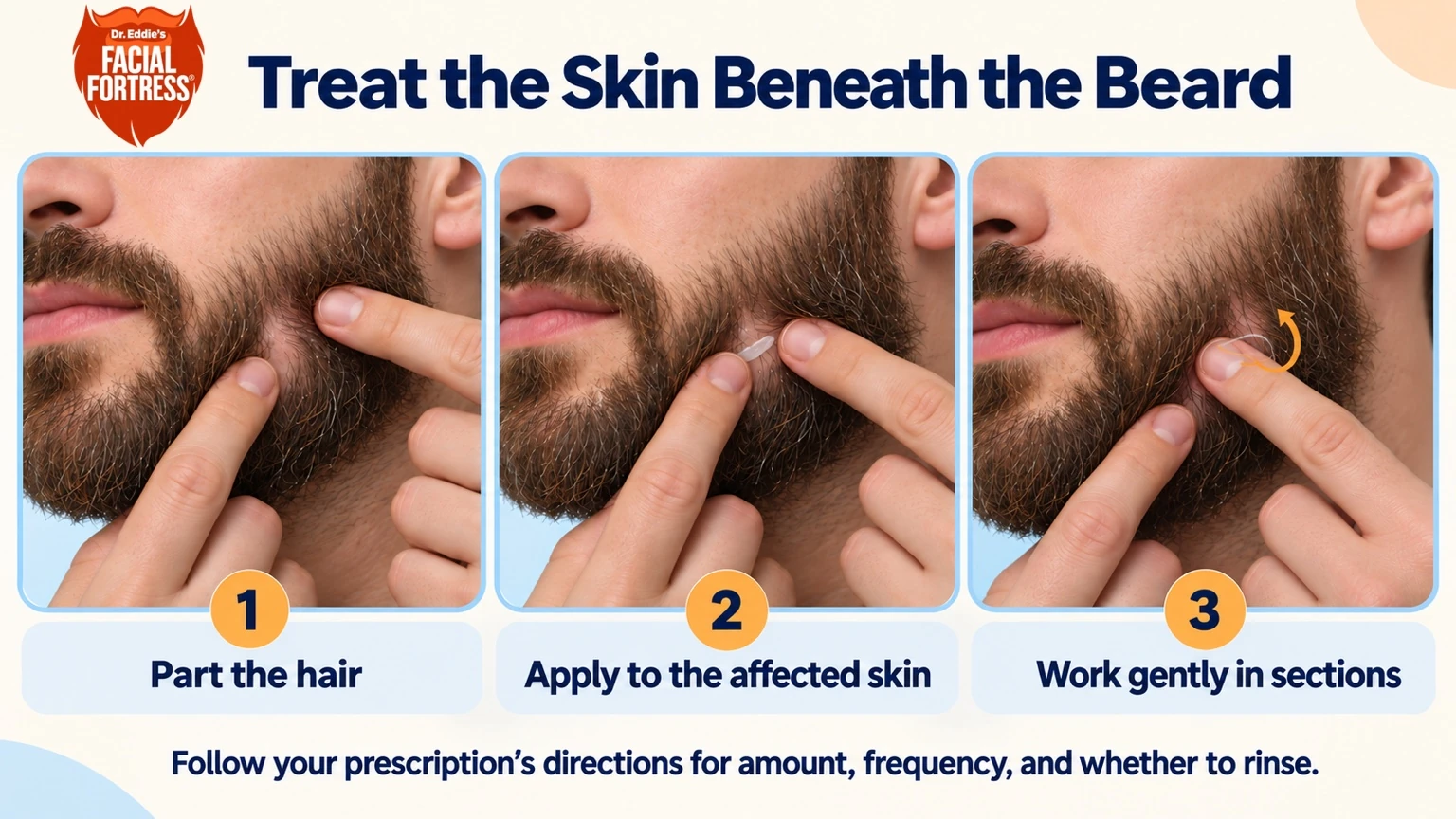
A helpful way to think about application is to work around the skin in small sections. A shiny outer beard does not tell you whether the affected skin received its medicine.
- Check whether the product stays on or rinses off. Use the prescribed amount and schedule.
- Prepare the skin as directed. For Zoryve, apply once daily when the area is not wet; shake the can first.
- Part the hair. Use clean fingers to expose small areas along the cheeks, chin, jaw, and beneath the beard.
- Place the medicine on the affected skin. For Zoryve, use a thin layer and rub it in completely. Work gently rather than scraping off attached scale.
- Finish according to the label. Leave Zoryve on and wash your hands. Keep products away from eyes, lips, and inside the nose unless your clinician specifically directs otherwise.
Parting facial hair is a practical way to carry out skin-directed application. Your clinician’s instructions and the product’s directions take priority.1
If a texture repeatedly gets caught in the hair, tell your pharmacist or prescriber. Shaving is one way to improve access, but a plan that reaches the skin beneath a beard may be practical. Do not mix a prescription into beard oil or moisturizer to make it spread farther.
Cleansing and Moisturizing Alongside Prescriptions
Our complete beard-dandruff care guide covers the broader routine. Keep the surrounding routine gentle: wash without aggressive scrubbing, rinse thoroughly, and choose a fragrance-free moisturizer if needed. Beard oil may soften hair or condition skin, but it does not replace treatment of a diagnosed inflammatory condition.4
For flaking and itching associated with seborrheic dermatitis, Facial Fortress 3-in-1 Medicated Face, Hair & Beard Wash is a fragrance-free, rinse-off option containing pyrithione zinc 0.95%. Follow its Drug Facts directions. If you start a prescription, ask which cleanser or medicated wash belongs in the plan and how often to use it. Combining several medicated products is not automatically a better routine.
A useful question at the visit is: “What do I use on treatment days, what can I keep using between applications, and where does moisturizer fit?” Ask about the order and spacing for your actual prescriptions. Avoid mixing products together in your hand.
For everyday technique, see beard oil versus moisturizer. For the separate cleansing decision, see how often to wash your hair and beard.
Prescription Cost and Insurance
Before filling a prescription, ask the pharmacy to check your actual cost. Ask whether your plan requires prior authorization or a trial of another medicine, and whether a covered alternative is reasonable. For Zoryve, manufacturer savings are subject to eligibility rules and program limits; an advertised offer is not a guaranteed price for everyone. Check the current manufacturer program information.
Bring up affordability early. A treatment plan is only useful if you can obtain the medicine and use it consistently.
Reassessing the Diagnosis or Treatment
Arrange reassessment if treatment is not helping within the agreed follow-up period, causes persistent irritation, or needs repeated rescue courses. Contact dermatitis, psoriasis, and other conditions can resemble seb derm. A clinical examination helps distinguish them.5
Prompt assessment is especially important for painful swelling, pus, spreading redness, or new patchy hair loss. A beard rash with those features deserves a closer look before you add another product. Our itchy-beard guide covers other possible causes.
Maintenance and the Next Flare
Seborrheic dermatitis can recur after improvement. Ask which medicines to continue, which to stop, and how to respond to another flare.
Medical References
- DailyMed: Zoryve foam prescribing information and instructions for use, revised September 2026.
- American Academy of Dermatology: Diagnosis and treatment.
- American Academy of Dermatology: Causes.
- American Academy of Dermatology: Self-care.
- DermNet: Seborrhoeic dermatitis.
- DailyMed: Tacrolimus ointment prescribing information.
- Zoryve: Manufacturer patient resources and access information.
Educational information; treatment should be tailored by your clinician. Brand disclosure: Dr. Eddie Valenzuela is the physician founder of Facial Fortress.