
Quick answer: Beard dandruff caused by seborrheic dermatitis is not contagious. You cannot pass the condition to someone else through ordinary contact. Flakes appearing on your eyebrows, nose, or scalp can reflect the same condition affecting several areas. A new or changing rash may have another cause, especially if it is painful, has pus, or causes patchy hair loss.
Beard dandruff caused by seborrheic dermatitis is a recurring skin condition, not something another person can catch from you. Finding flakes in your eyebrows or beside your nose can still be unsettling. Understanding why several areas can flare helps separate ordinary seborrheic dermatitis from a changing rash that needs a closer look.
Seborrheic Dermatitis Is Not Contagious
Seborrheic dermatitis is not contagious. Ordinary contact, including hugging or kissing, does not give someone else the condition.1
This reassurance applies to seborrheic dermatitis. “Beard dandruff” is an everyday description of flaking, and every flaky rash should not be assumed to have that diagnosis.
Flakes in Several Oil-Rich Areas
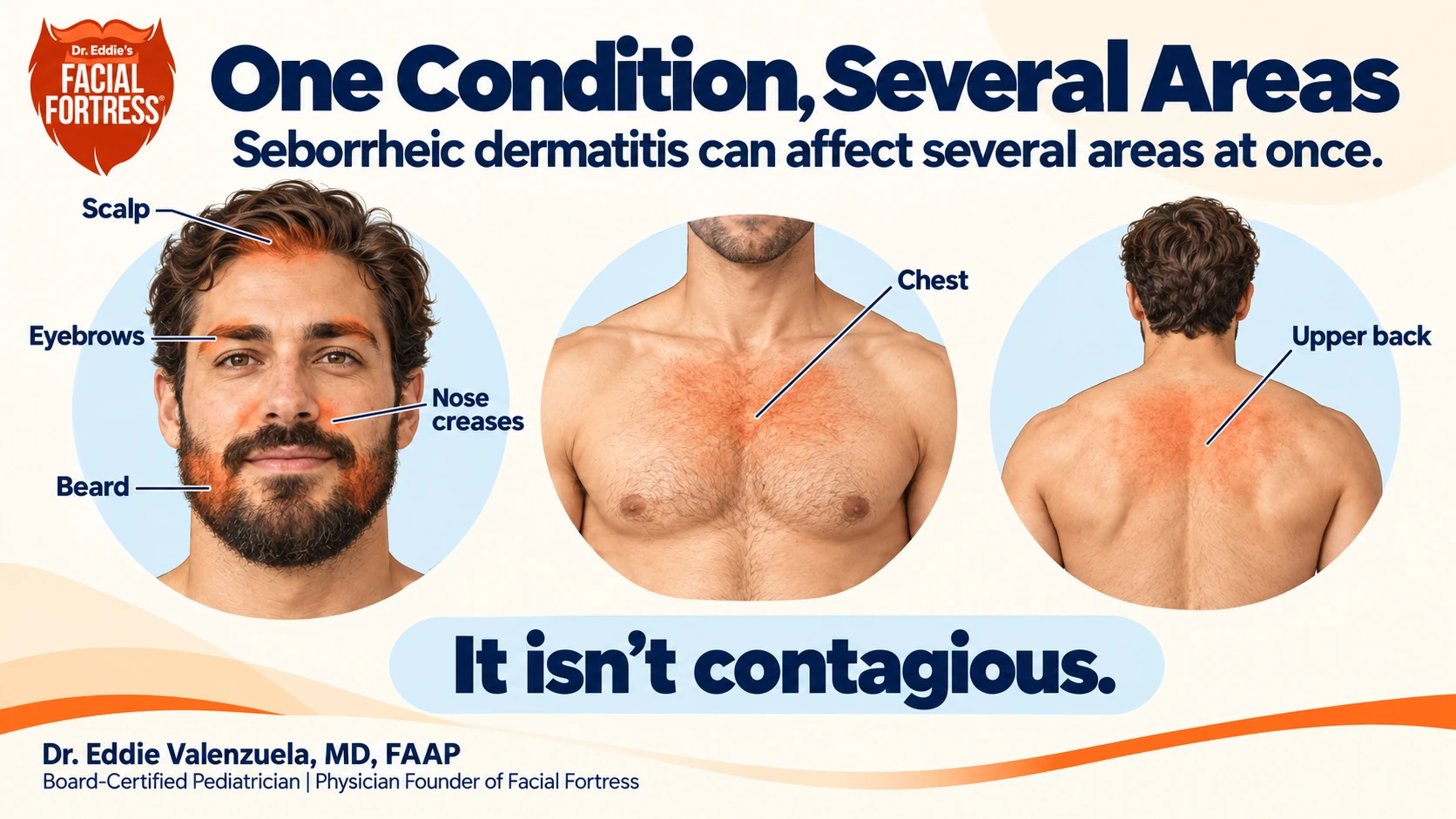
Seborrheic dermatitis tends to affect areas with many oil glands, including the scalp, eyebrows, sides of the nose, and beard. Symptoms can appear in several places together or become noticeable in another area later. That does not mean flakes have carried an infection across your face.2
Malassezia yeasts normally live on adult skin. Their activity, skin oils, the skin barrier, and an individual’s inflammatory response appear to interact in seborrheic dermatitis. Finding symptoms in another location does not mean a previously yeast-free area has become infected.3 Our Malassezia and beard seborrheic dermatitis guide explains that biology.
You can think of it as several areas of susceptible skin reacting, rather than one patch sending the condition to the next. A flare in a new location also does not automatically mean you have washed incorrectly or let your hygiene slip.
| Your concern | What it means |
|---|---|
| Contact with another person | Seborrheic dermatitis is not contagious. |
| New flakes in the eyebrows or beside the nose | The same condition can affect several oil-rich areas. |
| Recurring patches in different areas | Seborrheic dermatitis can recur. A changing pattern still deserves reassessment if it is unusual for you. |
| Pain, swelling, pus, or patchy hair loss | Get it examined. An infection or another condition may be responsible. |
For care specific to those locations, see facial dandruff around the eyebrows and nose. For symptoms on the chest or in skin folds, see seborrheic dermatitis on the body.
Scratching and Grooming Hygiene
Scratching does not make seborrheic dermatitis contagious. It can damage the skin, however, and broken skin can develop a secondary infection. Avoid picking or scraping off scale.
It is still sensible to keep brushes and combs clean and use your own razor and towel. Other conditions, including ringworm, can spread through infected people, animals, or objects. The reason for ordinary grooming hygiene is broader than dandruff.4
Other Causes of a Spreading Beard Rash
If a rash looks or feels different from your usual beard dandruff, something else may be causing it. A new beard oil, wash, or fragrance can irritate your skin or trigger an allergic reaction. Other conditions, including psoriasis and fungal infections, can also cause flaky skin.
Ringworm involving beard hair follicles, called tinea barbae, is different from seborrheic dermatitis. It can cause pronounced swelling, pus-filled bumps, and hair loss; it does not always resemble a neat ring. It needs medical assessment.5
- Arrange an assessment for persistent symptoms, broken hairs, patchy hair loss, crusting, or pus-filled bumps.
- Seek prompt care for rapidly worsening pain, warmth, swelling, or spreading redness, especially with fever or feeling unwell.6
- If eyelids or the eyes are involved, get advice about treatment suitable for that area. Do not put a beard wash in the eyes or along the lash line.
A rash that began after a new grooming product may fit the patterns in our seborrheic dermatitis vs. product reaction guide.
Care When Several Areas Are Affected
Treatment should suit the affected skin. Gentle cleansing, thorough rinsing, and a fragrance-free moisturizer for dry areas can support comfort; an inflamed facial patch and a persistently moist fold may need different care. Avoid products that repeatedly sting or irritate your skin.7
Facial Fortress 3-in-1 Medicated Wash is one option for associated flaking, scaling, and itching. Its active ingredient is 0.95% pyrithione zinc. Follow the Drug Facts directions, avoid the eyes, and ask a doctor before use if seborrheic dermatitis covers a large area of the body. Stop use and ask a doctor if it worsens or does not improve with directed use.8
The beard-dandruff care guide develops the daily routine, while the prescription guide explains additional treatment options. The goal is to control symptoms where they occur. You do not need to avoid ordinary closeness with other people because you have seborrheic dermatitis.
Medical References
- American Academy of Dermatology: Seborrheic dermatitis overview.
- American Academy of Dermatology: Signs and symptoms.
- American Academy of Dermatology: Causes.
- American Academy of Dermatology: Ringworm causes.
- American Academy of Dermatology: Ringworm signs and symptoms.
- American Academy of Dermatology: Cellulitis signs and symptoms.
- American Academy of Dermatology: Self-care.
- DailyMed: Facial Fortress Drug Facts.