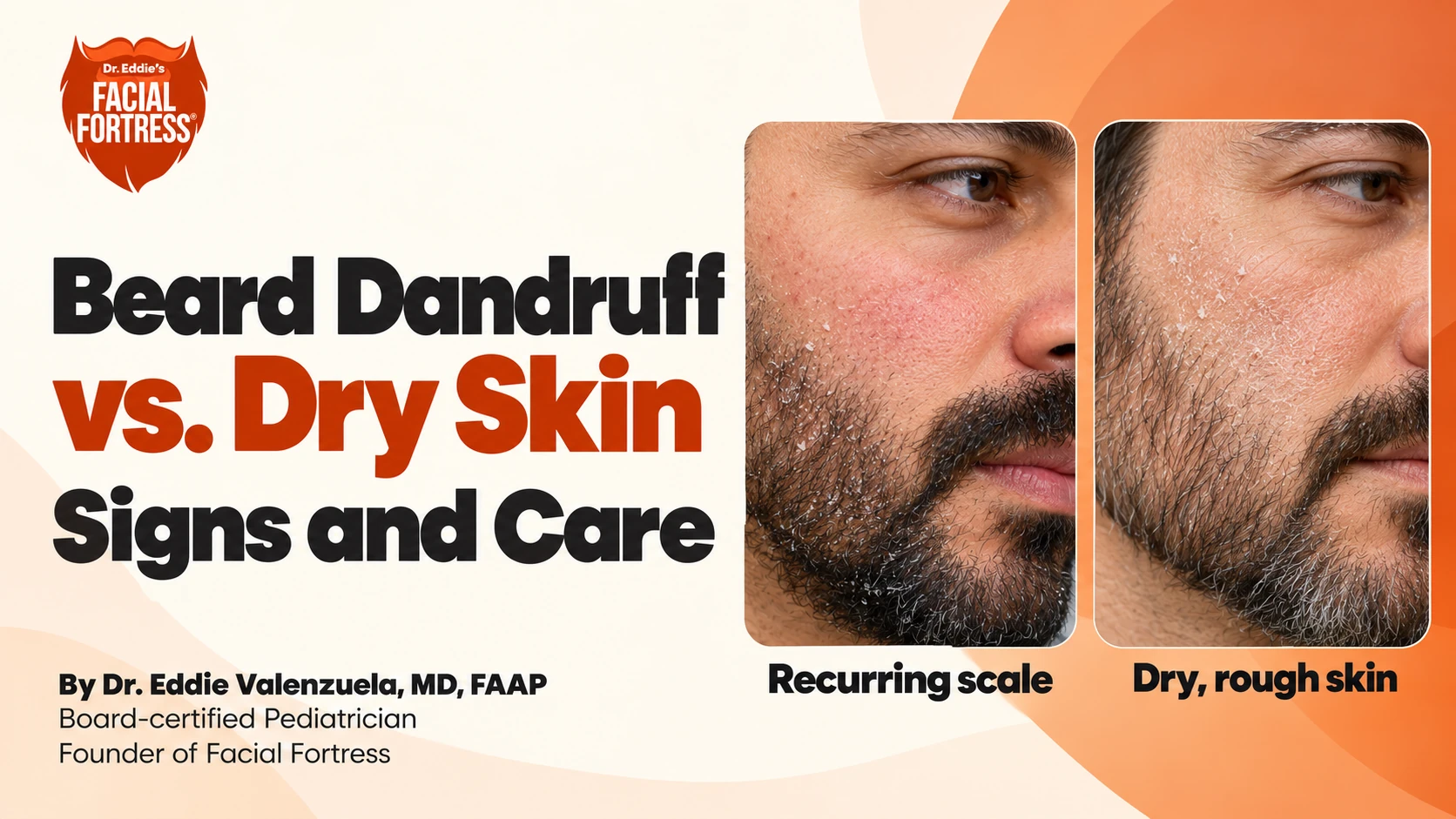
Quick answer: Dry skin is mainly a moisture and skin-barrier problem. Beard dandruff usually refers to seborrheic dermatitis, which can cause recurring scale, itching and inflammation. Skin feel, distribution and the history of a flare are more useful than flake color alone. Both can happen at the same time.
Beard Dandruff vs. Dry Skin Under the Beard
Use the overall pattern rather than looking for one decisive sign. This comparison describes common tendencies, not a way to diagnose yourself from a photograph.
Dry skin care · Dandruff and seborrheic dermatitis care
| Clue | Beard-area seborrheic dermatitis | Simple dry skin |
|---|---|---|
| Skin feel | Itching or irritation, sometimes with a greasy feel; dryness is also possible. | Tightness, roughness and dryness, often more noticeable after washing. |
| Scale | White or yellowish scale that may be loose or attached to inflamed skin. | Often fine, dry flakes over rough skin; appearance can overlap. |
| Distribution | May also involve the scalp, eyebrows, sides of the nose or ears. | May accompany dryness on cheeks or other areas exposed to harsh cleansing or dry weather. |
| Course | Often returns in familiar areas after periods of improvement. | May track changes in weather, washing or skin-care products. |
| Care needed | Often needs treatment for seborrheic dermatitis alongside gentle skin care. | Often improves with less irritating cleansing and regular moisturizer. |
Redness can be subtle on darker skin, where inflammation may instead look purple-toned, lighter or darker than surrounding skin. Also, improvement with moisturizer does not prove that dryness was the only issue: moisturizing can make inflamed skin more comfortable too.1,3
If you also have scalp flakes, Happy Cappy’s dandruff and dry-scalp comparison looks at that location. Scalp and facial skin can behave differently, so a shampoo that suits your scalp is not automatically the best choice for your beard.
Small white flakes in a beard do not tell you which problem you have. The more useful questions are how the skin feels, where else it flakes, and what happens after washing or moisturizing. Those clues help you choose sensible care without treating every dry patch as dandruff.
Two Different Reasons for Beard Flakes
Beard Dandruff and Seborrheic Dermatitis
Seborrheic dermatitis is a recurring inflammatory condition that commonly affects oil-rich areas, including the scalp, beard, eyebrows and sides of the nose. Its scale may look white and dry or yellowish and greasy. Itching and irritated patches can accompany either appearance, so dry-looking flakes do not rule it out.1,2
The condition involves normal skin yeast called Malassezia and the way susceptible skin responds to it. It is not simply a sign that the beard needs more washing. A tendency for the same areas to flare repeatedly is more informative than how oily the hair looks on a particular day.
Dry Skin Beneath a Beard
Dry skin develops when the outer skin layer does not retain enough moisture. Hot water, harsh cleansers, low humidity and repeated washing can contribute. The skin may feel tight, rough or uncomfortable, especially after cleansing. Facial hair can hide this roughness while the flakes become visible on the beard.3
Dryness can occur on its own, but it can also accompany eczema or a treatment routine that is too irritating. “Dry skin” describes a finding as well as a common problem; persistent inflammation should not automatically be dismissed as simple dryness.
Care for Dry Skin Under the Beard
Start by reducing avoidable irritation. Use lukewarm water and a gentle, fragrance-free cleanser, rinse well, and pat the skin dry. If your face feels stripped after washing, reconsider the cleanser and how often you are using it. A squeaky-clean sensation is not a useful goal for dry skin.
Apply a fragrance-free moisturizer while the skin is still slightly damp. Part the beard with your fingertips to reach the rough or tight areas. A cream may suit very dry skin, while a lighter formulation may be more comfortable for someone prone to clogged pores. The best texture is one you tolerate and can apply to the skin consistently.3,4
Beard oil can soften hair and may help some dry skin, but products vary widely. A fragranced oil that stings is not helping just because it is marketed for beards. Our beard oil and moisturizer guide explains how to choose between their different functions.
Avoid trying to remove every visible flake with a scrub or brush. Repeated friction can make already dry skin sore. Give a simpler routine a chance to show whether comfort and roughness improve, while seeking assessment if the rash is worsening or remains unexplained.
For dry skin beneath your beard, Dermal Defense moisturizing cream is one fragrance-free option. Apply it where moisture is needed.
Care When Seborrheic Dermatitis Fits the Pattern
Moisturizer alone may not control recurring seborrheic dermatitis. Medicated products can help address the condition, provided they suit the affected area and are used according to their directions. Common dandruff actives include ketoconazole, pyrithione zinc, selenium sulfide and salicylic acid; salicylic acid mainly helps loosen scale, and facial tolerance varies by formula.5,6
The complete beard-dandruff care guide explains treatment and maintenance. For product selection and application, see using anti-dandruff shampoo on the beard. Getting the wash onto the skin matters more than producing a thick lather on the hair.
Facial Fortress is one pyrithione-zinc wash option. Its 0.95% active ingredient is labeled for relief of flaking, scaling, itching and irritation associated with dandruff and seborrheic dermatitis. Review the Drug Facts and directions for the finished product. It is not necessary to add a medicated wash solely because otherwise comfortable skin has become dry.7
When Dandruff and Dryness Overlap
Someone with seborrheic dermatitis can also develop dryness from winter weather, frequent washing or an irritating product. In that situation, increasing treatment every time a new flake appears may worsen the moisture problem. Consider both the recurring rash and how the skin feels between washes.
A practical approach is to keep the appropriate medicated treatment while simplifying unnecessary products and adding a tolerated moisturizer. If a wash burns or the skin becomes progressively tighter and more inflamed, reassess the product and routine rather than pushing through. A clinician can help determine whether the problem is undertreated seborrheic dermatitis, irritation, allergy or another condition.
Changes in one part of the routine are also easier to interpret than replacing the cleanser, oil, balm and moisturizer all at once. Note what you changed and how the skin responded, including any delayed symptoms.
When the Comparison Is Not Enough
These are not the only causes of beard flakes. A contact reaction may follow a grooming product, including one used without problems in the past. Allergic reactions can be delayed, so the most recently applied product is not always the cause. The guide to seborrheic dermatitis and product reactions explains that distinction.8
Persistent itchy eczema, psoriasis, inflamed follicles and beard ringworm can also change the treatment needed. The itchy-beard guide covers those broader clues, including eczema beneath a beard.
Get assessed if the skin remains inflamed despite appropriate care, symptoms keep worsening, or the diagnosis is unclear. Pain, pus, swelling, broken hairs or distinct patches of hair loss warrant particular attention. Those changes should not be managed by repeatedly switching between moisturizer and dandruff shampoo.
Medical References
- American Academy of Dermatology. Seborrheic dermatitis: Signs and symptoms.
- DermNet. Seborrhoeic dermatitis.
- American Academy of Dermatology. Dermatologists’ top tips for relieving dry skin.
- American Academy of Dermatology. A dermatologist’s top tips for a healthy beard.
- American Academy of Dermatology. Seborrheic dermatitis: Diagnosis and treatment.
- American Academy of Dermatology. How to treat dandruff.
- DailyMed. Facial Fortress pyrithione zinc shampoo: Drug Facts.
- DermNet. Allergic contact dermatitis.