
Quick answer: Choose a fragrance-free beard wash with a mild cleansing blend and moisturizing ingredients such as glycerin. Sulfate-free does not automatically mean gentle; the complete formula matters. Sensitive skin alone is not a reason to use dandruff medication.
You should not need a chemistry degree to buy a beard wash. You want something that removes sweat, oil and yesterday’s grooming products without leaving the skin underneath feeling tight or stinging. The useful question is what the whole formula does for your skin.
Choosing a Beard Wash for Sensitive Skin
Start with your main concern. A wash for everyday cleansing and a wash for recurring dandruff have different jobs, even when both are designed for sensitive skin. For an overview of causes, treatment and ongoing care, read our beard dandruff guide.
| What you need | What to look for |
|---|---|
| Comfortable everyday cleansing | A gentle, fragrance-free, non-soap formula suitable for facial skin. |
| Less tightness after washing | A mild cleansing blend with humectants such as glycerin; a moisturizer afterward where needed. |
| Help with recurring dandruff | An appropriate dandruff active and directions for the area you are treating. |
| Avoidance of a known allergy | The complete ingredient list, checked against your clinician’s advice. |
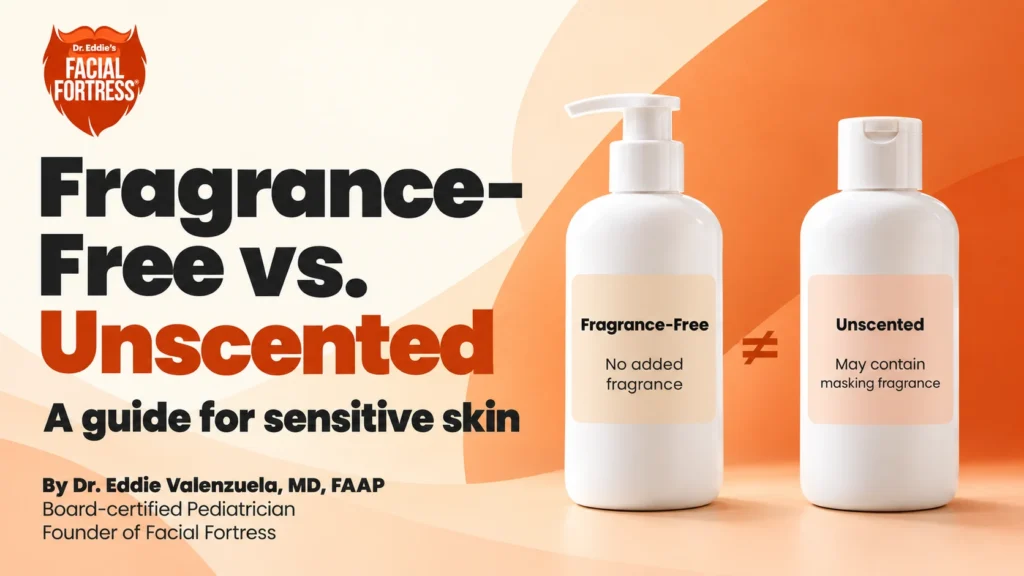
A long list of “free-from” claims is not a substitute for checking the formula and how your skin responds. Our guide to fragrance-free vs. unscented and dye-free labels explains those terms in more detail.
Cleansing Ingredients and Their Roles
Surfactants are the ingredients that help water lift away oil and buildup. Their names can look similar even when they belong to different chemical families.
Common surfactants on a beard-wash label
Surfactants differ in their chemistry and their interaction with skin. “Anionic” means the cleansing molecule carries a negative charge; “nonionic” means it has no ionic charge. Amphoteric surfactants have charge behavior that depends on their chemistry and conditions. These categories help formulators choose ingredients, but do not assign every member the same irritation potential.
| Ingredient or family | What to know for sensitive skin |
|---|---|
| Sodium lauryl sulfate (SLS) Anionic sulfate | A well-studied irritant benchmark. In a human patch study, SLS caused more irritation than SLES or the alkyl polyglucoside tested. This does not predict every finished formula. |
| Sodium laureth sulfate (SLES) Anionic ether sulfate | Chemically different from SLS. It was substantially less irritating in that study; grouping the two as equally harsh misses a meaningful distinction. |
| Sodium C14-16 olefin sulfonate Anionic sulfonate | A sulfate-free cleanser. Its absence of sulfate does not establish mildness; see the explanation below. |
| Decyl glucoside, lauryl glucoside, coco-glucoside Nonionic alkyl glucosides | Used in mild cleansing systems. Low irritation potential and freedom from contact allergy are different questions. |
| Sodium cocoyl isethionate; sodium lauroyl methyl isethionate Anionic isethionates | Sulfate-free options used in mild cleansers. These are distinct ingredients, with different formulation properties. |
| Cocamidopropyl betaine; cocamidopropyl hydroxysultaine Amphoteric/zwitterionic co-surfactants | Often blended with other cleansers to adjust foam and improve mildness. They are not interchangeable names for the same molecule. |
| Sodium cocoamphoacetate; disodium cocoamphodiacetate Amphoteric co-surfactants | Additional options for building mild cleansing blends. |
| Sodium cocoyl glutamate; sodium cocoyl glycinate; sodium lauroyl sarcosinate Amino-acid-derived anionic surfactants | Useful sulfate-free choices. Their behavior still depends on the particular ingredient, pH and blend. |
| Sodium methyl cocoyl taurate Anionic taurate | A sulfate-free surfactant used for mild cleansing and lather. |
| Disodium laureth sulfosuccinate Anionic sulfosuccinate | A different chemical family from SLS and SLES, despite the similar-looking name. It should be evaluated as its own ingredient. |
| Sodium laurylglucosides hydroxypropylsulfonate Anionic, modified sugar-based surfactant | Sold by Colonial Chemical as Suga®Nate 160NC. Among the lowest zein-protein interaction results in Colonial’s published comparison. Used in Facial Fortress; chemically different from sodium C14-16 olefin sulfonate. See the ingredient discussion below. |
This is an ingredient guide, not a strongest-to-gentlest ranking. Family and formulation descriptions are supported by Innospec’s personal-care ingredient guide1; the SLS/SLES comparison comes from the human study described below.
Decyl Glucoside: Mildness and Contact Allergy
Decyl glucoside belongs to the alkyl glucoside family, made from glucose and fatty alcohols. These ingredients can be sourced from renewable plant materials. They help cleanse and produce foam, and can be combined with other surfactants. Brenntag’s decyl-glucoside documentation2 describes its use in mild cleansing blends.
The Cosmetic Ingredient Review assessment of alkyl glucosides3 concluded that they are safe under the assessed uses and concentrations when formulated to be nonirritating. That qualification matters: a plant-derived ingredient still needs appropriate formulation.
Irritation and allergy are different. Irritation involves direct effects on skin and can depend on concentration and exposure. Allergic contact dermatitis is an immune response in a sensitized person. Published clinical research documents contact allergy to alkyl glucosides4. A person with a diagnosed glucoside allergy may need to avoid an ingredient that many other people tolerate well. Persistent reactions to otherwise gentle products are a reason to discuss diagnostic patch testing with a dermatologist.
Evidence from Mildness Testing
In a human patch-testing study5, researchers compared SLS, SLES and an alkyl polyglucoside at concentrations from 0.125% to 2%, with exposures lasting 6–24 hours. SLS produced the strongest response, SLES a much milder response, and the polyglucoside little detectable response under those conditions. These were prolonged test exposures, not ordinary beard washing, and the abstract does not identify the polyglucoside as decyl glucoside specifically.
Ingredient manufacturer Colonial Chemical also publishes an Irritation Potential by Zein Test chart6. Its laboratory program compared more than 60 surfactant ingredients and commercial cleansing products. The test measures how much zein, a corn protein, a sample dissolves; lower values indicate less protein interaction in this screening method.
This is useful supplier-generated evidence, not a human trial of beard washes. It does not measure contact allergy or capture every aspect of skin-barrier effects. The chart also mixes individual ingredients and blends. A low laboratory score does not establish that a finished wash will be a particular percentage gentler on your skin. Research comparing laboratory and human testing7 illustrates why more than one measure can be needed.
Sodium Laurylglucosides Hydroxypropylsulfonate
This long name deserves a closer look. Sodium laurylglucosides hydroxypropylsulfonate is a modified sugar-based, anionic surfactant. Colonial Chemical sells it as Suga®Nate 160NC8 and describes it as naturally derived, sulfate-free and suitable for facial cleansers and sensitive-skin washes.
Unlike the nonionic glucosides discussed above, its modified structure carries an anionic charge. It is also chemically different from sodium C14-16 olefin sulfonate. Sharing “sulfonate” in their names does not give the two ingredients the same mildness profile.
There is supporting laboratory evidence for its mildness. Suga®Nate 160NC appears among the lowest zein-protein interaction results in Colonial’s published comparison, below the tested SLS, SLES and sodium C14-16 olefin sulfonate samples. That is a meaningful result within this supplier’s screening method, although it does not measure allergy or prove superiority in every finished cleanser.
This is one of the cleansing ingredients in Facial Fortress, alongside sodium lauroyl methyl isethionate and cocamidopropyl hydroxysultaine. It helps explain the formulation’s focus on mild cleansing more clearly than a sulfate-free claim alone. The complete blend and finished-product performance still matter.
Isethionates are not sulfates
Sodium Lauroyl Methyl Isethionate is a sulfate-free surfactant. It belongs to the isethionate family and is used in mild cleansing formulas. It should not be confused with sodium lauryl sulfate (SLS) or sodium laureth sulfate (SLES). Innospec’s ingredient documentation9 identifies this distinction.
Sodium C14-16 Olefin Sulfonate
Sodium C14-16 olefin sulfonate is a cleansing ingredient found in some beard washes and shampoos. It helps water lift away oil and buildup. The “C14-16” describes the lengths of its carbon chains, not its concentration or strength.
It is a sulfonate, not a sulfate. A wash can contain it and still be labeled sulfate-free. That makes it a useful example of why “sulfate-free” alone does not tell you whether a cleanser will feel gentle on your skin.
Like other cleansing agents, it can cause irritation under some exposure conditions. The Cosmetic Ingredient Review safety assessment10 supports its use in rinse-off cosmetics under the assessed conditions. Its presence does not prove that a finished beard wash is irritating, and it is not automatically harsher than every formula containing SLS or SLES.
Do not confuse it with sodium laurylglucosides hydroxypropylsulfonate: similar endings do not make these the same ingredient. Look at the complete cleansing blend rather than judging every ingredient containing “sulfonate” alike.
The Complete Cleansing Blend
A cleanser may combine several surfactants to balance cleansing, lather and skin feel. Seeing one ingredient near the beginning of the list does not reveal its exact percentage or how the finished wash performs.
Concentration, pH, the other ingredients and how you use a cleanser all matter. A sulfate-free label describes a formulation choice; it does not establish that every sulfate-containing wash is harsh or every sulfate-free wash is gentle.
Soap-free and sulfate-free describe different things
Traditional soap is typically alkaline. Non-soap cleansers offer other formulation options for sensitive facial skin. SLS and SLES are themselves non-soap surfactants, so “soap-free” does not automatically mean “sulfate-free.” A beard wash made with saponified oils is soap-based, even when its label emphasizes natural oils.
Moisturizing and Conditioning Ingredients
A comfortable wash can include ingredients that support skin and hair feel alongside the cleansing agents. A rinse-off product still does not replace a leave-on moisturizer when your skin needs one.
- Glycerin: a humectant that helps attract moisture.
- Panthenol: provitamin B5, used for moisturizing and conditioning skin and hair.
- Dipotassium glycyrrhizate: a licorice-derived ingredient used to help soothe the appearance of redness.
- Apple fruit extract: a skin-conditioning botanical. Its presence does not make a wash an exfoliating treatment.
These supporting ingredients have a different role from an active dandruff medicine. They also cannot guarantee that a finished product will suit every person.
The Role of a Dandruff Active
Dandruff treatment adds a different job to ordinary cleansing. Compare the active ingredient, suitability for facial skin, the complete formula and the product directions. Our guide to using anti-dandruff shampoo on a beard explains those choices, while the Facial Fortress selection checklist applies them to the product.
Over-the-counter dandruff actives include pyrithione zinc, selenium sulfide, ketoconazole, salicylic acid, sulfur and coal tar. They have different functions and precautions, and a scalp product is not automatically suitable for facial skin. Moisturizing oils and botanicals do not replace an indicated dandruff medicine. Sensitive skin alone, however, does not establish a need for medication.14
If you are unsure what the flakes mean, start with beard dandruff versus dry skin. Symptoms that began after a new grooming product deserve a look at seborrheic dermatitis versus a product reaction.
Fragrance, Essential Oils and Added Color
Fragrance can be synthetic or botanical
Check for fragrance or parfum, as well as aromatic oils such as peppermint, tea tree, lavender, eucalyptus and citrus peel oils. “Natural” does not mean allergy-proof, and a pleasant scent does not tell you how sensitive skin will tolerate a wash. The FDA explains that fragrance ingredients can cause allergic reactions in susceptible people11.
You can enjoy a scented beard wash and tolerate it well. But if fragrance is a known trigger, an essential-oil blend is not automatically a suitable alternative. For the broader label distinctions, see our fragrance-free versus unscented guide.
Added color does not improve cleansing
Some beard-wash ingredient lists include a dye such as Blue 1 (CI 42090). Others list mica or titanium dioxide for appearance. These ingredients have different properties; they should not all be labeled irritating simply because they add color or opacity. A dye-free formula removes an optional ingredient category, but does not guarantee freedom from irritation.
The useful question is whether an ingredient serves your needs and whether you have a known sensitivity. There is no need to treat every colorful wash as unsafe.
Preservatives and Product Safety
An unfamiliar preservative name is not, by itself, a reason to avoid a beard wash. If you have a diagnosed allergy to a particular preservative, check the ingredient list for it. Otherwise, focus on whether the complete formula suits your skin.
Preservatives help protect products from microbial contamination. “Paraben-free” describes a formula; it does not establish that parabens damage everyone’s skin barrier. The FDA’s paraben information12 does not support that blanket claim.
Likewise, plant-derived ingredients are not automatically gentler. Use the complete formula, your experience and any diagnosed allergies to guide the choice.
Using Your Wash Without Overdoing It
Use lukewarm water, massage with fingertips through the beard to reach the skin, and rinse thoroughly. Follow the specific product’s directions for application and frequency.
Your skin should not need to feel squeaky-clean for washing to have worked. If a wash repeatedly leaves burning, tightness or increased redness, stop using it and reassess the product and your washing habits. Persistent irritation, a spreading rash or symptoms that do not improve deserve medical advice.
For an everyday cleansing schedule, see everyday beard washing. If you use a medicated wash, see how often to wash hair and beard when managing dandruff. For moisturizing and sun protection, use our simple face and beard skincare routine.
Facial Fortress for Sensitive Skin with Dandruff
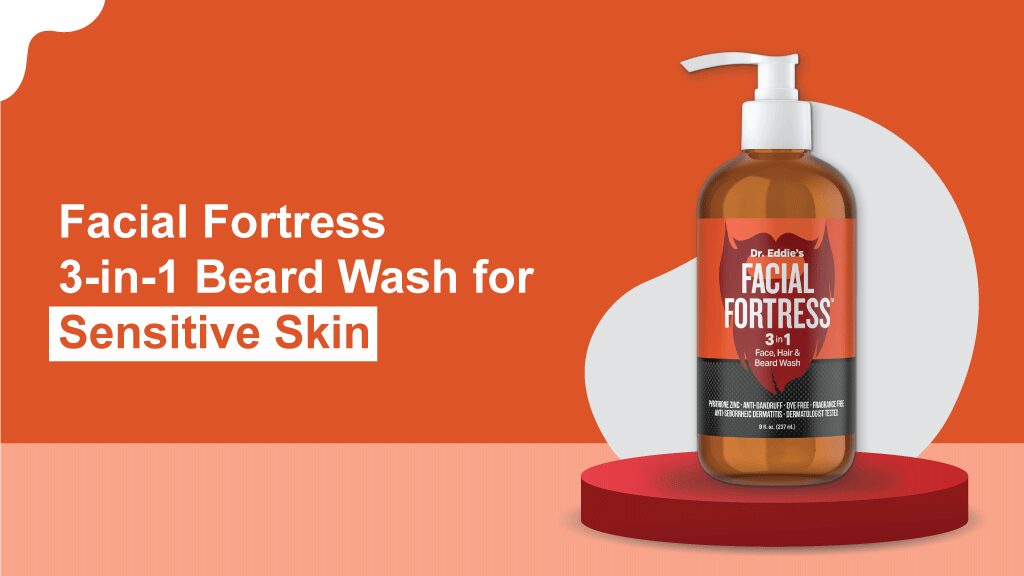
Facial Fortress® 3-in-1 medicated wash was developed by Dr. Eddie for the face, hair and beard. It contains 0.95% pyrithione zinc to help relieve flaking, scaling and itching associated with dandruff and seborrheic dermatitis. It is fragrance-free and dye-free, and made without SLS or SLES.13
Its non-soap cleansing blend includes sodium lauroyl methyl isethionate, sodium laurylglucosides hydroxypropylsulfonate and cocamidopropyl hydroxysultaine. Glycerin and panthenol support moisture and conditioning, while licorice-derived dipotassium glycyrrhizate helps soothe the appearance of redness. Follow the complete ingredients and Drug Facts for use directions.
Choose it for its intended medicated purpose and the formula that supports that use. If you simply need a gentle daily cleanser without dandruff treatment, medication is not a requirement.
Medical References
- Innospec’s personal-care ingredient guide
- Brenntag’s decyl-glucoside documentation
- Cosmetic Ingredient Review assessment of alkyl glucosides
- clinical research documents contact allergy to alkyl glucosides
- human patch-testing study
- Irritation Potential by Zein Test chart
- Research comparing laboratory and human testing
- Suga®Nate 160NC
- Innospec’s ingredient documentation
- Cosmetic Ingredient Review safety assessment
- FDA explains that fragrance ingredients can cause allergic reactions in susceptible people
- FDA’s paraben information
- DailyMed. Facial Fortress Drug Facts.
- American Academy of Dermatology. How to treat dandruff.