Quick answer: An appropriate anti-dandruff shampoo can help seborrheic dermatitis beneath a beard. Choose a formula suited to the affected skin, work it down to the skin, and follow that product’s directions. Scalp shampoos are not interchangeable facial cleansers, and a dandruff wash will not treat every cause of beard flakes.
A beard can make a medicated wash harder to apply: the hair catches the lather while the flaky skin underneath receives little contact. Product choice and application both matter. This guide explains how to assess a wash and use it without adding unnecessary irritation.
When a Dandruff Wash Fits the Problem
Recurring scale and itching beneath the beard may be seborrheic dermatitis, particularly when the scalp, eyebrows or sides of the nose also flare. Dermatologists use medicated dandruff shampoos for some beard-area cases; the American Academy of Dermatology specifically discusses ketoconazole shampoo for the beard and mustache.1
Simple dryness, product reactions and other rashes can look similar. If a new cleanser left your skin tight and uncomfortable, adding another medicated product may not be the best first step. The beard dandruff and dry-skin comparison can help put those clues in context.
Ingredients and Facial-Skin Suitability
Check the active ingredient, intended use, warnings and directions together. The surrounding formula also matters: a product can contain a useful dandruff active and still be uncomfortable on your facial skin. Fragrance-free, dye-free options may help you avoid unnecessary ingredients, but no label guarantees that a product will suit everyone.
| Active ingredient | Role | Beard-use consideration |
|---|---|---|
| Ketoconazole | An antifungal used for seborrheic dermatitis. | Shampoo and prescription formulations have different directions. Follow the instructions for the exact product and site. |
| Pyrithione zinc | A medicated dandruff active used to control associated flaking and itching. | Choose a finished formula intended for the affected skin, and check its label. |
| Selenium sulfide | An active used in dandruff and seborrheic dermatitis care. | Some formulas are intended primarily for the scalp. Facial tolerance and eye precautions matter. |
| Salicylic acid | Helps loosen scale rather than acting as the same kind of yeast-targeted treatment. | Can be drying or irritating. Do not assume a scalp scale-removing product belongs on an inflamed face. |
These are common over-the-counter options in the United States, although strengths and formulations vary and some related products require a prescription. A higher concentration is not automatically a better choice for sensitive facial skin. Use the labeled directions or the specific instructions given by your clinician.1,2
The Meaning of Antifungal Beard Shampoo
People often use this phrase when searching for a wash for yeast-associated beard dandruff. Malassezia normally lives on skin; seborrheic dermatitis reflects its interaction with susceptible skin rather than a need to eliminate all yeast. Our Malassezia guide explains that relationship.
Beard ringworm, or tinea barbae, is a different fungal infection. Inflamed lumps, pustules, broken hairs or hair loss may need testing and an oral prescription antifungal. A routine dandruff shampoo, including Facial Fortress, is not a substitute for treatment of tinea barbae.3
Ketoconazole Shampoo for the Beard
Ketoconazole shampoo is an option for beard dandruff associated with seborrheic dermatitis. The American Academy of Dermatology recommends a shampoo containing 1% ketoconazole or a dermatologist-recommended product for affected beard and mustache skin.4 When comparing washes, look beyond the active ingredient to the complete formula.
The current U.S. Nizoral 1% Anti-Dandruff Shampoo formula contains fragrance, Blue 1 dye and sodium laureth sulfate (SLES). These are characteristics of that particular shampoo, not of every ketoconazole product.7 Fragrance is a useful distinction for easily irritated skin: the Academy advises avoiding fragranced skin-care products because they can irritate skin affected by seborrheic dermatitis.4
For someone seeking a fragrance-free, dye-free medicated face and beard wash, Facial Fortress offers an alternative with 0.95% pyrithione zinc and no SLS or SLES.5 These formula differences can help guide a choice; they do not establish that one product works better or causes less irritation for everyone.
Applying the Wash to Beard Skin
You do not need an elaborate pre-wash routine. Gently untangle the hair if needed, then concentrate on reaching the affected skin. Keep the wash away from the eyes and mouth, and do not add vigorous brushing or exfoliation to make it feel more active.
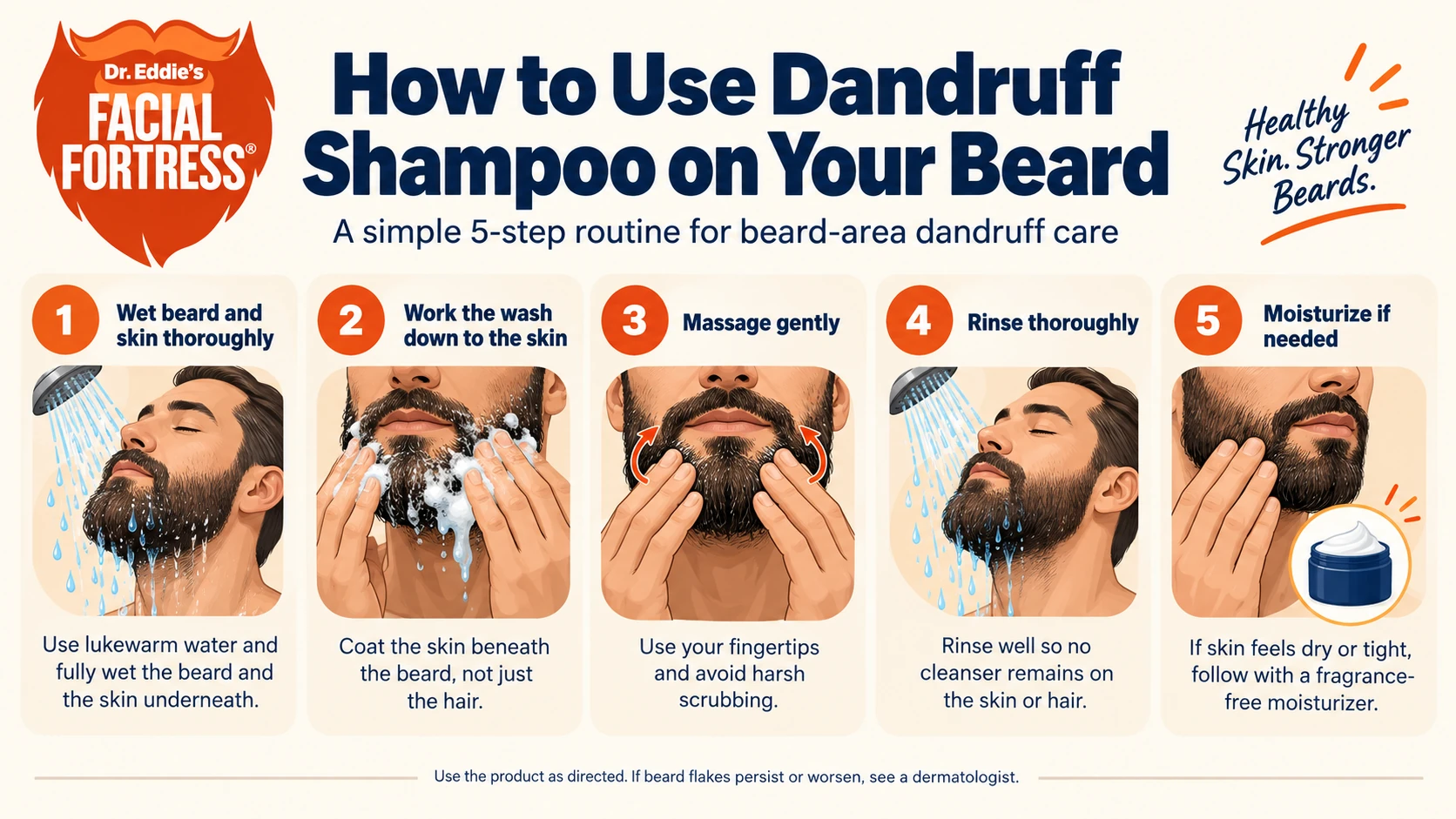
- Wet the beard and skin thoroughly. Use lukewarm water and part dense hair so water reaches the areas you want to treat.
- Work the wash onto the affected skin. Spread it gently with your fingertips. Lather coating only the beard hair may miss the skin where symptoms begin.
- Follow the product’s contact-time directions. Some shampoos specify a waiting time; others direct massage and rinsing. There is no universal five-minute rule for all dandruff washes.
- Rinse thoroughly. Remove the cleanser from both skin and hair. Take particular care around the mustache so residue is not left beside the lips.
- Pat dry and moisturize if needed. Apply a tolerated, fragrance-free moisturizer to dry or tight skin without rubbing vigorously.
The technique should be gentle enough to repeat consistently. Scratching with fingernails or a stiff brush can add irritation even when the medicine itself is appropriate. These practical steps complement the Academy’s advice to follow shampoo directions and support the skin with gentle care.2,4
Frequency and Care Between Medicated Washes
Use the schedule for your product or prescribed treatment. Do not transfer a twice-weekly instruction from one wash to another, and do not assume daily use will work faster. Frequency can change between an active flare and maintenance, but that adjustment should still fit the directions.
Ordinary cleansing and medicated treatment are separate decisions. After exercise, an extra rinse or gentle cleanse may be useful without turning every wash into another treatment. If the skin becomes tight, rough or stinging, review the cleanser, water temperature and other products in the routine.
A moisturizer can support dry skin between washes. Beard oils and balms may improve the feel of hair, but they do not replace medication and can cause trouble if a particular formula irritates you. The washing-frequency guide discusses skin type, weather and activity; the beard-dandruff guide covers the full maintenance routine.
Facial Fortress for Beard Dandruff
Facial Fortress 3-in-1 Medicated Wash contains 0.95% pyrithione zinc to help relieve flaking, scaling, itching and irritation associated with dandruff and seborrheic dermatitis. It is a fragrance-free, dye-free wash developed for the face, beard, hair and scalp. Glycerin and panthenol are included in the surrounding formula. Its mild, non-soap cleansing system contains no SLS or SLES.
For best results, its label directs use at least twice a week or as directed by a doctor. Wet thoroughly, massage onto the scalp and skin, and rinse. The label does not prescribe a five-minute leave-on time. Avoid eye contact, and if contact occurs, rinse thoroughly with water. Stop use and ask a doctor if the condition worsens or does not improve.5
The full ingredients and Drug Facts are the reference for using this particular wash. If you are comparing formulations before choosing one, the beard-shampoo selection checklist brings the active ingredient, formula and intended use together.
Response and Reassessment
Do not judge a recurring skin condition only by the number of flakes after one wash. Watch the overall direction of itching, scale and irritation as you follow the treatment instructions. Improvement may be gradual, and there is no single guaranteed timeline that applies to every ingredient, formula and diagnosis.
Happy Cappy’s guide to a realistic dandruff-shampoo results timeline explains response and maintenance in more detail. A worsening rash or significant burning is a reason to reassess, not a reason to keep waiting for an arbitrary deadline.
If symptoms persist despite consistent use, check whether the wash actually reaches the skin and whether the routine matches its directions. Then consider whether the diagnosis or treatment needs review. More inflamed facial seborrheic dermatitis may require a topical antifungal cream or a clinician-selected anti-inflammatory treatment. The prescription treatment guide explains those options.1,6
When to Stop and Seek Care
Stop a product that causes marked burning, swelling or worsening irritation. A reaction may come from the active ingredient or another component of the formula. Keep the packaging so a clinician can review what you applied; the product-reaction comparison describes the relevant patterns.
Seek assessment for painful or swollen skin, pus, spreading inflammation, broken hairs, distinct bald patches or a rash that remains unexplained. Eye pain or changes in vision need prompt evaluation. These findings require a closer look at the cause rather than stronger scrubbing or a longer shampoo contact time.
Medical References
- American Academy of Dermatology. Seborrheic dermatitis: Diagnosis and treatment.
- American Academy of Dermatology. How to treat dandruff.
- DermNet. Tinea barbae.
- American Academy of Dermatology. Seborrheic dermatitis: Self-care.
- DailyMed. Facial Fortress pyrithione zinc shampoo: Drug Facts.
- DermNet. Seborrhoeic dermatitis.
- DailyMed. Nizoral ketoconazole 1% shampoo: Drug Facts and inactive ingredients. Label updated September 10, 2026.